


Business Sectors
Events
Contents
Register to read more articles.
Behind the scenes of the world’s largest electric ferry
Incat chief executive Robert Clifford on why the Buquebus all-electric ferry will be “huge for the industry”


Following the launch of the world’s largest battery ship, Incat Tasmania founder and chief executive Robert Clifford tells PST, “This ferry is going to be huge for the industry, no doubt about that.”
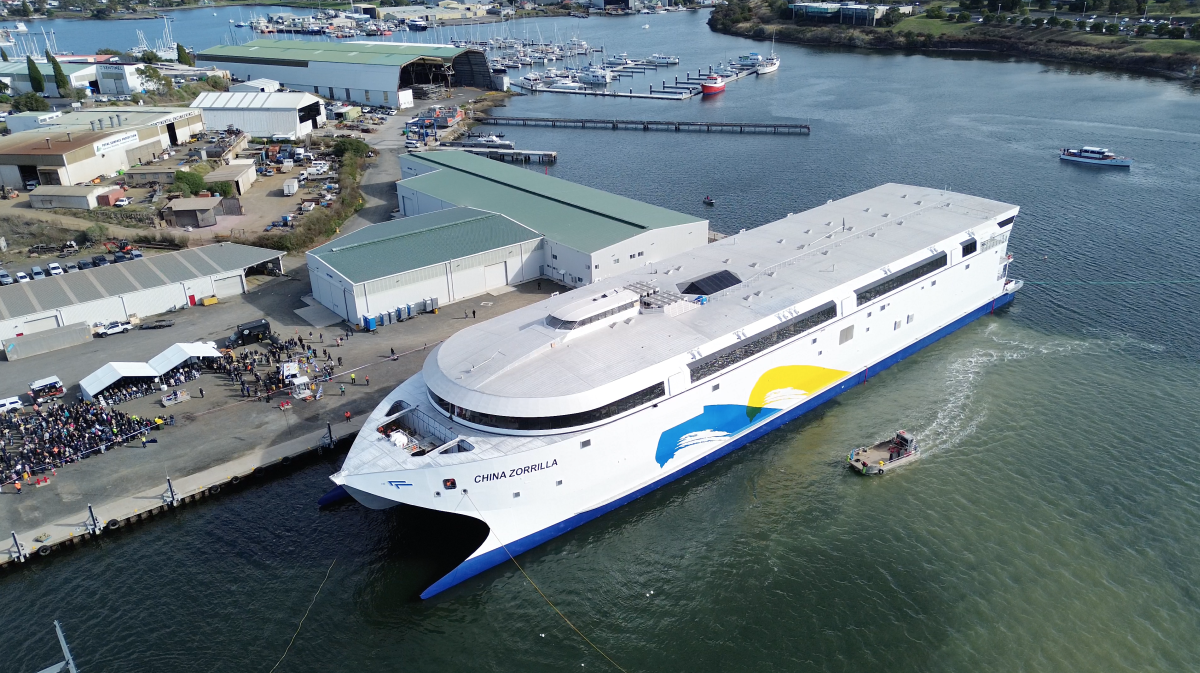
In May this year, hundreds gathered at Incat shipyard in Hobart to watch the launch of the battery-electric ship. Constructed for South American ferry operator Buquebus, Hull 096 is the most significant vessel ever built by Incat. When it enters service between Buenos Aires and Uruguay, it will operate entirely on battery-electric power, carrying up to 2,100 passengers and 225 vehicles across the River Plate.
At 130 m in length, Hull 096 is not only the largest electric ship in the world, but also the largest electric vehicle of its kind ever built – and one of the most significant single export items in Australia’s manufacturing history.
The ship is the ninth Incat-built vessel for Buquebus, continuing a long-standing partnership between the two companies.
Mr Clifford reminisces about how the ferry was originally meant to be LNG dual fuelled when its construction stopped due to the pandemic. “Afterwards he [Buquebus CEO] said to me, “The next ship is going to be electric.” It took me about 15 minutes to realise he was talking about the one we are already building.”
Some 20% of the ship’s hull had already been built. “It was a massive change,” reflects Mr Clifford. “We had to cancel the order with Wärtsilä for the gearboxes, engines and tanks and we had to make a lot of structural changes for new battery rooms.”
He explains how Buquebus is a very progressive customer. “They like to be a leader, and we like to be a leader, and the possibility of change was there.”
For access to this full feature, please see Passenger Ship Technology Q3 2025
Sign up for Riviera’s series of technical and operational webinars and conferences:
- Register to attend by visiting our events page.
- Watch recordings from all of our webinars in the webinar library.
Related to this Story
Events

Maritime Regulations Webinar Week
 16 Dec 2025
 GMT - ONLINE
Floating energy: successfully unlocking stranded gas using FLNGs and FSRUs
24 Feb 2026GMT - ONLINE
© 2024 Riviera Maritime Media Ltd.


