


Business Sectors
Business Sectors
Events
Contents
Boluda deploys hybrid propulsion on tug newbuilds
Shaft generators and battery packs are already reducing fuel consumption, emissions and maintenance costs on tugboats built for Boluda Towage’s port operations


Boluda Towage has deployed hybrid propulsion technology on its newbuild tugs to reduce fuel consumption and emissions and extend engine maintenance periods.
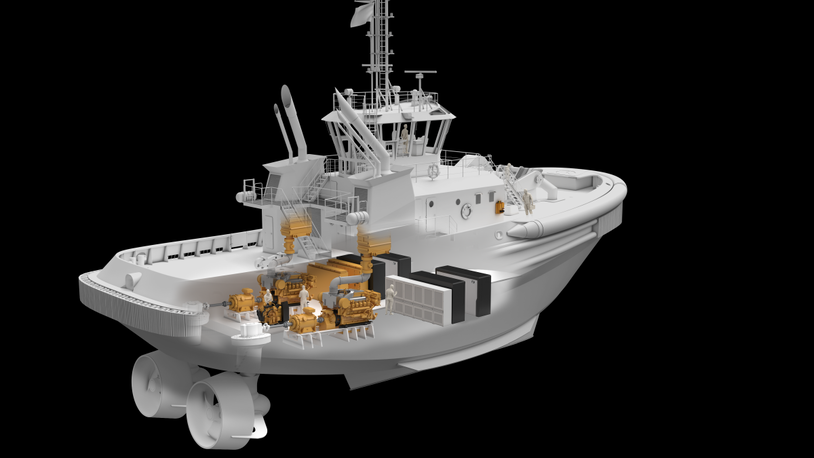
The Spanish shipowner incorporated the Total Energy Optimization System (TEOS), involving a shaft generator, into its azimuth stern drive (ASD) and advanced Voith tractor (AVT) tugs, built by Damen Shipyards in 2025.
TEOS enables the conversion of mechanical, rotational energy from the main propulsion shaft into electrical power for storage and onboard consumption, reducing dependency on auxiliary diesel generators.
According to a Boluda spokesperson, TEOS optimises engine loads, reduces fuel consumption, lowers emissions of CO2, NOx and particulates and “improves lifecycle costs and maintenance intervals by decreased auxiliary engine running hours”; it also “enhances electrical system stability and redundancy.”
Four new harbour tugs were built by Damen, including three to its ASD 2312 design and one to Robert Allan’s TRAktor 3200-V naval architecture, equipped with integrated tail shaft generators.
ASD, 23-m tugs VB Cobra (in Honduras), VB Foxtrot and VB Fenix (in Rotterdam, the Netherlands) were launched in 2025 and mobilised to their home ports in Q1 2026.
VB Bolu is an AVT tug with Voith propellers powered by two Caterpillar-manufactured Cat 3516E engines, rated at 3,000 kW at 1,800 rpm and a Danfoss 300 kW electric motor and Reintjes LAFH73 transmission, all in a hybrid configuration.
According to Boluda, the hybrid energy integration and onboard power management on VB Bolu reduces CO2 emissions by as much as 20%.
Its powertrain includes a direct-current grid, battery packs and power take-in and power take-off generators, which enable bidirectional energy flow between propulsion shafts and the onboard electrical network.
This configuration enables hybrid operational modes, reduced engine running hours, partial zero-emissions functionality during low-load operations, power load smoothing and improved manoeuvrability through instant torque availability.
In Q1 2026, Boluda took delivery or other harbour tugs built by Damen, including VB Fantastic in Rotterdam and VB Boluman to Tilbury in the Port of London.
Both reverse stern drive (RSD) tugs were built to Damen’s RSD 2513 design at the Damen Song Cam Shipyard in Vietnam.
These 25-m, 353-gt tugs have a bollard pull of 80 tonnes, FiFi1 class firefighting systems and IMO Tier III-compliant propulsion, incorporating twin Caterpillar diesel four-stroke engines driving two azimuth thrusters.
In Mexico, Boluda’s affiliate Compania Maritima Mexicana has been operating two new ASD tugs, CMM Azteca and CMM Mexico, in Coatzacoalcos, while Boluda started operating Damen-built VB Bribon and VB Kukulkan in Puerto Cortés, Honduras, in 2025.
Boluda’s port operations in Italy were boosted by the arrival of at least five new harbour tugs in Q4 2025 and Q1 2026 – VB Etna, VB Jupiter, VB Marte, VB Neptuno and VB Stromboli – all built by Turkish shipyards.
Other Damen-built tugs joined the group’s fleets in various countries in 2025, with VB Amsa and VB Azla supporting ships at a container terminal in Tangier, Morocco, VB Kudu operating in Abidjan, Ivory Coast and VB Brandy and VB Cayenne working in France.
The 28th International Tug & Salvage Convention, Exhibition & Awards will be held in Gothenburg, Sweden, in association with Caterpillar, 19-21 May 2026. Use this link for more details of this industry event and the associated social and networking opportunities.

Related to this Story
Events

Maritime Regulations Webinar Week
 16 Dec 2025
 GMT - ONLINE
Floating energy: successfully unlocking stranded gas using FLNGs and FSRUs
24 Feb 2026GMT - ONLINE
© 2026 Riviera Maritime Media Ltd.


