


Business Sectors
Business Sectors
Events
Contents

Register to read more articles.
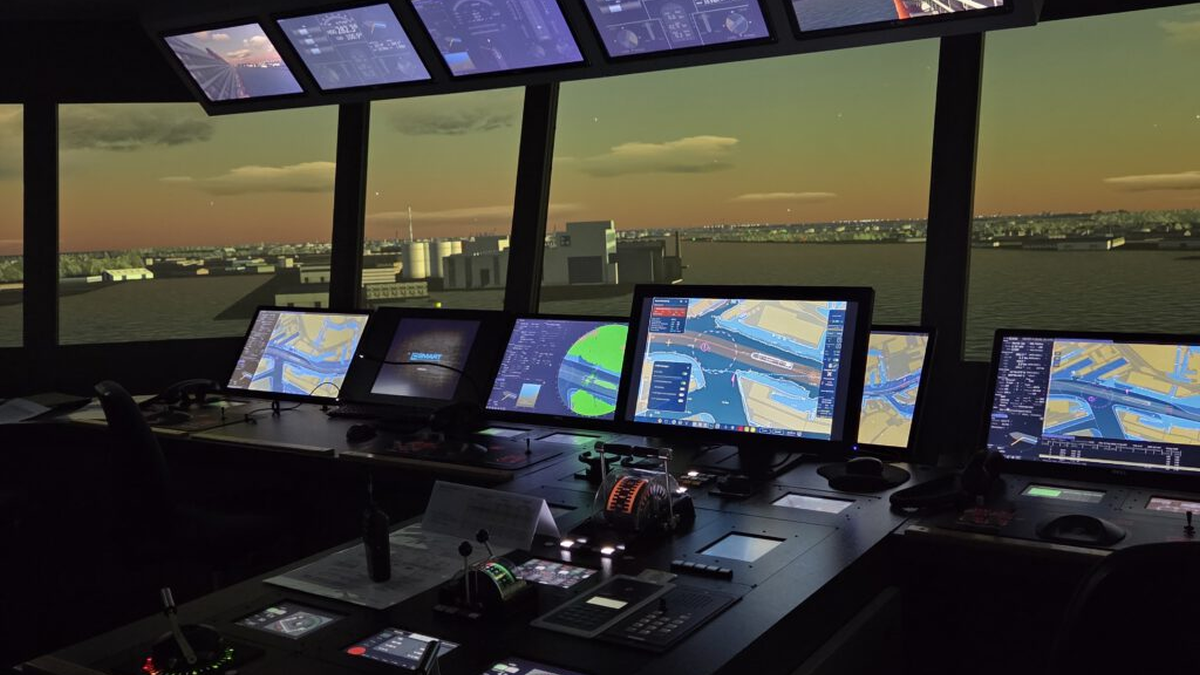
Carnival's CSMART hosts S-100 trials for navigating cruise ships into confined ports
Teams of pilots, ship officers, managers, hydrographic offices and port authorities worked together using simulators to evaluate S-100 datasets from multiple perspectives


Carnival Corp joined global maritime partners to test S-100 navigation data in bridge simulators to understand its benefits when sailing in confined waters.
The cruise ship owner was joined by maritime authorities, hydrographic offices, pilots, and bridge technology developers in trials at test centres, including its own Center for Simulator Maritime Training (CSMART) in Almere, the Netherlands.
This was undertaken during the International Hydrographic Organization’s (IHO) S‑100 Test Bed and Sea Trial in Confined Waters study, which tested this new digital framework for enhanced ship navigation.
The simulator tests brought together ports, marine pilots, ship captains and deck officers, shore‑based marine managers, maritime technology providers and national hydrographic offices from the United Kingdom, the Netherlands, Australia and New Zealand.
They evaluated S‑100 navigational data in confined‑water environments, expecting the higher resolution and data quality would open more fairways or widen existing ones in port entrances for cruise ships.
“S-100 has the potential to change how ships are navigated, and its full value comes to life when mariners feel confident using it,” said CSMART managing director Mark Jackson.
“By testing S-100 in the simulator first, we can explore how crews interact with the new data to understand what feels intuitive and where training will help support a smooth, practical transition to real-world adoption.”
S‑100 integrates multiple types of safety‑critical maritime information – including electronic charts, port data and real‑time marine conditions such as water levels, tides and currents – into a unified navigational environment displayed on a ship’s ECDIS.
The simulator trials replicated navigation scenarios from four ports with different operational complexity: the Port of Rotterdam, the Netherlands; Port of Napier, New Zealand; Port of Melbourne, Australia and Port of Southampton, United Kingdom.
S-100 test datasets were produced by the national hydrographic offices of Australia, the Netherlands, New Zealand and the United Kingdom, as well as by the Port of Rotterdam, the Australian Maritime Safety Authority (AMSA) and OMC International.
Participants conducted repeated port approaches, transits and departures while using bridge simulators equipped with two S-100 capable ECDIS displays provided by Teledyne and OSI Maritime Systems and two portable pilot units supplied by QPS and SEAiq Pilot.
All four systems were connected to two Wärtsilä full-mission bridge simulators at CSMART.
During the simulations, mariners switched between different S‑100 data layers, using datasets developed through the IHO testbed by participating national hydrographic offices, while manoeuvring through simulated port scenarios with tight operational margins.
These layers provided detailed information such as 3D seabed representation, changing tidal heights, currents’ strength and direction, and under-keel clearance management overlays, enabling users to integrate this additional information into planning and pilotage.
The simulator environment enabled direct collaboration among end users, data producers and system developers, enabling immediate feedback on data resolution, accuracy, coverage and usability.
This approach proved critical to identifying how S-100 products can be optimised for specific port operations without overwhelming the navigator.
“The strength of this test bed and sea trial was the collaboration between CSMART, national hydrographic offices, ports, pilots and technology providers,” said CSMART senior manager for simulation studies, Antonio Di Lieto.
“Having pilots, ship officers, ship managers, hydrographic offices, port authorities and technology providers working together in the simulator made it possible to look at S-100 from multiple perspectives and feed that insight directly back into IHO standards development, ECDIS design and future training needs.”
Sign up for Riviera’s series of technical and operational webinars and conferences:
- Register to attend by visiting our events page.
- Watch recordings from all of our webinars in the webinar library.




Related to this Story
Events

Maritime Regulations Webinar Week
 16 Dec 2025
 GMT - ONLINE

Floating energy: successfully unlocking stranded gas using FLNGs and FSRUs
24 Feb 2026GMT - ONLINE
© 2026 Riviera Maritime Media Ltd.


