


Business Sectors
Business Sectors
Events
Contents
Register to read more articles.
Chemical tanker operators expand wind-assisted propulsion fleet
Chemical tanker operators are integrating wind-assisted propulsion technologies to improve efficiency, meet environmental regulations and reduce emissions


Several chemical tanker operators are adopting wind-assisted propulsion (WAP) technologies as part of their broader strategies to reduce emissions and improve efficiency. This shift underscores the industry’s efforts to align with increasingly stringent environmental regulations while enhancing operational performance.
Denmark-based Terntank has announced its latest hybrid-power chemical tanker on order will feature wind-assisted propulsion.This will bring the number of Terntank’s newbuilds equipped with WAP technology to five.
These vessels, which also operate on diesel, biofuel or methanol, and include a battery-powered hybrid solution, are expected to reduce emissions by up to 19%.
Terntank chief executive, Claes Möller, commented, "We are not just building ships; we are building a sustainable future for the maritime industry."
The first vessel in this series is due for delivery in March 2025, with operational deployment starting in January 2027.
Terntank’s environmental strategy also extends to shore power. Two of its vessels, Tern Fors and Tern Island, have already connected to shore power at ports such as Gothenburg and Gävle, reducing emissions during port calls.
Chief engineer of Tern Fors, Robert Friborg, described the initiative as a "breakthrough for the industry," demonstrating the feasibility of zero-emissions operations in ports.
Meanwhile, Chemship, a Dutch operator, has installed four 16-m VentoFoils from Econowind on Chemical Challenger, a move expected to cut carbon emissions by approximately 10%, amounting to an annual reduction of about 805 tonnes of CO2.
"Our customers increasingly demand CO2 reports. The better our ships perform, the higher the rating from our customers," said Chemship chief executive Niels Grotz. "We anticipate an annual CO2 reduction of 850 tonnes.”
Eastern Pacific Shipping (EPS) is also expanding its wind-assisted propulsion efforts. Following a previous retrofit of three eSAILs on 50,000-dwt Pacific Sentinel, the company has now commissioned three 22-m eSAILs from bound4blue for a new medium-range tanker under construction at New Times Shipbuilding in Jiangsu, China.
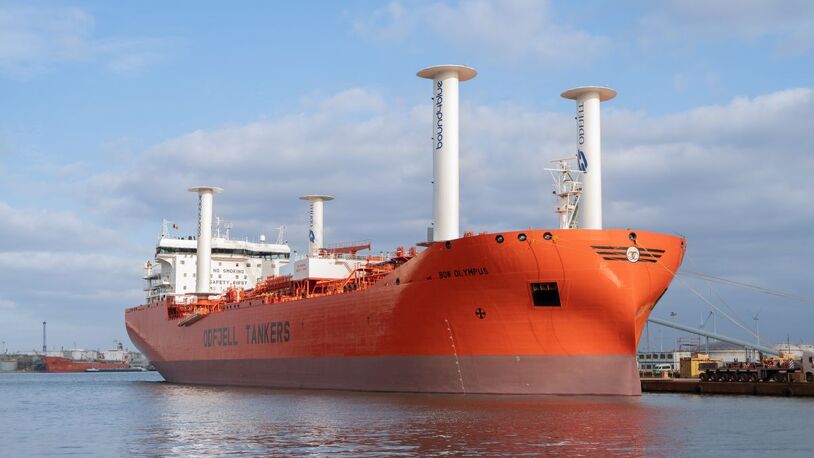
Odfjell SE has taken a similar step, installing four bound4blue eSAILs on its 49,000-dwt Bow Olympus. These 22-m suction sails are expected to improve fuel efficiency and provide regulatory advantages under FuelEU Maritime and the EU ETS scheme.
Odfjell vice president technology, Erik Hjortland said, "Wind power was the next step. bound4blue’s suction sails have been chosen so we can determine the potential of wind propulsion in the continued work to reduce our emissions."
Odfjell chief sustainability officer Øistein Jensen will speak at the International Chemical and Product Tanker Conference 2025, scheduled for 23-24 April 2025, where he is expected to discuss decarbonisation strategies in chemical tanker shipping.
However, Stolt Tankers has taken a different approach. The company has assessed wind-assisted propulsion and determined it is unsuitable for its operational profile, as its vessels spend approximately 45% of their time in port, leading to a negative return on investment.
Instead, the company has focused on other energy-efficient technologies, such as Yara Marine’s FuelOpt propulsion optimisation system, which maximises fuel savings and is compatible with various marine fuels.
Mitsui OSK Lines Ltd (MOL), the parent company of MOL Chemical Tankers, has been actively developing and deploying wind-assisted propulsion systems across its fleet.
In 2022, MOL introduced Shofu Maru, a 100,000-dwt coal carrier equipped with Wind Challenger, a hard sail system designed to harness wind energy for propulsion. The company has since committed to expanding its Wind Challenger-enhanced fleet, with plans for 25 installations by 2030 and 80 by 2035.
MOL has also collaborated with Chevron Shipping Co to install a Wind Challenger system on a new LNG carrier, which is currently under construction at Hanwha Ocean and is expected to be delivered in 2026.
Riviera’s International Chemical & Product Tanker Conference will be held in London, 23 April 2025. Click here for more information on this industry-leading event.
Related to this Story
Events

Maritime Regulations Webinar Week
 16 Dec 2025
 GMT - ONLINE
Floating energy: successfully unlocking stranded gas using FLNGs and FSRUs
24 Feb 2026GMT - ONLINE
© 2026 Riviera Maritime Media Ltd.


