


Business Sectors
Business Sectors
Events
Contents

Register to read more articles.
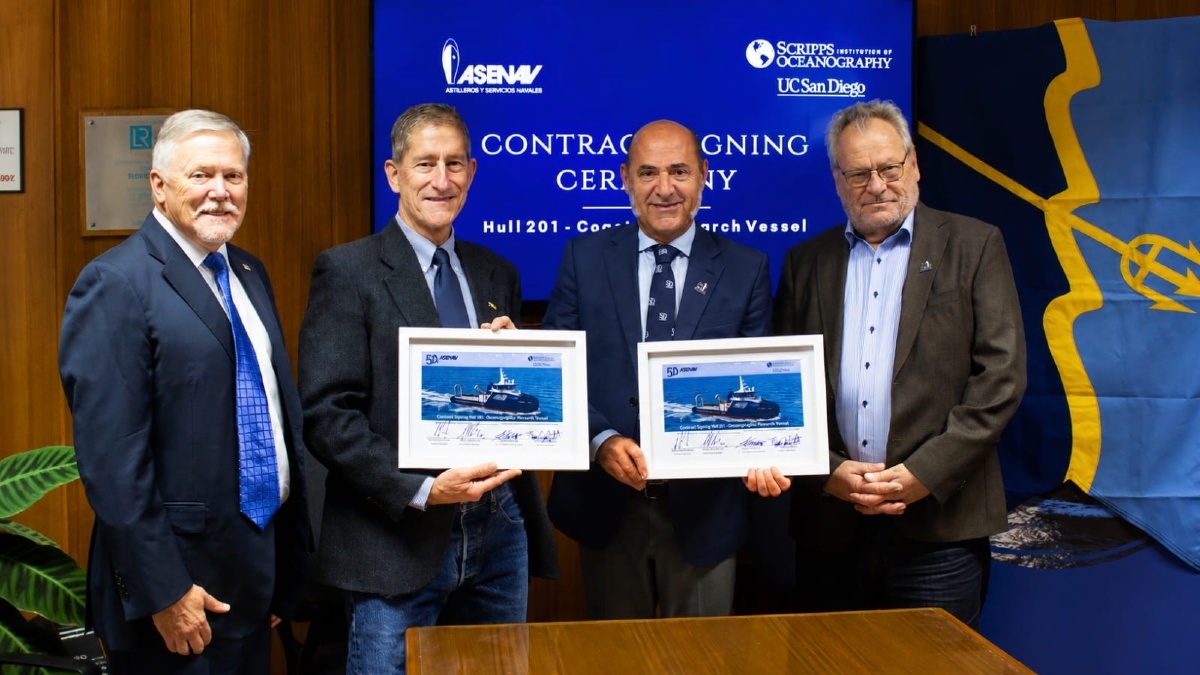
Chilean shipyard to build battery-hybrid research vessel for UC at San Diego
In a major export win for Chile, ASENAV to design and build new Coastal Class research vessel for Scripps Institution of Oceanography


Chile’s ASENAV has signed a contract to build a new battery-hybrid research vessel for the University of California at San Diego.
Designed by Seattle naval architectural and marine engineering firm Glosten for coastal scientific exploration, the 38 m, low-emissions vessel will be a floating laboratory based in San Diego, where it will serve hundreds of scientists and students each year along the Eastern Pacific coast as part of the U.S. Academic Research Fleet. The newbuild will replace the 1981-built, diesel-powered research vessel Robert Gordon Sproul, which will be retired after four decades of service.
Expectations are that the vessel will operate 200 days per year, carrying up to 20 people — crew, students and scientists — on oceanographic scientific research missions for Scripps Institution of Oceanography, one of the oldest, largest, and most important ocean, earth, and atmospheric sciences research institutions in the world.
ASENAV was selected as the builder by the university following a request-for-proposal process.
The project has an estimated timeline of 24 months and covers a comprehensive scope of design, construction, testing, and trials through to delivery of the vessel, projected for July 2028.
At the contract signing ceremony attended by university representatives, ASENAC chief executive Fernando Rodríguez, said the award of this project “represents a new milestone for Chile and a tremendous opportunity, as it allows us to demonstrate our capabilities to export engineering, design, and shipbuilding not only focused on the maritime industry, but also in the scientific field and for one of the most important academic institutions in the world.”
According to Mr Rodríguez, the new Coastal Class Research Vessel will incorporate hybrid battery propulsion technology to reduce the environmental impact of its operations at sea and will meet a range of technical requirements mandated by US regulations.
Based on a monohull design, the vessel will have a length of 38.0 m, beam of 10.2 m, and draught of 3.0 m. Propulsion will be supplied by two azimuthing L-Drive stern thrusters and a bow thruster. The advanced propulsion system will allow the ship to maintain precise control over its speed and position. During its scientific missions, the vessel will operate at various working speeds: transit at 10 knots, survey at 8 knots, towing at 2 knots, and maintaining exact positioning using dynamic positioning at low or no speed.
A key technical requirement will be compliance with performance guarantees related to speed, range, power quality, airborne noise, exhaust emissions, and low underwater radiated noise at survey speeds between 1 and 10 knots — a condition of particular importance to avoid interference with scientific measurements and the marine environment.
Glosten’s subsidiary, Noise Control Engineering, will lead the vessel’s airborne and underwater noise analysis to ensure the vessel’s acoustic performance requirements are met.
It will be built to comply with ABS class requirements, USCG regulations, and applicable US federal, state, and local regulations.





Related to this Story

Events

Maritime Regulations Webinar Week
 16 Dec 2025
 GMT - ONLINE

Floating energy: successfully unlocking stranded gas using FLNGs and FSRUs
24 Feb 2026GMT - ONLINE
© 2026 Riviera Maritime Media Ltd.


