


Business Sectors
Business Sectors
Events
Contents

GasTech 2026 sees deals for new vessel designs, autonomous navigation and wind-assisted propulsion
A round-up of some of the vessel contracts, technology partnerships and development agreements announced during the global gas industry’s meeting in Bangkok


Autonomous 180,000-m³ LNG carrier
HD Hyundai Samho, Avikus and ClassNK have agreed to develop and verify an autonomous-navigation design for an 180,000-m³ LNG carrier under construction.
The project will incorporate Avikus’s HINAS Control autonomous-navigation system into HD Hyundai Samho’s vessel design, with ClassNK assessing the design against its guidelines for automated and autonomous ship operation.
HD Hyundai Samho will develop the basic design, Avikus will provide HINAS Control and its navigation algorithms and system functions, and ClassNK will conduct the design review. The partners aim to assess whether the system can meet the requirements for a ClassNK autonomous-navigation notation and subsequently expand its application to operational vessels.
The project follows the entry into force of the non-mandatory IMO MASS Code on 1 July 2026, as work continues on the regulatory framework for autonomous ships.
Wind-assisted 174,000-m³ LNG carrier
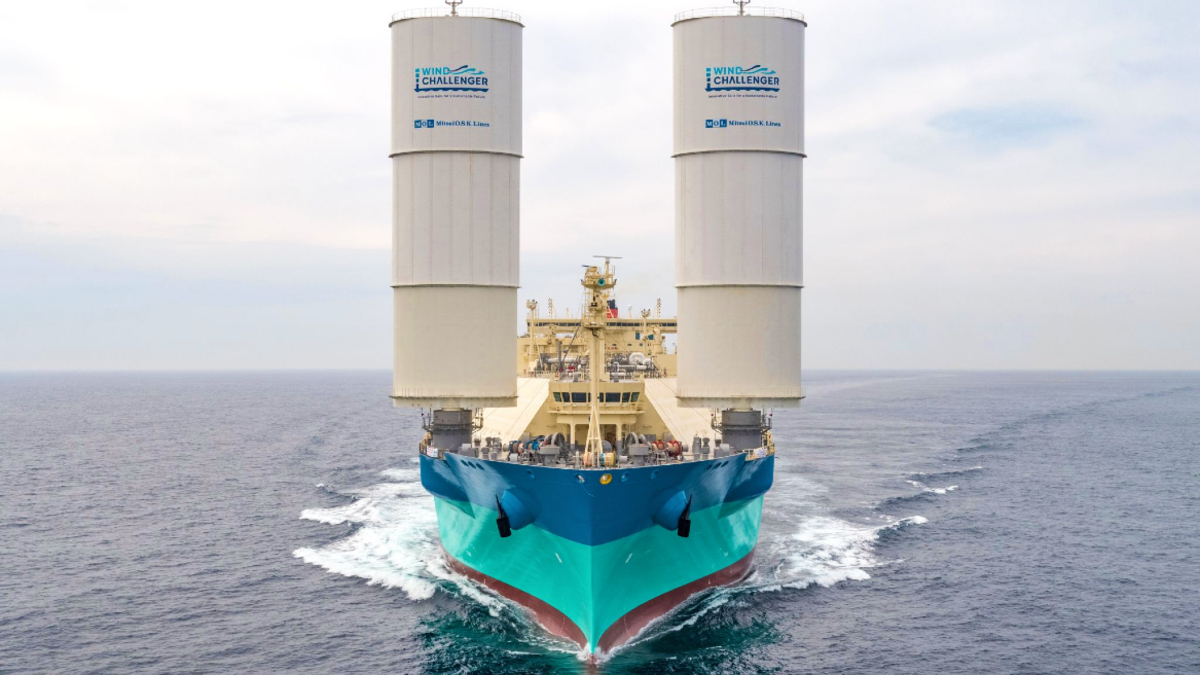
HD Hyundai Heavy Industries (HD HHI), Korean Register, BAR Technologies and the Liberian Registry have signed a memorandum of understanding (MoU) to assess the installation of WindWings on a 174,000-m³ LNG carrier.
The project centres on an HD HHI design with the accommodation block positioned forward. This arrangement creates additional upper-deck space for the large rigid wing sails developed by BAR Technologies, which use wind as supplementary propulsion.
HD HHI will lead the vessel design, while BAR Technologies will provide data covering WindWings arrangement, structural requirements, operating concepts and expected fuel savings. KR and the Liberian Registry will assess safety and technical suitability against applicable rules, with KR considering Approval in Principle (AiP).
The partners said the project is intended to advance the commercial application of wind-assisted propulsion on LNG carriers. BAR Technologies said its WindWings are already deployed on 10 bulkers and tankers.
18,000-m³ LNG bunkering vessel
Hanwha Ocean and Korean Register have signed an MoU to jointly develop two design concepts for an 18,000-m³ LNG bunkering vessel, targeting growing demand for ship-to-ship LNG fuel supply as the LNG-fuelled fleet expands.
The two concepts will use different cargo-containment systems: Hanwha Ocean’s MCTIB high-manganese-steel independent Type-B tank and independent Type-C tanks. Hanwha Ocean will lead the basic vessel design, including the cargo-tank arrangement, bunkering system and operating concept, while KR will review safety, regulatory compliance and operational efficiency from the early design stage.
KR will also assess the designs for Approval in Principle. Hanwha Ocean said the project is intended to combine safety and economic efficiency as LNG bunkering infrastructure develops alongside the growth of LNG-fuelled shipping.
42,000-m³ liquefied CO2 carrier
A 42,000-m³ liquefied carbon dioxide (CO2) carrier jointly developed by K Line, MOL, Nihon Shipyard, NYK Line, MILES and Mitsubishi Shipbuilding has received an AiP from ClassNK.
The vessel design is aimed at the emerging CO2 transport market supporting carbon capture and storage projects, where liquefied CO2 carriers will be required to move captured carbon from collection points to storage sites.
ClassNK reviewed the design under its rules incorporating the IGC Code and carried out a HAZID risk assessment before granting the AIP. The approval is intended to support development of a more standardised hull design for liquefied CO2 carriers as CCS projects expand.
The project brings together four major Japanese shipping companies with shipbuilding and engineering partners to establish a vessel concept for the transportation of captured CO2 at scale.
50,000-m³ LPG carrier
A 50,000-m³ LPG carrier jointly developed with HD Hyundai Heavy Industries has received Approval in Principle from project partner Korean Register.
The new design is intended to occupy the space between established 45,000- and 60,000-m³ LPG carrier classes, targeting the mid-size segment and a wider range of cargo volumes and trading patterns.
The vessel uses Type A independent cargo tanks, which separate the LPG containment system from the ship’s hull structure. HD HHI undertook the concept and basic design, while KR reviewed compliance with international standards and gas-carrier regulations before granting the AIP.
HD HHI said demand for mid-size LPG carriers is being driven by expanding LPG trade and increasingly diverse shipping routes, with the smaller vessels offering different port-access and operational characteristics from larger carriers.
LNG carrier design for amended IGC Code
HD Hyundai Samho and ClassNK have signed an MoU to jointly develop an LNG carrier design incorporating forthcoming amendments to the IMO’s IGC Code.
The work will address requirements covering emergency shutdown arrangements for cargo-tank valves, materials for exposed cargo piping, interlocking and accumulation-pressure requirements for cargo-tank pressure-relief valves, and risk-based cargo filling limits.
The amendments are expected to be adopted at the IMO Maritime Safety Committee’s 112th session in December 2026 and enter into force on 1 July 2028.
HD Hyundai Samho will develop the revised vessel design, while ClassNK will conduct the technical review. The partners said working ahead of the regulatory change should reduce future design rework and give shipowners an early, technically validated design compliant with the amended requirements.
9,000-m³ Eco LPG carrier
K Shipbuilding, Sejin Heavy Industries and ClassNK have agreed to jointly develop a 9,000-m³ LPG carrier incorporating the forthcoming IGC Code amendments and energy-saving technology.
The vessel will feature a rudder bulb and energy-saving fin, designed to improve propulsive efficiency and thereby reduce fuel consumption and greenhouse-gas emissions.
K Shipbuilding will develop the carrier design, while Sejin Heavy Industries will develop its cargo-tank design and wide-plate bending technology. ClassNK will review the design against the amended IGC Code requirements.
The project is intended to prepare the vessel for regulatory requirements due to take effect in 2028 while incorporating efficiency measures into the design from the outset.
Continuous emissions monitoring on LNG carrier
Lloyd’s Register, Seapeak, Kongsberg Maritime and Tunable have launched a joint development project to test continuous, direct emissions measurement aboard a new LNG carrier.
The trial will use Kongsberg Maritime’s Continuous Emissions Monitoring System (CEMS), incorporating Tunable’s gas-analysis technology, on a vessel scheduled for delivery in early 2027. The partners will compare directly measured CO₂ emissions with engine test-bed data and standard emissions factors.
Lloyd’s Register will act as independent verifier, with monitoring and analysis continuing through 2027. The partners will assess the accuracy of CEMS under real operating conditions and examine how direct measurements could be used within IMO and EU emissions-reporting frameworks.
The project is intended to provide evidence on whether continuous measurement can improve the accuracy and transparency of emissions data used by shipowners, charterers and regulators.
Ethanol-fuelled MR tanker
K Shipbuilding and Lloyd’s Register have signed an MoU to develop a 50,000-dwt medium-range tanker designed to run on ethanol.
The project will assess the technical feasibility, safety and regulatory requirements of an ethanol-fuelled MR product tanker, with the partners targeting Approval in Principle from LR.
K Shipbuilding will lead the vessel design, while LR will review arrangements covering stability, structure and integration of the ethanol fuel tanks. The partners will also examine opportunities to improve vessel and operational efficiency.
The project is intended to explore ethanol as a marine fuel in a vessel segment where the fuel is already familiar as a cargo. LR said the work could give product-tanker owners a basis for assessing ethanol-fuelled designs as part of future fleet strategies.





Related to this Story

Events

Maritime Regulations Webinar Week
 16 Dec 2025
 GMT - ONLINE

Floating energy: successfully unlocking stranded gas using FLNGs and FSRUs
24 Feb 2026GMT - ONLINE
© 2026 Riviera Maritime Media Ltd.


