


Business Sectors
Business Sectors
Events
Contents

Hanwha Ocean debuts 'firsts' on MOL's newbuild LNG vessels
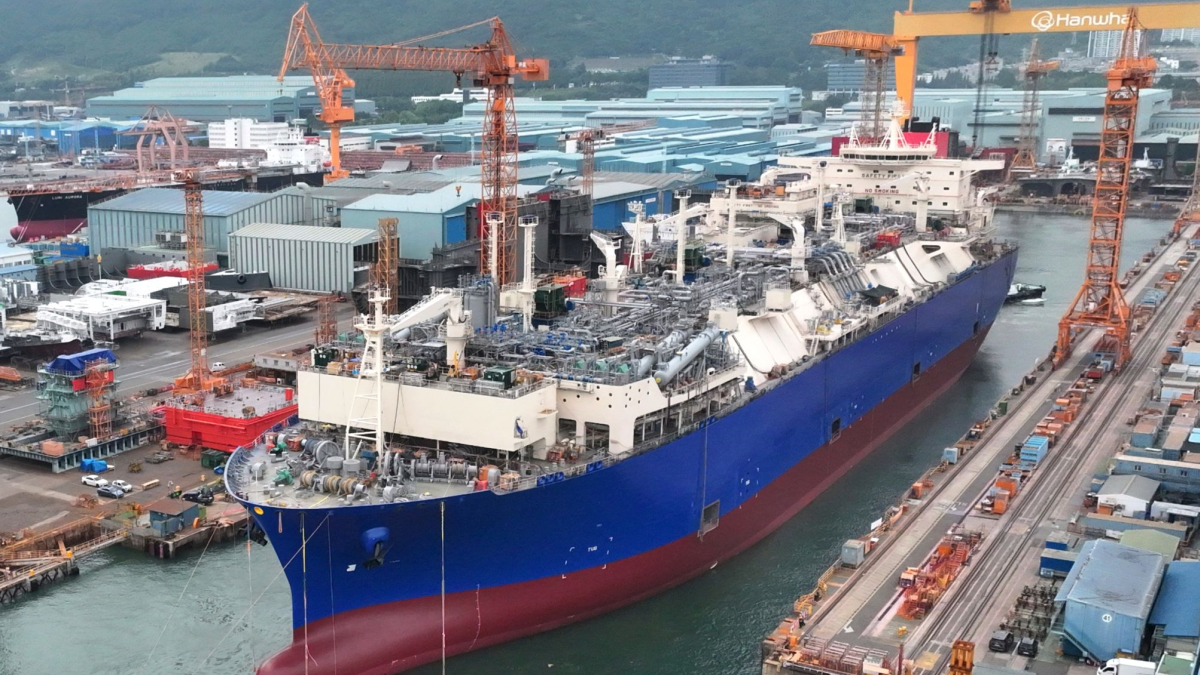
Hanwha Ocean has launched what it’s calling the ’world’s first’ FSRU that can regasify continuously for 25-years and held a naming ceremony for an innovative wind-assisted LNG carrier


Hanwha Ocean has marked two LNG vessel innovations at its Geoje shipyard in South Korea, launching a floating storage and regasification unit (FSRU) designed for 25 years of continuous regasification and holding a naming ceremony for an LNG carrier that will be the first to be equipped with a particular wind-assisted propulsion system.
The FSRU was ordered by Mitsui OSK Lines (MOL) in 2024 and will be chartered by Singapore LNG Corporation (SLNG) to supply natural gas to Singapore.
Hanwha Ocean said the vessel is the first LNG FSRU designed to operate continuously for 25 years without the maintenance normally carried out during dry-docking and classification surveys.
The company said it has previously built 12 LNG FSRUs, but the requirement for continuous operation over 25 years presented an “unprecedented challenge”.
To meet the requirement, the shipbuilder said it added redundant equipment and durable coatings to the vessel build, while carrying out dozens of risk assessments and expanding the use of 3D model reviews throughout the vessel.
The FSRU will form part of Singapore’s gas infrastructure, supplying natural gas to the city state under its charter to SLNG.
LNG carrier debuts MOL-Oshima rigid sail wind-assisted propulsion
MOL separately held a naming ceremony on 10 September at Hanwha Ocean’s Geoje shipyard for its newbuild LNG carrier Fujin Sailor.
MOL describes the vessel as the world’s first LNG carrier equipped with a wind-assisted propulsion system, as well as the world’s first vessel of any type equipped with two Wind Challenger hard-sail units.
The vessel is scheduled for delivery to a long-term charter with US energy major Chevron at the end of September.
Chevron Supply & Trading president Molly T Laegeler is the vessel’s godmother and formally christened it Fujin Sailor. Ms Laegeler said the vessel demonstrated how practical innovation could help reduce the carbon intensity of LNG transportation.
MOL said the two Wind Challenger units are expected to reduce fuel consumption and associated greenhouse gas emissions compared with conventional propulsion alone. The vessel is the fourth MOL Group ship to be equipped with Wind Challenger technology, out of 11 vessels that have been or will be fitted with the system.
MOL has set a target of net-zero greenhouse gas emissions by 2050 and plans to expand its use of Wind Challenger technology. The company aims to have 25 vessels equipped with the system by 2030 and 80 by 2035.





Related to this Story

Events

Maritime Regulations Webinar Week
 16 Dec 2025
 GMT - ONLINE

Floating energy: successfully unlocking stranded gas using FLNGs and FSRUs
24 Feb 2026GMT - ONLINE
© 2026 Riviera Maritime Media Ltd.


