


Business Sectors
Business Sectors
Events
Contents
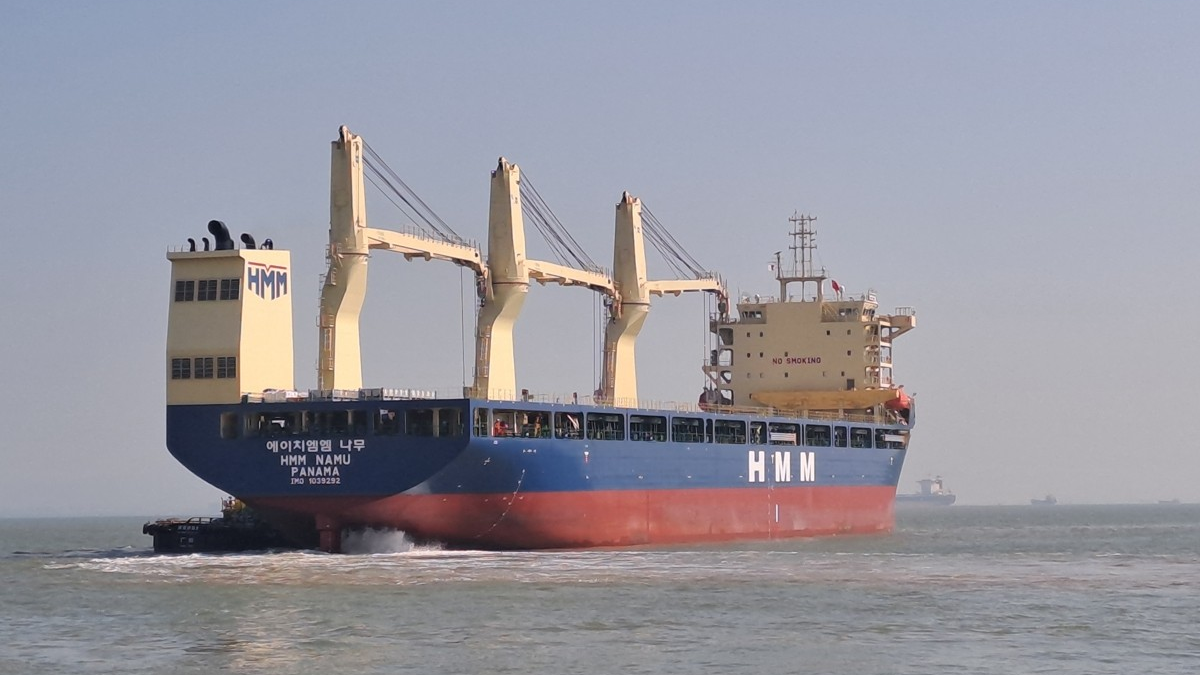
HMM ship under tow to Dubai following explosion in Strait of Hormuz, more ships attacked
A multipurpose carrier was hit by an engine-room explosion and subsequent fire while at anchor off the United Arab Emirates (UAE) on 4 May


South Korean-operated HMM Namu is being towed to Jebel Ali Port, Dubai, after explosions rocked the vessel at its anchorage in the Strait of Hormuz.
AIS data indicates the Panama-flagged vessel, operated by HMM, is expected to arrive in Dubai on 8 May.
The incident involving the 2026-built cargo ship has further heightened maritime security tensions across the vital Middle Eastern waterway. The blast, which occurred on Monday night local time, caused significant damage and left the 38,314-dwt vessel without propulsion, necessitating its tow. No casualties were reported, and operator HMM is not speculating on the cause of the fire, citing an ongoing investigation into the incident.
“A fire broke out in the engine room near 20:40 KST on 4 May. It is now fully extinguished,” an HMM spokesperson told Riviera, confirming that all 24 crew members on board are safe and the 182-m ship is prepared for tow.
HMM investigation looks at ‘external object’
While the cause of the fire remains unverified, HMM confirmed that investigators are looking into the possibility of outside interference.
“We are investigating the cause, including potential contact with an external object, in close coordination with relevant authorities,” the company stated.
Officials from the Korea Maritime Safety Tribunal and the National Fire Agency are set to lead the technical investigation and damage assessment. It is anticipated that repairs will be conducted in Dubai.
South Korean government response to Namu incident
The fire on board HMM Namu triggered an emergency midnight meeting by the South Korean Ministry of Foreign Affairs on 5 May, involving representatives from seven regional diplomatic missions and the Ministry of Oceans and Fisheries.
Second Vice Minister Kim Jin-ah expressed "deep concern" over the incident, noting it marks the first damage sustained by a South Korean vessel within the Strait of Hormuz since the escalation of regional conflict in the Middle East.
Minister Kim emphasised the urgency of identifying the cause to prevent recurrence and reiterated the government’s commitment to the safety of seafarers operating in high-risk corridors.
South Korean news agency Yonhap reported that the South Korean government is maintaining a "cautious stance" on the cause of the blast on board the HMM vessel, noting that a government team, including experts from the Korea Maritime Safety Tribunal, has been sent to Dubai for an investigation.
US President Donald Trump had earlier claimed without offering evidence that HMM Namu was "hit by Iran" after attempting to navigate the strait without US protection.
The Iranian Embassy in Seoul has denied involvement. "The Embassy of the Islamic Republic of Iran firmly rejects and categorically denies any allegations regarding the involvement of the armed forces (…) in the incident involving damage to a Korean vessel," the diplomatic mission stated.
Attacks on vessels continue as rhetoric from US and Iran clouds potential truce
Vessels have continued to come under fire in and around the Strait of Hormuz, even as the US President claimed that "great progress" has been made in an agreement to reopen the Strait of Hormuz and Iran hinted at safe transit of the strait.
Among the incidents in recent days, an apparent missile strike hit French-operated container vessel CMA CGM San Antonio on 5 May. Targeted while transiting the Strait of Hormuz, CMA CGM confirmed that several of the vessel’s crew members were injured in the attack and that its box ship had sustained damage. The line said the injured crew members had been evacuated and were receiving medical treatment.
International Maritime Organization (IMO) reports on the incident confirmed that eight seafarers from San Antonio had been injured and that the vessel had been hit 30 nautical miles northeast of Fujairah off the UAE. IMO has confirmed a total of 10 seafarers killed in incidents related to the war, with one seafarer missing from a 1 March incident at 16 injured, in total.
On 6 May, US Central Command (US CENTCOM) reported that a US fighter jet had fired on and disabled Iranian oil tanker Hasna in the Gulf of Oman, after the vessel reportedly attempted to breach the US military blockade of Iranian ports and vessels.
"After Hasna’s crew failed to comply with repeated warnings, U.S. forces disabled the tanker’s rudder by firing several rounds from the 20mm cannon gun of a US Navy F/A-18 Super Hornet launched from USS Abraham Lincoln (CVN 72). Hasna is no longer transiting to Iran," US CENTCOM said.
Despite the violence, officials in Washington and Tehran have hinted that a framework for safe transit may be forthcoming. The conflict has severely disrupted regional energy flows, locking in vast volumes of Middle Eastern oil and gas production for the past two months. Currently, hundreds of vessels remain anchored or diverted, creating a massive logistical backlog as shipowners wait for the blockade to lift and a resumption of safe passage through the vital waterway.
Sign up for Riviera’s series of technical and operational webinars and conferences:
- Register to attend by visiting our events page.
- Watch recordings from all of our webinars in the webinar library.




Related to this Story

Events

Maritime Regulations Webinar Week
 16 Dec 2025
 GMT - ONLINE
Floating energy: successfully unlocking stranded gas using FLNGs and FSRUs
24 Feb 2026GMT - ONLINE
© 2026 Riviera Maritime Media Ltd.


