


Business Sectors
Business Sectors
Events
Contents

Register to read more articles.
How augmented reality is bringing two zero-emission ropax vessels to life
Two all-electric vessels for Baleària, designed by Incat Crowther using digital shipbuilding technology, will serve the first green corridor between Europe and Africa in 2027


As Baleària’s new 123 m ropax ferry joins its fleet in the Atlantic, the Spanish owner’s design partner is hard at work completing two advanced zero-emission ropax designs that will create the first green corridor between Europe and Africa.
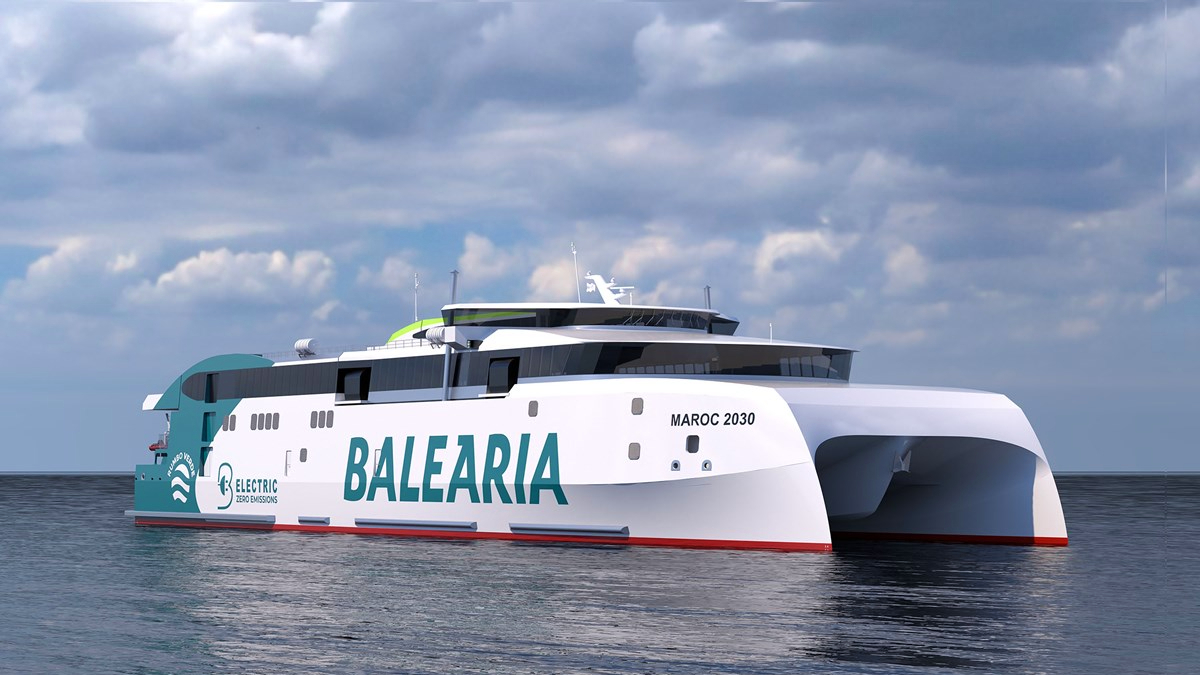
Australian naval architectural firm Incat Crowther and Astilleros Armon’s Giron shipyard are working closely to complete the two 87 m-long by 25 m-wide all-electric vessels for launch in 2027.
Baleària president Adolfo Utor explained that the ships will create the first green shipping corridor between Europe and Africa, and enable the vessel owner to meet 2050 zero-emission targets more than 20 years ahead of schedule. “This is a pioneering and technologically advanced public-private project that will enable us, for the first time, to run the entire route using only electric energy and, therefore, zero emissions,” said Mr Utor.
Baleària’s €135M investment in the battery-powered ropax vessels is backed by a 15-year contract awarded by the Port Authority of the Bay of Algeciras.
These sister ships, Espana 2030 and Maroc 2030, will be powered by an electric power capacity of 16 MW thanks to four electric propulsion motors powered by 11,500-kWh capacity batteries. Each ropax vessel will have a capacity of 804 passengers and 225 vehicles on a 29-km crossing between Spain and Morocco at a speed of 26 knots. Four electric motors drive four fixed-pitch propellers. In the event of contingencies, back-up power is provided by four 2,800-kW diesel generators with a total capacity of 11,200 kW.
Onshore power supply
The respective ports of Tarifa and Tangier are rising to the zero-emission occasion. Two autonomous robotic arms at each terminal will automatically connect the ship to onshore power, allowing the vessels to charge in 40 minutes during their one-hour layover. The port authorities have earmarked US$72M for onshore power supply (OPS) at both quays. Tarifa will have a 5 MW OPS and 8 MWh of shoreside battery storage, while Tangiers will have 8 MW of OPS and 8 MWh of batteries.
To bring the project to life, Incat Crowther is working with naval engineering and maritime consultant Cotenaval, Spanish electricity giant Endesa and Morocco-based electricity distributor Amendis.
The design of the sister ships owes much to earlier 123 m, natural gas-powered ropax ferries while being optimised for the ports. High visibility and manoeuvrability are assured by the ship’s bridge wings, two bow thrusters and four rudders. Two high-capacity stern ramps will speed up operations in port. An underwater T-foil system will be installed to reduce vertical movement.
Baleària’s newest fast ferry, Mercedes Pinto, completed sea trials in May and began service in the Canary Islands in June, connecting Las Palmas, Morro Jable and Tenerife. Sister vessels, Eleanor Roosevelt and Margarita Salas, designed by Incat Crowther and built by Astilleros Armon, are operating between the Spanish mainland and the Balearic Islands. Margarita Salas has been sailing between Barcelona and the islands of Mallorca and Menorca since 2024, while Eleanor Roosevelt, the first of Incat Crowther’s big ropax designs, has been operating between Denia, Ibiza and Mallorca since 2021. With a capacity of 1,200 passengers and 425 vehicles, Mercedes Pinto is an iterative design that follows in the wake of its sister vessels.
While it’s equipped with LNG dual-fuel main engines, Mercedes Pinto can operate on biomethane or green hydrogen blends of 25%. The vessel has energy efficiency systems, smart sensors, integrated emissions monitoring equipment, and enhanced real-time navigation systems.
Although all three of the 123m-long ropax look outwardly the same, each of them takes the design a step further. For instance, Margarita Salas was given a second passenger deck with a lounge and a bar. The area of the aft terrace was doubled with an outdoor bar service.

Digital design
Incat Crowther and Baleària are learning from each vessel, benefiting from passenger experience. Mercedes Pinto, for instance, has a redesigned atrium between the main and upper passenger decks, a larger aft terrace with outdoor bar service, an extra passenger deck with a spacious bow lounge, improved seating throughout the VIP lounge, and more crew area behind the wheelhouse. There’s also a dedicated children’s area, more cafeterias, extra onboard entertainment and, to set animal owners’ minds at rest, a pet surveillance system.
Spain-headquartered Oliver Design has partnered with Baleària and Incat Crowther on each ferry. Highly versatile, this family-owned group operates from Bilbao, the largest port in northern Spain, and specialises in passenger spaces for ferries, cruise ships and even dredgers. Since its establishment some 50 years ago, Oliver Design has completed more than 400 award-winning projects and the interiors for Baleària’s latest ropax ferries may put the firm in line for more prizes.
European content
As Incat Crowther’s technical manager, Dan Mace, said, Mercedes Pinto has a high level of content from the European supply chain. In this, digital design is fundamental to the entire project, and it’s become a breakthrough tool for Incat Crowther as it manages a growing global portfolio of ship projects.
“It was central to the [Baleària] project because stakeholders were able to engage with the digital model of the ship throughout the process,” explained Incat Crowther chief executive Brett Crowther. The collaboration started well before construction and carried on throughout the entire process, he said.
Digital models are not new in vessel design; for example, 3D product models have been used by the oil and gas industry to design and build complex floating storage and regasification units for roughly two decades. But Incat Crowther and its collaborators are developing these models further with each subsequent project.
According to SSI ShipConstructor, which started working with Incat Crowther a few years ago on an electric ropax, the models employ augmented reality and mixed reality that stream software to Microsoft HoloLens headsets. This allows all the partners to visualise, review and test 3D digital ship models at full scale - well before any plate is cut on the shop floor.
Although they’re not ropax vessels, it was digital design that sped the development and launch of a seven-vessel fleet of ferries on Sydney Harbour, the latest delivered in mid-2026. Based on augmented reality, the software kept all the parties in the loop. Similarly, digital shipbuilding technology was used to integrate the electric drivetrain in the Incat Crowther 32’s launched on Auckland Harbour in 2026.
It’s a revolutionary approach to ship design that avoids misunderstandings and mistakes. In the case of the Sydney ferries, masters and crew members could virtually sit in full-size wheelhouses and assess sightlines, ergonomics and ease of operation. Transport authorities were able to walk through a three-dimensional digital twin to inspect interior layouts and passenger flows. In engine rooms, mechanics could inspect the placement of various components for clear access and maintenance.
Overall, the technology allowed the entire project to be sped up through real-time collaboration. The plate shop got instructions sooner, fabrication was more efficient and accurate, and assembly was faster. As SSI explained, under the two-dimensional system, class and construction drawings often had to be modified with inevitable delays.
The involvement of all the parties also leads to happier outcomes. For instance, when masters on the Sydney ferries asked for a larger wheelhouse to improve visibility and comfort, the modification was quickly designed and integrated into HoloLens.
SSI ShipConstructor is convinced about the future of mixed augmented reality: “It will play an increasing role in the design, verification and maintenance processes for its ability to foster collaboration and shorten workflows and timelines.”
Thus Incat Crowther can work with partners all over the world in a seamless way that reduces cost, speeds up construction and quickly spreads vital knowledge between the collaborators. As Mr Crowther further explained: “Given Astilleros Armon is based in Europe, they provide a great option for European operators seeking large, customised, high-quality vessels built close to the market, negating the high cost of delivery and oversight costs.”
The firm is currently flooded with orders. South Korea’s Kangnam Corp has recently commissioned an 80m-long ropax ferry that will accommodate 60 cars or 50 utility trucks and transport 572 passengers. Ropax designs are getting faster – this particular ropax will top out at 45 knots courtesy of a six-engine drive train of MTU M05 engines.
Passenger amenities are top priority these days. There will be four seating classes, a kiosk and pantry, cargo and luggage holds, a medical room, ample bathroom facilities, a smoking room, and paid massage chairs. Construction starts in late 2026 for delivery in late 2028.
Digital design is also enabling the construction of a 10-strong fleet of 55 m-long fast-crew vessels for Asia’s Fast Offshore Supply. Capable of transporting 80 passengers and a payload of 150 tonnes at speeds of up to 30 knots, they will be constructed in several shipyards across the region, including FOS’s own shipyard in Singapore.
Incat Crowther managing director for Europe, Ed Dudson, explained that digital design speeds up the whole project. “Each shipyard receives an identical, highly detailed digital package containing everything required for construction – from structural arrangements through to internal routing of auxiliary systems, electrical cable trays and heating, ventilation and air-conditioning. This approach ensures that despite the complexity of a multi-location build, all ten vessels will be delivered to an identical design and specification, providing FOS with a consistent, reliable fleet.”
Hydrogen fuel cell-powered vessel
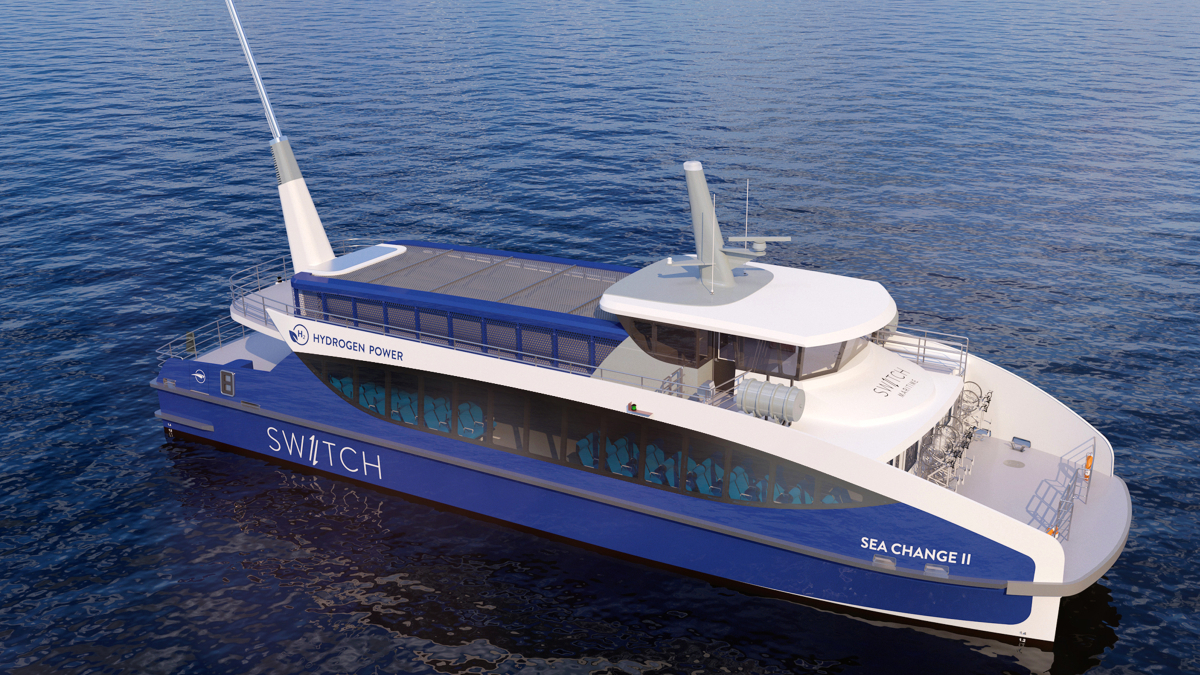
In early 2026, Incat Crowther began detailed work on another advanced fast ferry, a 150-passenger, 28 m-long hydrogen fuel-cell electric vessel that will be deployed first on New York waters. This is a collaboration with Switch Maritime, the zero-emission vessel developer, in another global project involving companies supplying the propulsion system and requirements for fuel safety among other technicalities.
In another learning curve for the Australian firm, this highly original design will have to run like a diesel vessel. That means similar service speeds, a daily bunkering schedule, rapid turnaround times, and no investment, as Switch puts it, in costly shoreside charging infrastructure and power grid upgrades. “The drop-in nature of the technology ensures the new hydrogen fuel cell-electric ferry will seamlessly integrate into current operations, rather than requiring schedule changes or a system-wide reorientation,” said the vessel owner.
The New York ferry is likely to open up even more international opportunities for Incat Crowther. Although it will be put on short runs at first, Switch predicts hydrogen-fuelled ferries will work for longer trips as well as for ports where shoreside charging for battery-electric ferries may not be possible for technical or economic reasons.
Switch co-founder and chief executive Elias Van Sickle sees the ferry as a pioneer. “Switch aims to provide operators with commercially viable vessels that future-proof ferry fleets. Our objective is to meet existing performance standards with drop-in solutions that don’t require overhauling systems or schedules. And if it can be done in New York, it can be done anywhere,” said Mr Van Sickle.
Similarly to Baleària’s latest vessels, this new ferry prioritises the passenger experience. The vessel’s main deck will have comfortable seating for 150 passengers, ample luggage storage, a kiosk, three bathrooms including a wheelchair-accessible bathroom, and large windows to allow passengers to enjoy the views from New York’s waterways.
The New York ferry is a step up for Incat Crowther and Switch. They also collaborated on the design, delivery and regulatory approval of the smaller Sea Change, the world’s first zero-emissions, hydrogen fuel cell-powered, electric-drive high-speed passenger ferry. This 21m-long, 75-passenger vessel operates in San Francisco’s Bay Area.




Related to this Story


Events

Maritime Regulations Webinar Week
 16 Dec 2025
 GMT - ONLINE

Floating energy: successfully unlocking stranded gas using FLNGs and FSRUs
24 Feb 2026GMT - ONLINE
© 2026 Riviera Maritime Media Ltd.


