


Business Sectors
Events

Floating energy: successfully unlocking stranded gas using FLNGs and FSRUs
 24 Feb 2026
 GMT - ONLINE
Contents
Register to read more articles.
VIDEO: Human-robot teams to service offshore windfarms ‘within the decade’
One of the UK’s most ambitious robotics projects has proven the concept of robotic teams combining marine, aerial and climbing assets repairing offshore windfarms


The £4.0M (US$5.5M) MIMRee project (see video below) paves the way for human-robot teams at windfarms within 10 years and windfarms designed for robotic maintenance in the longer term.
The project, which was funded by Innovate UK, concluded this month and reported on its drive to develop an autonomous robotic team for inspecting and repairing offshore windfarms.
Two years since starting the project, the MIMRee team, including leading academics and technology developers, said they have successfully proven and demonstrated the core technologies at the heart of the concept.
Under the MIMRee scenario, a Thales autonomous mothership detects defects in the blades on a wind turbine using an onboard inspection system that can scan their structure while they are still turning.
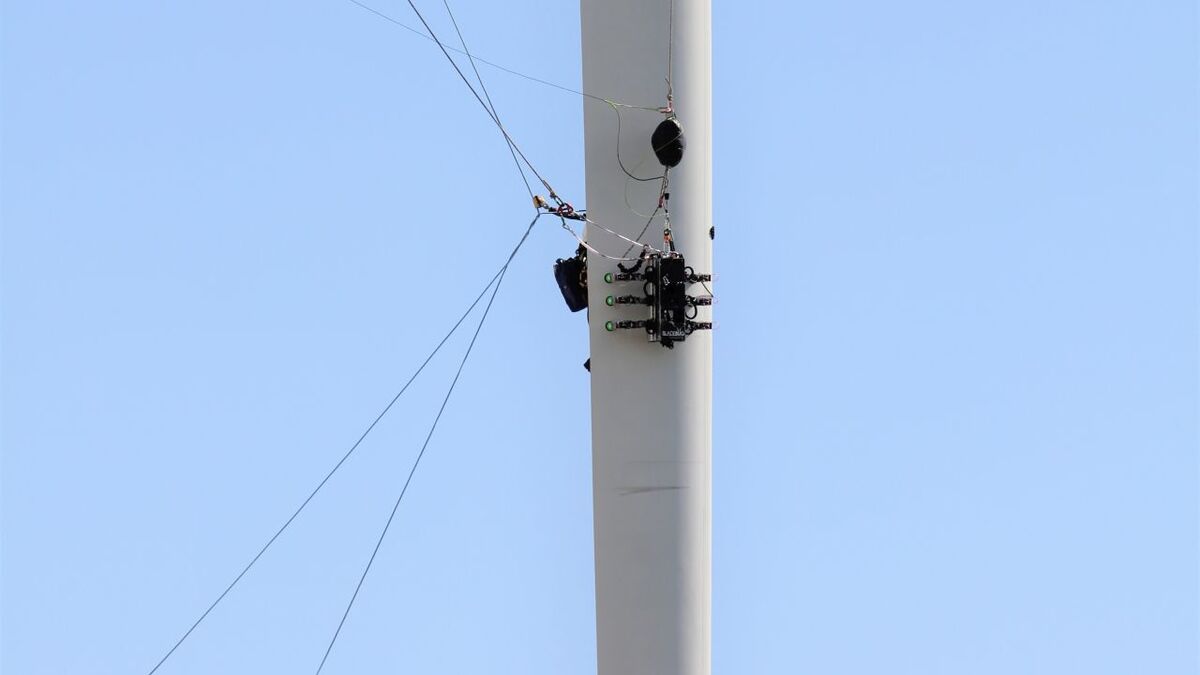
The mothership then signals the blades to stop and launches a specially adapted drone that can transport a six-legged ‘blade crawler’ onto them to effect repair.
The Offshore Renewable Energy (ORE) Catapult, which has led the project, believes that within 10 years this scenario will be feasible at offshore windfarms with robots working semi-autonomously (that is, under the remote supervision of humans and only requiring technicians for intervention offshore when essential).
By 2050, such a system could be capable of planning its own missions and conducting them autonomously at windfarms of the future that are built for repair by resident robots.
ORE Catapult estimates that this move will shift workers from hazardous environments at sea to onshore control room roles and reduce the cost of energy by 10% (including a 27% reduction in operating expenses).
ORE Catapult operations and maintenance lead Ben George said, “This is not just a way for the sector to reduce costs, it is essential if the offshore wind industry is to achieve the scale of expansion needed for net zero.”
“Today, conditions at sea make human-only missions subject to safety risks, delays, cancellations and extensive turbine downtime. This will not be a feasible way of running the super-sized offshore power stations of tomorrow that lie in deep waters hundreds of miles from shore.”
The inspiration for the project was drawn from space exploration, the epitome of an extreme environment. Professor Sara Bernardini, who previously worked on mission planning for space mission operations, including the NASA’s Mars Exploration Rovers programme, developed the AI system that controls how the MIMRee robots work together and communicate with humans.
“Space provides a good example of humans working with robots. The current Mars exploration programme uses a team of robots, from helicopters to rovers, that can withstand extreme conditions. Astronauts are deployed selectively, where human ingenuity is most needed and risk to life is lowest. Likewise, future offshore work will be about humans being in the control room, developing and managing robotics and learning the skills required to work in teams with them,” said Professor Bernardini.
Another technological breakthrough was developing a robot’s ability to repair blades. The BladeBUG robot was lent to the project by BladeBUG Ltd, a London start-up that has previously achieved the world’s first robotic ‘blade walk’ at a working offshore wind turbine.
Wootzano Ltd fitted their patented electronic skin, used in harsh environments such as nuclear decommissioning and applied it to the feet of the crawler robot. The Wootzkin allows robots to navigate around slippery wind turbine blades monitoring for slips and avoiding falls while carrying out repairs.
The Royal College of Art’s Robotic Laboratory developed the repair module that is capable of cleaning and recoating damaged blades.
Drone technologies were adapted to take-off and land on the autonomous vessel when it is moving at high speed while it is carrying the blade crawler. This phase of the work was led by the University of Bristol, University of Manchester and Perceptual Robotics.
“The project has proven that such a system is possible and can handle the extreme environments at sea,” said Mr George. “We have tested each of its components in real-world settings, including at our offshore demonstration turbine off the coast of Scotland.
“We have also developed a hardware-in-the-loop simulation system that allows individual robots to connect to a simulated environment so we can fine-tune their team behaviour before they go into field. It is highly significant that these technologies are being developed and demonstrated first in the UK – this puts us in pole position for a fast-growing global export market.”
Related to this Story

Events

Maritime Regulations Webinar Week
16 Dec 2025GMT - ONLINEFloating energy: successfully unlocking stranded gas using FLNGs and FSRUs
24 Feb 2026GMT - ONLINE
© 2024 Riviera Maritime Media Ltd.


