


Business Sectors
Business Sectors
Events
Contents
Hydrogen tankers: from first mover to full fleet
With just one purpose-built hydrogen tanker in service, the sector’s growth hinges on future demand, infrastructure and engine readiness


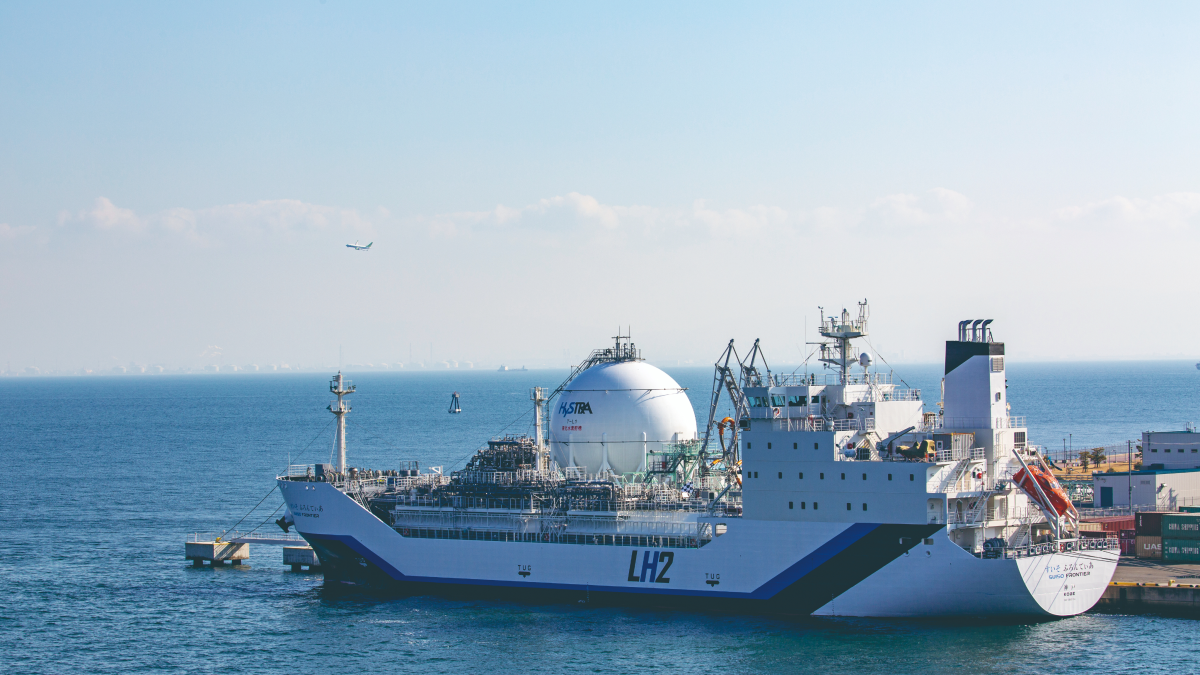
The world’s first liquid hydrogen (LH2) carrier, Suiso Frontier, completed its maiden voyage in 2022, loading at Kobe and discharging in Australia. Operated by Kawasaki Heavy Industries, the demonstration vessel remains the sole operational example of ocean-going hydrogen transport by ship. However, technical demonstrations alone are insufficient to catalyse a broader uptake.
Hydrogen has long been considered a compelling, if technically demanding, energy option. Its low volumetric energy density and cryogenic boiling point of −253°C pose challenges for transport, particularly over long distances. As a result, Suiso Frontier has drawn considerable attention, not only for its spherical containment system but also for proving that maritime LH2 transport is technically feasible. The vessel’s design is based on a 1,250 m³ capacity Moss-type tank — a scale insufficient for full industrial rollout but pivotal as a proof-of-concept.
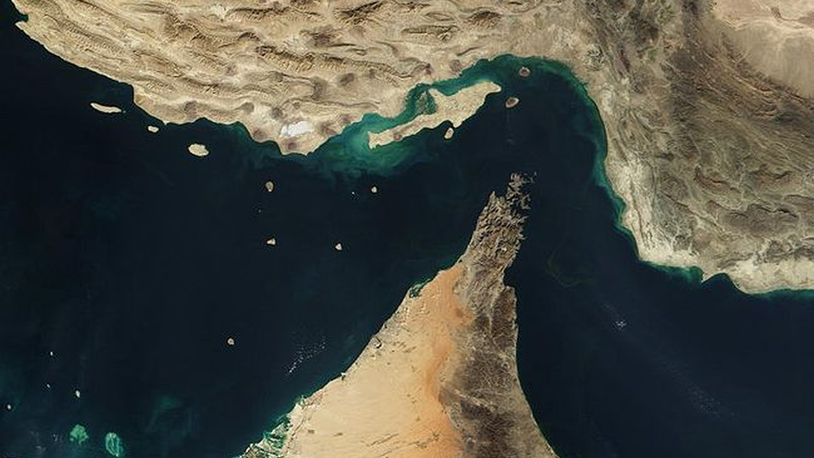
According to the Port of Amsterdam, the forthcoming hydrogen corridor from Oman to Europe will be the first commercial-scale maritime supply chain dedicated to LH2. A joint development agreement signed in April 2025, by Hydrom, OQ, Gasunie, the Port of Amsterdam and others, outlines a full value chain, from production in Duqm to import terminals in the Netherlands and further distribution into Germany. This project, designed for intercontinental hydrogen supply via shipping, will require a new class of large hydrogen tankers, capable of transporting much greater volumes over longer distances and integrating more sophisticated containment systems.
The proposed corridor differs fundamentally from earlier hydrogen strategies, focused on localised or regional distribution. The intention is not merely to export green hydrogen but to establish a sustained, large-scale commercial maritime supply chain. As part of this, ECOLOG International, which is directly involved in the Oman–Europe corridor, is working on the development of ‘net-zero boil-off’ LH2 carriers. These will incorporate advanced multilayer insulation, cryogenic containment, and onboard reliquefaction technologies. According to project partners, the planned vessels will be “substantially larger” than Suiso Frontier, with conceptual designs ranging from 20,000 to 30,000 m³. The first generation of these carriers is expected to be in service by the early 2030s.
In parallel, ports are moving quickly to develop the infrastructure required to support hydrogen imports and bunkering. The Port of Antwerp-Bruges has already begun implementing facilities for receiving alternative fuels, including methanol and ammonia. However, port officials have stated that LH2 infrastructure presents a steeper set of requirements. In particular, they point to the need for berth-side liquefaction systems, dedicated cryogenic pipelines, boil-off gas management systems, and stringent safety buffers for cargo handling. Without carrier-specific infrastructure, direct LH2 imports remain infeasible, regardless of vessel availability.
While deep-sea hydrogen transport is drawing much of the current attention, hydrogen is also gaining traction in the inland and short-sea vessel segment. In Lithuania, the country’s first hydrogen-powered inland waterway vessel was launched in 2024 by Western Baltija Shipbuilding. Designed for the Klaipėda region’s rivers and lakes, the vessel is equipped with a 60 kW hydrogen fuel cell and lithium-ion battery hybrid power system. Though its output is modest, the vessel’s operational profile reflects growing interest in hydrogen as a marine fuel, even in non-industrial contexts.
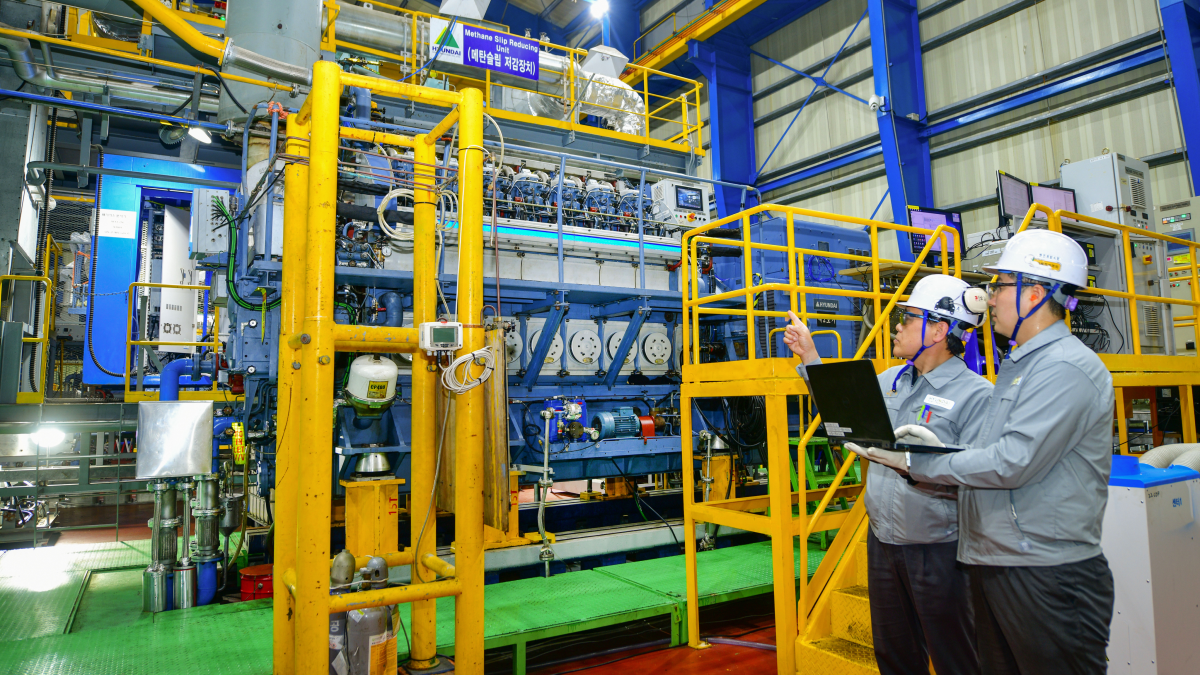
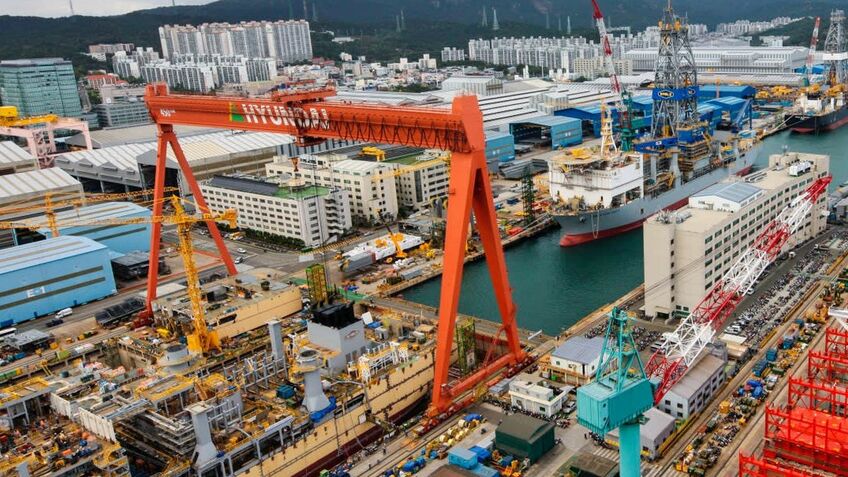
Nevertheless, hydrogen propulsion for ocean-going tankers remains at an earlier stage. Hyundai’s HiMSEN four-stroke LNG–hydrogen dual-fuel engine has been proposed as one potential solution. The engine has been designed for medium-speed marine applications and is currently undergoing combustion tests with hydrogen blends of up to 50%. The manufacturer reports that early results indicate hydrogen’s high flame speed may allow for increased thermal efficiency and improved transient response, provided combustion stability and pre-ignition are carefully controlled.
“Without carrier-specific infrastructure, direct LH2 imports remain infeasible, regardless of vessel availability”
Further development is ongoing to improve hydrogen injection systems and address material compatibility, particularly in relation to embrittlement risks. The engine’s designers also note that fuel supply chain stability will be critical, particularly in terms of hydrogen purity and pressure regulation.
However, propulsion is only one part of a broader chain. Bunkering logistics, onboard safety systems, and crew training all require substantial revision. LH2’s high diffusivity and low ignition energy demand multiple layers of containment and constant leak detection. Most proposed LH2 tanker designs now include dual-walled tanks, vacuum insulation, and distributed gas sensors linked to automated venting systems. Regulatory standards for LH2 bunkering have not yet been harmonised globally, which adds complexity to ship design and port readiness.
Hydrogen’s risks are not confined to technical aspects. The economics of LH2 transport remain sensitive to energy prices, liquefaction costs, and boil-off losses. For example, liquefaction of hydrogen consumes approximately 30% of its initial energy content. Until scale is reached, few shipping companies are likely to make unilateral investments in hydrogen carriers.
In Oman, however, public and private sector alignment appears more advanced. Speaking in April 2025, Hydrom chief executive, Salim Al Harthy, told the Oman Observer that the country intends to become “a global hub for green hydrogen”, with maritime exports forming a core part of the strategy. He stated that liquefaction, port storage and shipping must be integrated into project planning from the outset, given the cost of retrofitting hydrogen-specific infrastructure at a later stage. “Shipping must not be an afterthought,” he said. “It is the bridge that connects Oman’s production capacity to industrial demand in Europe.”
The timeline remains tight. Final investment decisions for Oman’s first hydrogen export modules are expected by 2026, with carrier deliveries required by the end of the decade to meet European import targets. Newbuild availability, classification society approval, containment system reliability and engine certification will all play critical roles. Regulatory frameworks must also keep pace with technology, particularly around safety and port reception standards.
Until then, Suiso Frontier remains alone. But the vessel’s legacy may yet lie in demonstrating not just what is possible, but what must follow.

Related to this Story

Events

Maritime Regulations Webinar Week
 16 Dec 2025
 GMT - ONLINE
Floating energy: successfully unlocking stranded gas using FLNGs and FSRUs
24 Feb 2026GMT - ONLINE
© 2026 Riviera Maritime Media Ltd.


