


Business Sectors
Business Sectors
Events
Contents

Register to read more articles.
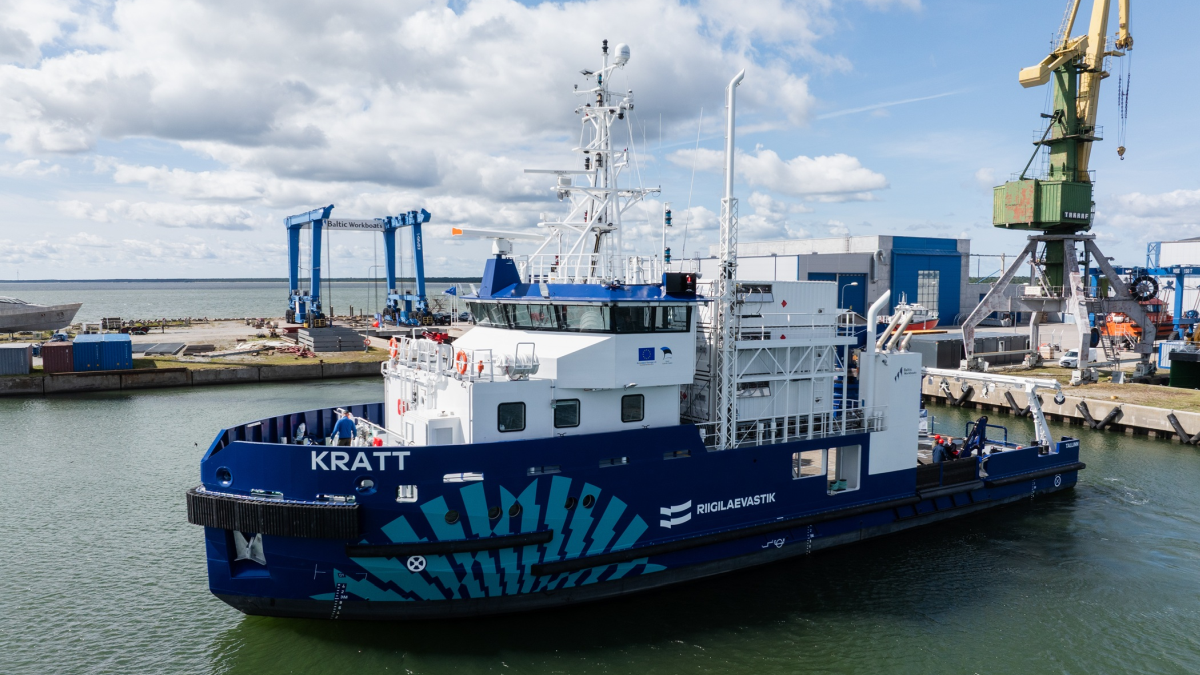
Kratt: Estonia’s new CBM-burning SAR battery hybrid-electric workboat
Estonian State Fleet’s newest multipurpose emergency response and buoy maintenance vessel will run on compressed biomethane and a 400-kWh energy storage system


A new €22M (US$25.5M) multipurpose workboat has been built in Estonia. It features hybrid propulsion and will operate in the areas of pollution response, rescue operations, marine research and navigation services, setting a new benchmark for sustainable vessels.
Baltic Workboats designed and built this 38-m vessel with battery-electric propulsion, including engines for combusting compressed biomethane (CBM) for the Estonian State Fleet.
Kratt was officially named on 12 August 2026 in Saaremaa, Estonia, witnessed by Estonia’s minister of infrastructure, Kuldar Leis, and representatives of the country’s maritime sector and shipbuilding industry.
It is scheduled to enter service in Estonian waters in Q4 2026, carrying out a wide range of maritime and emergency response tasks, reducing the need for stationing multiple vessels in the country.
It is equipped for maintenance and deployment of navigation buoys, fairway and ice-clearance services, supporting search and rescue (SAR) operations and environmental, oceanographic, hydrographic and geological research.
Kratt has four 350-kW gas generators, fuelled by CBM, and a 400-kWh energy storage system for electric propulsion and onboard power.
It can reach a maximum speed of 11 knots and travel up to 1,000 nautical miles at 7 knots on CBM fuel and for up to two hours at 5 knots on its batteries alone.
When at anchor, the battery system can provide electrical power for up to 10 hours, reducing the need to run auxiliary engines, lowering fuel consumption, emissions and noise.
“Kratt is a milestone for Estonia in moving towards more sustainable shipping and a good example for others to follow,” said Mr Leis.
“This new vessel shows how a state fleet can become both more capable and more environmentally sustainable at the same time,” he said
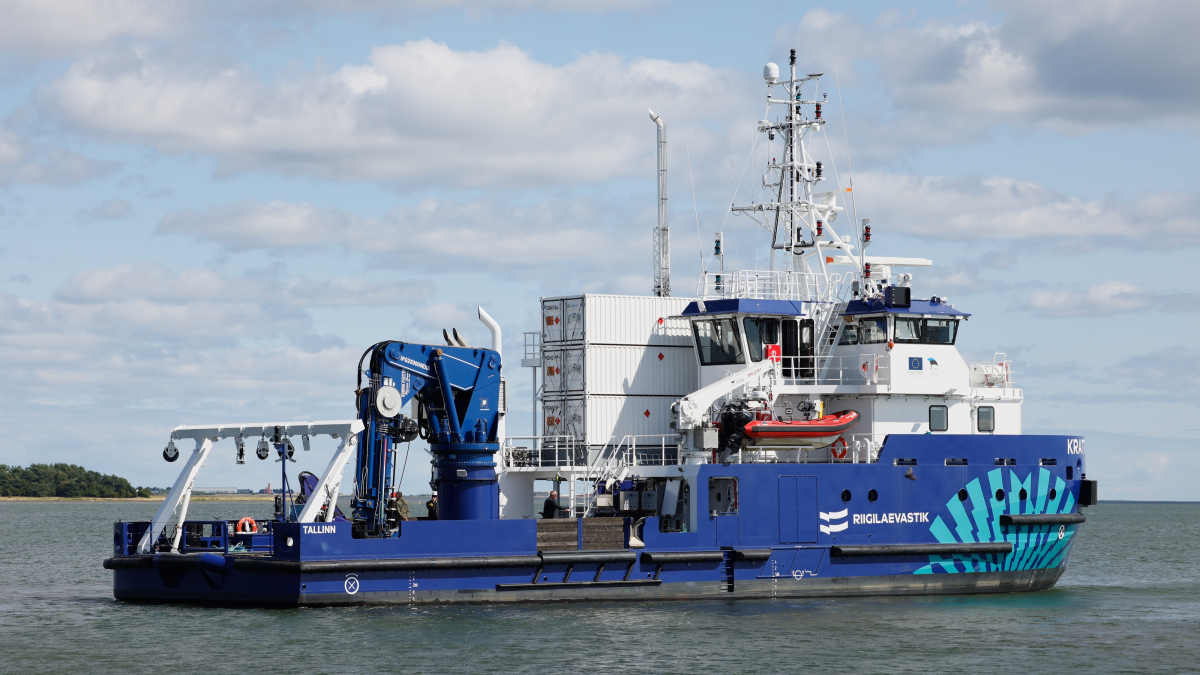
Kratt has a beam of 10 m, an operating draught of 2.5 m, accommodation for six crew members and up to 10 researchers and sufficient fuel storage to operate at sea for up to seven days without replenishing supplies.
It strengthens Estonia’s maritime emergency reaction capabilities as it can cover around 25% of Estonia’s oil pollution response capacity. It has a mobile and portable pollution containment and recovery unit, an off-ship firefighting system, a daughter craft and advanced SAR radar.
For research missions the vessel features sonar, towlines, environmental sensors, a 50 m² wet and dry laboratory, sampling equipment, a seawater flow-through system, offices and utility spaces.
“We needed to develop our fleet intelligently,” said Mr Leis. “One vessel should be able to perform as many different tasks as possible while doing so with a lower environmental impact,” he said.
Researchers on Kratt can undertake water and sediment sampling, seabed hydrographic surveys, and meteorological and biological observations, while the vessel can tow research equipment, deploy remotely operated and autonomous systems and install and recover buoys and seabed stations.
“It is important that state vessels are used as efficiently as possible,” said Estonian State Fleet director general, Andres Laasma.
“Kratt is designed as a genuinely multipurpose platform, allowing us to carry out a wide range of essential tasks with one highly capable vessel,” he said.
“It’s combination of biomethane propulsion, battery-electric operation, research capabilities and heavy-duty deck equipment gives us significantly greater flexibility in organising the state’s maritime tasks,” Mr Laasma added.
Kratt has Ice Class 1C for operating in up to 40 cm of level ice at a speed of at least 2 knots, extending its operations into the northern hemisphere winter months, an A-frame on the aft deck for deploying buoys off the stern, and a deck crane for lifting 15 tonnes at 3 m from the vessel’s side.
“We needed to develop our fleet intelligently”
Baltic Workboats secured the contract to construct this vessel in January 2024 and subcontracted Damen Shipyards to build the ice-resistant hull at its facilities in Gdansk, Poland.
After it was completed and launched in Q4 2025, the hull was transported to Saaremaa, Estonia, where Baltic Workboats completed the vessel’s outfitting, systems integration and construction.
The complete design and construction process took around 30 months and cost €22M (US$25.5M), financed through the European Union’s NextGenerationEU Recovery Fund.
“When building this vessel, it was essential to find a solution that combines high work capacity, versatility and a lower environmental impact,” said Baltic Workboats management board chairman, Margus Vanaselja.
“Combining biomethane and electricity offers strong opportunities to achieve this and makes the vessel unique in its solutions on a global scale,” he said.
Baltic Workboats is also building a semi-autonomous modular SAR vessel with hybrid propulsion for Euroguard, a European Defence-funded project ready for delivery in 2027 or 2028.
This 45-m vessel will be built to support maritime emergencies, surveillance and reconnaissance, mine countermeasures and drone operations. It is funded under a €95M (US$110M) project that includes €65M (US$75M) from the European Defence Fund and €30M (US$35M) from participating countries and industry.
Other Baltic Workboats vessel projects
In May 2026, Baltic Workboats passed a critical design review of the proposed Euroguard vessel at its shipyard in Nasva, Estonia, where it presented progress on constructing the hull and a virtual system demonstration. The project brings together 27 organisations from 10 European countries to strengthen Europe’s defence and industrial co-operation.
In June, a new hydrogen-powered waste collection tanker, built by Baltic Workboats in partnership with BLRT Group, was officially named Rasa at the Port of Klaipėda, Lithuania.
This 42-m vessel can collect waste oil, bilge water and sewage from visiting vessels. It has a 2-MWh energy storage system, two 40-kW hydrogen fuel cells and electric propulsion, enabling it to operate in zero-emissions mode for more than 10 hours continuously. It can store 400 m3 of cargo and thanks to its automation and control systems, it can be operated by a crew of just three people.
Riviera will host TUGTECHNOLOGY ‘27 in Rotterdam, the Netherlands, 19-20 May 2027. Use this link for more information and to register.





Related to this Story

Events

Maritime Regulations Webinar Week
 16 Dec 2025
 GMT - ONLINE

Floating energy: successfully unlocking stranded gas using FLNGs and FSRUs
24 Feb 2026GMT - ONLINE
© 2026 Riviera Maritime Media Ltd.


