


Business Sectors
Business Sectors
Events
Contents

MEPC 84 drafts tighten ballast water compliance checks
Draft BWM Convention amendments point to survey-linked testing and record checks, while wider guidance work is left for later


The documents submitted so far for discussion of the BWM Convention at MEPC 84, to be held from 27 April to 1 May, point to the end of the review stage. Australia’s report of the Correspondence Group on Review of the BWM Convention states that, after eight rounds of input in 2025, “all the objectives relating to the regulations and appendices in the annex to the BWM Convention were concluded”, and the draft amendments are provided in annex 3 “with a view to their approval by the Committee”.
That position — that the Convention-side objectives are complete — is the pivot for MEPC 84. The Committee is being asked to approve a consolidated package of draft regulation and appendix amendments, adopt a revised edition of the G4 guidance, and then re-establish correspondence work for the remaining instruments.
The Committee is invited to approve the draft amendments to the BWM Convention, as set out in annex 3, adopt the revised guidelines (G4) and re-establish the Correspondence Group. The report also indicates that the unresolved ballast water work is now concentrated in the Code for Approval of Ballast Water Management Systems (BWMS Code) — the final four BWMS Code objectives, 29 to 32 — plus a longer tail of guidelines, circulars and guidance documents.
The practical change embedded in the draft Convention text is a stronger inspection-and-testing regime at survey. Under the proposed amendments to regulation E-1, a renewal survey would have to verify that any ballast water management system (BWMS) is properly installed, in good working order and achieves the standard described in regulation D-2, taking into account the guidelines developed by the organisation. Intermediate and annual surveys would similarly ensure the system is properly installed.
These clauses matter and go some way towards addressing the issue raised in EN Decision Ltd consultant owner/director Dr Wei Chen’s analysis of ballast regulation, the critique that rules can approve systems without policing discharges. In the documents before MEPC 84, the Convention amendments do more than tighten documentation. The Correspondence Group’s status table lists, as concluded objectives, a requirement for “a biological efficacy test (sampling and analysis) to be undertaken as part of intermediate and renewal surveys”, and a new requirement for annual sampling of residual active substances. The draft regulation text then translates that intent into survey obligations, including annual sampling of residual active substances.
Simplify Ballast owner Mark Riggio, who is also a member of the Correspondence Group, told Riviera that it was important to reflect what is actually in the package: “The proposed package of amendments at MEPC 84 does include mandatory biological testing (Objective 16).”
He added that it “does include mandatory testing of ballast discharges annually to verify residual active substances (Objective 17).” Those points align with the Correspondence Group’s status table and the draft E-1 annual survey language.
The same draft amendment package hardens the compliance trail around planning, records and oversight of maintenance. The draft amendments to regulation B-1 add requirements for ballast water management plans to identify whether an installed BWMS was type approved under the BWMS Code, approved under the earlier G8 framework, or is being operated under regulation D-4. It also requires the plan to include “high-level information on maintenance procedures and schedules necessary to keep any ballast water management system installed on the ship operating in good working order”, with a reference to the operation, maintenance and safety manual.
A separate draft amendment inserts a new paragraph 2 into regulation B-1 stating that the plan’s information “shall be kept up to date to ensure accuracy”, and that changes to the mandatory provisions “shall be approved by the Administration”, with a required version history reflecting revisions approved by the Administration.
On records, the Correspondence Group completed objective 83 by introducing a BWMS maintenance log template for ships that do not already have an equivalent system acceptable to the Administration. The template text states that “a record is to be kept of any maintenance operation that is undertaken on any ballast water management system installed on the ship”, covering “both planned maintenance and unplanned maintenance or repairs”. The amended annual survey language then ties survey activity to this record trail by requiring confirmation that maintenance has been undertaken “by verifying the Ballast Water Record Book and/or other equivalent maintenance recording system”.
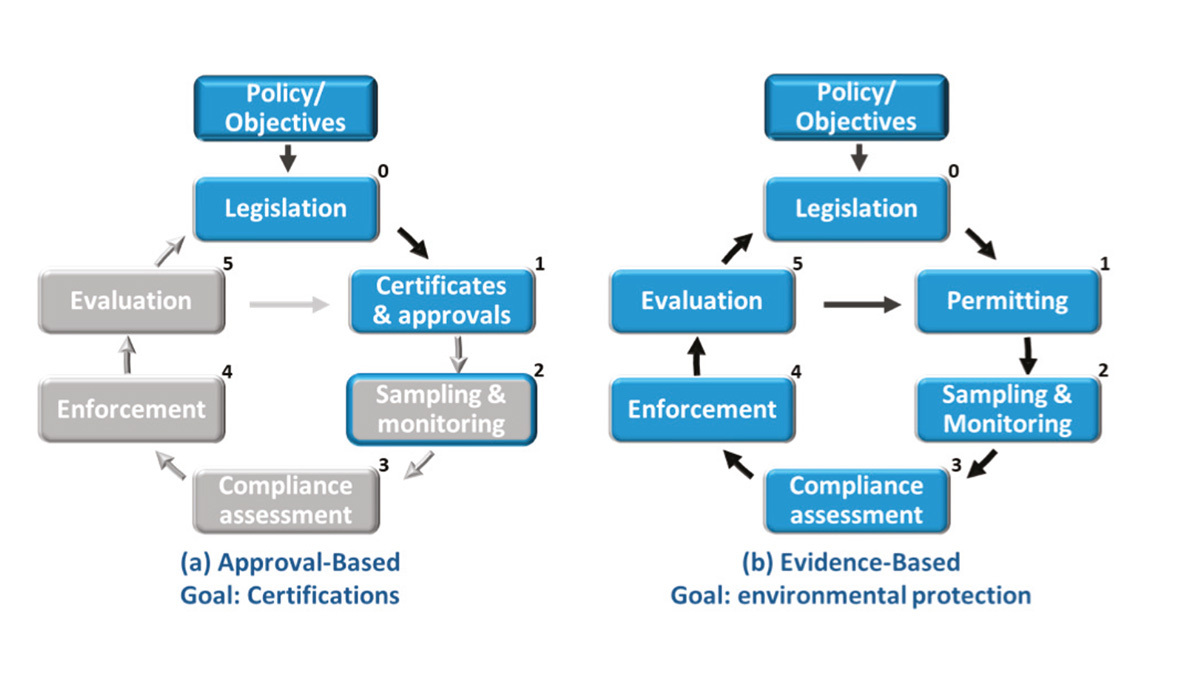
"The unresolved argument is therefore less about whether MEPC 84 introduces compulsory testing — it does, within surveys and annual sampling for residual active substances — and more about how far those mechanisms go towards the end-to-end feedback loop"
For BWMSs using active substances, the draft amendments also add a discharge-side constraint framed as a legal requirement rather than an enforcement preference. The draft inserts a new paragraph 3 into regulation D-2 stating that ships conducting ballast water management under D-2 “shall discharge active substances not exceeding the maximum allowable discharge concentration in accordance with the limit set as part of the type approval” of a relevant BWMS using active substances. That aligns with the Correspondence Group’s description of objective 12, which aims to ensure that in-service ships “regularly discharge effectively neutralized ballast water” for systems using active substances, “in line with the limit set as part of the Final Approval of the BWMS.”
Some might say this is where the “open loop” argument needs more careful calibration in light of the MEPC 84 texts. The package does not introduce routine, port-driven biological sampling of every discharge as a general enforcement model, and the Correspondence Group status table shows that several port state control guideline objectives remain “Not started”. Even so, the Convention amendments do embed mandatory sampling and analysis within the statutory survey system: a biological efficacy test at intermediate and renewal surveys, and annual sampling of residual active substances for systems using active substances. It tightens the loop through flag survey and certification rather than by creating a new, universal discharge policing regime at the quayside.
The distinction becomes clearer when reading how the Correspondence Group treats “onboard sampling” objectives. The report notes that objective 38 “will be considered as part of objectives pertaining to Guidelines (G2) as it relates to onboard sampling.” Mr Riggio stressed that point: “Objective 38 relates to Guideline G2, how to take samples, not that samples need to be taken.” The status table supports that framing, describing objective 38 as a need to create ship-specific guidance “to prevent improper sample collection”.
A second point of contention in earlier drafts was objective 42, which the Correspondence Group describes under G4 as “Create a new requirement for mandatory performance testing at survey and use of CMDs [compliance monitoring devices] for general surveillance”, marked “Not taken forward”.
In the Correspondence Group report, the way forward is not that self-testing is introduced via G4 in this tranche, but that survey-linked testing is anchored in regulation E-1 and related amendments, while wider surveillance and port state control-related measures are parked in the later, not-started work programme for other instruments.
"For ship and fleet managers, the near-term operational impact of the MEPC 84 draft package is concentrated in survey preparedness, record discipline and treatment assurance"
The unresolved argument is therefore less about whether MEPC 84 introduces compulsory testing — it does, within surveys and annual sampling for residual active substances — and more about how far those mechanisms go towards the end-to-end feedback loop that Dr Chen’s article describes. The Correspondence Group itself signals that the post-MEPC 84 workload shifts to guidance instruments, including the sampling guideline (G2) objectives, and port state control guideline objectives that could formalise indicative monitoring and inspection checklists. In parallel, the BWMS Code still carries unfinished work on land-based test water conditions and the proposed endurance test. The report lists consensus issues that “would benefit from in-person discussion”, including how to define the new endurance test and whether biological testing is included in it, noting that objective 30 “is not concluded and will continue after MEPC 84”.
The Global TestNet endurance-testing submission is effectively proposing the environmental technology verification-style testing already used for US Coast Guard type approvals, a comparison that would place the endurance test debate firmly in the type-approval domain rather than discharge enforcement. The Correspondence Group report frames the same issue in procedural terms, advising that the endurance test should be renamed and defined to avoid confusion with non-Convention requirements, while leaving the substantive design choices open for MEPC 84 discussion and later correspondence work.
For ship and fleet managers, the near-term operational impact of the MEPC 84 draft package is concentrated in survey preparedness, record discipline and treatment assurance. The draft survey text makes intermediate and renewal surveys explicitly performance-linked to D-2, and it adds both annual sampling for residual active substances and mandatory verification of maintenance via the Ballast Water Record Book or an equivalent system. The BWMP amendments require a clearer description of the approval basis of installed systems, a defined approach to safe ballast water exchange for partially treated or non-neutralised ballast water, and a structured approach to contingency measures, with Administration-approved version control when mandatory plan provisions change.
What MEPC 84 does not yet deliver, on the evidence of the documents submitted so far, is a complete operational surveillance regime that is independent of survey cycles, uniform across port states, and supported by fully developed sampling and port state control guidance. The Correspondence Group’s own status table shows that those elements sit in the next tranche: G2 sampling guidance is not started, and the port state control guideline objectives, including indicative monitoring and sampling to confirm effective operation, are not started. MEPC 84’s ballast water meeting is therefore best understood as the point at which the Convention review outputs are wrapped into an approvable amendment package, while the detailed “how” of sampling practice and the inspection model migrates to the next round of work on guidelines, circulars and related guidance documents.




Related to this Story



Events

Maritime Regulations Webinar Week
 16 Dec 2025
 GMT - ONLINE
Floating energy: successfully unlocking stranded gas using FLNGs and FSRUs
24 Feb 2026GMT - ONLINE
© 2026 Riviera Maritime Media Ltd.


