


Business Sectors
Business Sectors
Events
Contents
Register to read more articles.
Mobile phone, outdraft current and pilot error cause US$1.3M tow accident
Pilot inexperience and an active mobile phone were factors in the collision of a barge tow and a vane dike on the Ohio River in the USA, resulting in US$1.3M in damage


National Transportation Safety Board (NTSB) investigators discovered the pilot had no experience of navigating on the river and was texting on his personal phone when the accident occurred.
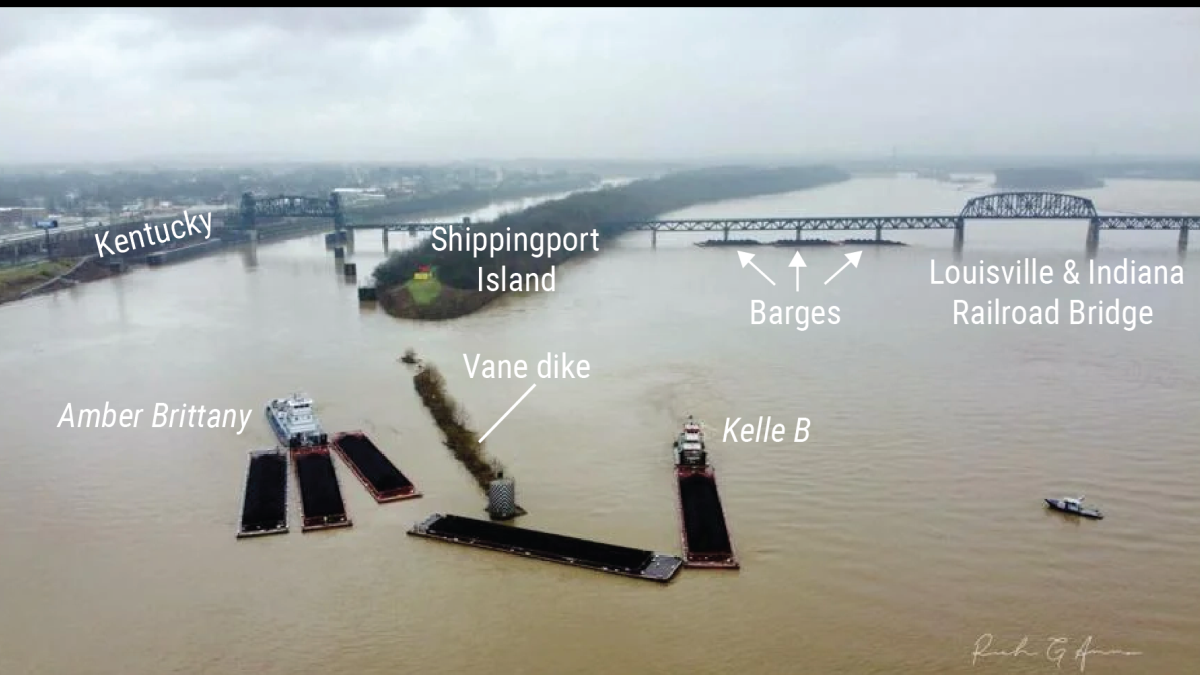
Towing vessel Amber Brittany was transiting the Ohio River on 8 March 2024, pushing 15 barges, when the tow struck the vane dike at the upstream end of the McAlpine Locks in Louisville, Kentucky.
In its accident report, the NTSB highlighted how the pilot on this towing vessel was inexperienced and inattentive to navigational challenges as investigators found a series of outgoing and incoming text messages on the personal mobile phone that coincided with Amber Brittany’s departure from the sailing line.
As the towing vessel made its port turn while passing under the L&I Railroad Bridge, the head of the tow entered the area of the canal where it was impacted by an outdraft current.
The tow broke apart and 10 barges floated down the river, resulting in an estimated US$1.3M in damage to the barges, cargo and dam gates.
“Using cell phones and other wireless electronic devices has been demonstrated to be visually, manually, and cognitively distracting,” said the NTSB in its accident report. “Talking on cell phones can have serious consequences in safety-critical situations, and sending or reading text messages is potentially even more distracting than talking because texting requires visual attention to the display screen of the device,” the safety board said.
“Mariners should avoid using mobile devices, especially while manoeuvring in unfamiliar areas of restricted navigation.”
The NTSB also focused on the contribution of the strong outdraft current at that location on the Ohio River on the tow strike in its accident report. Outdraft currents move across a lock entrance toward a dam, and are strongest when dam gates are almost fully open and river levels are rising.
At this location, these currents pulled the head of the tow to port as the tow proceeded upriver. After becoming aware of this, the pilot attempted to counteract the force of the outdraft, but this was ineffective.
“Lock canal entrances near dams present unique hazards for vessels transiting inland rivers,” the NTSB said in its report. “Fast-moving river water near low-flow canal waters can produce outdraft currents.
“Mariners should thoroughly assess the potential impact of outdraft currents when entering or exiting locking channels. Vessel power and handling should be carefully considered.”
The NTSB said the upstream section of the McAlpine Locks and Dam is uniquely difficult to navigate, even under ideal circumstances.
There have been nine reported incidents in this area involving towing vessels since January 2020, totalling over US$2.7M in property damage. This includes the contact of Queen City tow with the vane dike, which the NTSB investigated in March 2023.


Related to this Story
Events

Maritime Regulations Webinar Week
 16 Dec 2025
 GMT - ONLINE
Floating energy: successfully unlocking stranded gas using FLNGs and FSRUs
24 Feb 2026GMT - ONLINE
© 2026 Riviera Maritime Media Ltd.


