


Business Sectors
Business Sectors
Events
Contents
Alternative fuels could save costs and be green


Although the sunny climes of Barcelona, Spain, provided the backdrop for Interferry’s 36th annual conference, there are still clouds on the horizon for many ferry operators. High fuel prices, stringent regulation and falling passenger numbers have all served to stretch the economic viability of some routes, but could alternative fuels offer an efficient answer to many of these issues?
Chief among the fuel options is LNG, with DNV principal engineer, Torill Grimstad Osberg, telling the conference’s 280 delegates that the price of oil is increasing more sharply than that of LNG. “LNG is also a solution to stricter emission requirements because it contains no sulphur, therefore it produces no sulphur emissions,” she said. “Furthermore, gas is burned in a lean mixture with air, therefore the combustion temperature is much lower. Nitrogen oxide (NOx) only forms at high temperatures in the combustion chamber, so NOx emissions are reduced by 90 per cent. In addition the combustion is very clean. Also, gas has a lower proportion of carbon to hydrogen than oils, allowing a 20-25 per cent reduction in CO2.” There are also no particulate matter emissions.
IMO is developing a mandatory International Code of Safety for Gas-fuelled Ships and Ms Osberg reported that one of the issues currently under discussion is whether LNG tanks can be located safely below deck. She believes this is possible, as long as the ventilation and tank protection conditions are met.
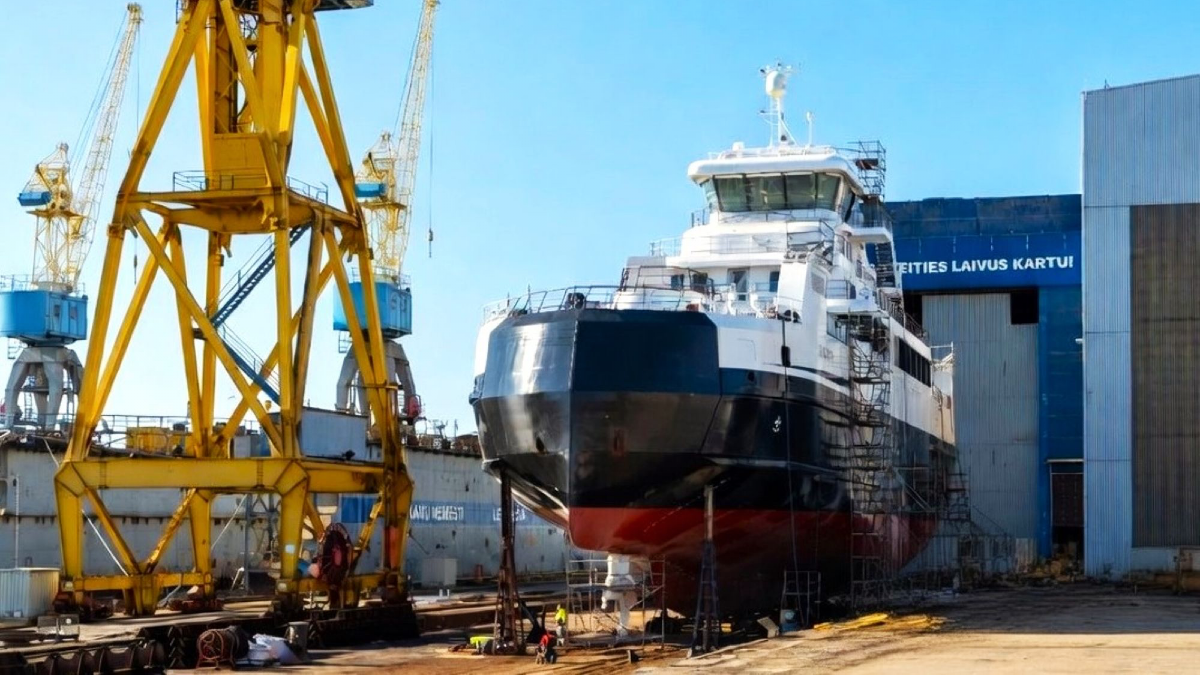
There are 22 LNG-fuelled ships in operation globally, with at least 17 more under construction. Another two ferries which could add to that number are the 170m-long vessels under construction for Norway’s Fjord Line at Bergen Group’s Føsen yard. Ingvald Fardal, the owner’s president and CEO told the conference how these vessels are being prepared for dual fuel operation, retrofitted a year after their deliveries towards the end of next year.
Fjord Line’s route between Bergen, Stavanger and Hirtshals, Denmark, is in the North Sea emissions control area, which could face a 0.1 per cent sulphur emissions cap from 2015. Mr Fardal believes that low sulphur fuel oil will cost significantly more than LNG, and so he will decide in the near future what fuel to operate the newbuilds on. He mentioned that one issue influencing Fjord Line’s decision is whether LNG will be allowed to be bunkered while passengers are on board, as port turnaround time is tight.
In preparation for an LNG installation, the ferries’ design has allowed for a ventilation ‘blow out’ pipe, and space for LNG tanks, an LNG bunkering station and a bunkering pipeline to the tanks. Another challenge is the availability of bunkering for LNG. Mr Fardahl said this would not be a problem for these ferries, as a small scale LNG plant recently began operation in Stavanger. “LNG import terminals and hubs are limited from a European perspective, but the number is growing,” he said. However, he conceded that it will be simpler to use LNG when operating a regular route, but sees potential in LNG bunker barges to broaden to scope of supply.
One solution to the infrastructure issue has been designed by Flensburger Schiffbau-Gesellschaft of Flensburg, Germany. The yard’s vice president of sales, Raimon Strunck, presented a trailerised solution for bunkering and storing LNG on board. Containerised LNG tanks would be used which can be stored onshore for weeks, then driven on board while loaded on a truck, and stored on the deck. “The tanks are not part of the ship structure, so the bunkering rules will not apply to them. This gives owners maximum flexibility as to when to load the LNG,” he said.
Flensburger has calculated that for a return trip of 16 hours per day at a cruising speed of between 20 and 22 knots, plus two hours in each port, each LNG unit would have a range of 150nm. The yard also believes that over five years the cost benefit compared to marine gas oil would be €10 million.
However, Per Stefenson, marine standards advisor for Stena Rederi, pointed out that LNG usage increases methane emissions. Therefore he suggested using methanol, which, as it is liquid, does not require cooling or pressurising. However, it can be toxic, with formaldehyde produced in the exhaust gases. Another alternative proposed by Mr Stefenson was dimethyl ether (DME), which is non-toxic and environmentally benign, but requires pressurised tanks at 5 bar, with limited bunkering options. Mr Stefenson suggested that reforming methanol into DME on board could be the ideal solution.
Elsewhere, Kristian Caroe Lind, partner at OSK-ShipTech, reported on a project to design a new ferry to connect the islands of Strynø and Langeland in Denmark. The ferry was specified to accommodate at least 15 private cars on the 3.5nm journey. OSK-ShipTech calculated that one round trip would use 208.67 kWh. Therefore a conventional solution of two main engines and two auxiliary engines would cost DKK576.79 (€77.47) per round trip, whereas a battery solution would only cost DKK485.03 (€65.14). The batteries could be charged onshore using electricity supplied from Denmark’s many windfarms. Favourable tax breaks also make battery power an appealing alternative for smaller ferries.
For those owners who wish to continue to use heavy fuel oil within emission control areas, equipment manufacturers presented different types of after-treatment solutions. MAN Diesel & Turbo’s upgrade and retrofit project engineer, Marcel Lodder, explained that dry exhaust gas scrubbers will absorb sulphur from exhaust gas using limestone granules of between 2 and 8mm diameter. The sulphur oxides are then reduced into gypsum which can be pumped ashore using a pneumatic transport system. Mr Lodder said there was no impact on exhaust gas temperature and believes that a short payback time offsets the outlay. However the installation would occupy a lot of space on board.
Wärtsilä’s director of environmental services, Leonardo Sonzio, explained that its wet scrubbers use sodium hydroxide to neutralise sulphur oxides in fresh water. The closed loop principle of the system means there is zero discharge in an enclosed area, but results in an approximately 0.1 per cent parasitic increase of fuel consumption. Mr Sonzio emphasised the relatively small size of the scrubber unit and calculated a payback time of 2.3 years for a 30,000gt roro passenger ferry operating in the Baltic Sea.
Regarding regulations, Esa Jokionen, concept and development manager at designer, Deltamarin, pointed out that IMO’s proposed energy efficiency design index (EEDI) in its current form does not fit ferry operations. “Ferries are designed for scheduled traffic and the EEDI is practically a power and, therefore, speed limit,” he said. “If the EEDI principle is to be applied on ropax ferries, drastic modifications are needed to the calculation formula. Speed dependency and a fair definition of capacity must be taken into the formula.” He additionally proposed that ships on dedicated routes should be allowed to demonstrate their energy efficiency in an alternative way.
Ropax ships have been exempted from the first phase of EEDI implementation in 2013, due to the lobbying of Interferry, in particular by its new European representative, Johan Roos, who was Stena Rederi’s director of sustainability. Mr Roos presented to the conference the background to the current sulphur regulations. He said that when IMO originally proposed stringent sulphur emission limits, the lack of knowledge of the consequences meant that no-one initially objected to the figures.
Subsequently, a Finnish government assessment on the impact of a 0.1 per cent sulphur limit in emissions control areas, suggested that it could cost Finnish firms up to US$1.6 billion. Alfons Guinier, secretary general at the European Community Shipowners’ Association told the conference that this could also cause a modal shift to road transport of 10 to 50 per cent. Mr Roos is pushing for the implementation to be postponed to 2020 to enable the ferry industry to comply.
However, the EU continues to support the original timeframe. Jesús Bonet Company, head of maritime safety standards at the EU’s Directorate-General for Mobility and Transport told delegates, “It’s not realistic to think that the EU is going to deviate from the IMO regulations’ objectives. However, we know it is a difficult and expensive challenge, and we need to ensure that any regulations are global.”
Consultant at Videotel, David Dearsley, reminded the conference of the importance of training crew to be able to comply with upcoming regulations, including IMO’s updated Standards of Training, Certification and Watchkeeping and the Maritime Labour Convention. Mr Dearsley believes that tutor-assisted computer-based training is the most effective method. James Douglas, director of Exis Technologies recommended a similar process for shoreside staff to learn how to comply with the International Maritime Dangerous Goods Code. “If people carry out e-learning before they come to the classroom session, it can help to level the field in terms of knowledge,” he said.
Operations in the conference’s host country Spain, as well as the development of new routes in Africa were also discussed. Acciona Trasmediterranea’s strategy director, Carlos Alvarez-Cascos described how his firm is instigating a holistic energy management plan that considers how to save fuel using technical and commercial means, as well as looking at new technologies and fuels going forward. In Egypt, the Alkahera Co for Ferries and Marine Transport has invested in two Austal-built 88m fast ferries, Al Kahera and Al Riyadh, as well as new passenger terminals to inaugurate routes between Duba, Saudi Arabia, and Safaga and Hurghada in Egypt. “We are working hard to increase our market share of 60 per cent on these Red Sea routes,” said the owner’s chairman and CEO, Hussein Gamiel Elharmiel. PST

Related to this Story
Events

Maritime Regulations Webinar Week
 16 Dec 2025
 GMT - ONLINE
Floating energy: successfully unlocking stranded gas using FLNGs and FSRUs
24 Feb 2026GMT - ONLINE
© 2026 Riviera Maritime Media Ltd.


