


Business Sectors
Business Sectors
Events
Contents
Making slicker coatings decisions using an algorithm
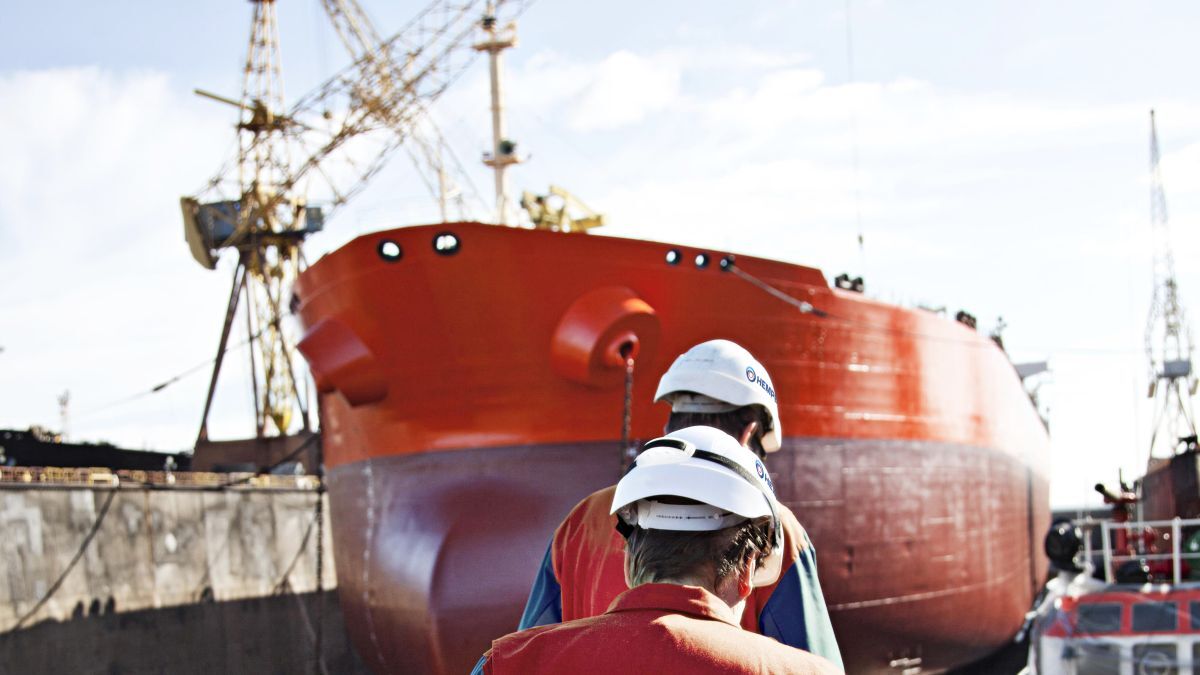
Using high-resolution video footage of a hull shot by an ROV and analysed using an algorithm allows recommendations to be made for the optimum hull coating


Transformational technology has come to the seemingly mundane business of anti-fouling – the perennial bugbear of the shipping industry.
Time consuming, expensive, exceedingly complex but unavoidable, anti-fouling traditionally required divers to be sent down to assess the state of the hull.
Now, help is at hand in the form of digitally controlled devices such as Hempel’s remotely operated vehicles (ROVs) that can be deployed to inspect hulls in as little as two hours, searching for bio-fouling or coating defects. The resulting high-resolution video footage can be analysed in real time by algorithms.
“Our experts use classification systems aligned with international standards, such as those produced by the National Association of Corrosion Engineers (NACE) and the Baltic and International Maritime Council (BIMCO), to make an assessment of the bio-fouling type and coverage over the entire wetted surface of the hull,” Hempel group segment manager for marine drydock Andreas Glud tells Container Shipping & Trade in a briefing.
And the HullSkater, a device with magnetic wheels developed by Jotun and Kongsberg, works its way around the hull removing bacteria and bio-film before they can accumulate to levels that lead to speed loss.
And that is to be avoided at all costs. According to Hempel’s definition, speed loss is all about hydrodynamic inefficiency. “If a vessel’s main engine is set at a specific power output, it will propel the ship at a constant speed through the water.”
But that is before the hull becomes fouled. “The accumulation of fouling will happen over time, increasing drag and decreasing the vessel’s speed in spite of a constant output of power by the main engine. This reduction in speed is termed ‘speed loss’,” Hempel explains.
However, instead of ships trailing around a wide variety of unwanted sea life for months on end, the latest coating technology claims to keep hulls cleaner for longer. And there is a lot of unwanted sea life out there.
Technically speaking, notes Mr Glud, the most common forms of bio-fouling comprise slime (microscopic organisms including bacteria and diatoms); incipient algae (adherent algae at the early stage of its formation of about 5 mm in length); algae (soft biofouling between 3 mm-5 mm in length); long algae (soft biofouling longer than 3 cm); small calcareous (hard biofouling under 5 mm such as barnacles, mussels and tube worms; and large calcareous (hard biofouling bigger than 5 mm including barnacles, mussels and tube worms).
The way these organisms accumulate closely reflects the operational pattern of the vessel, explains Mr Glud. “The intensity of fouling depends on a range of factors including the water temperature, nutrients, light and the vessel speed. Algae growth is very dependent on light and will typically settle on the vertical sides of the ship, closer to the waterline. While barnacles and tubeworms are more likely to attach to any cavities and the flat bottom. A vessel sailing in warm waters with higher levels of nutrients – closer to the shore, sailing at low speeds or even idle – will have faster fouling growth, for example.”

But that is just the sea life – damage to the coating itself and even the hull routinely contributes to slowing a ship. The coating can detach from the hull, for instance. Impacts with hard objects can dent or damage the surface. Coating blisters – dome-shaped projections caused by peeling paint – may form bubbles. Finally, there is “coating polishing off early” – the topcoat letting go before the due date, abrasions and marks left on the hull from brushes or waterjets, and “cracking, flaking or pin-holes”.
According to widely accepted calculations, even a small amount of growth on the hull can boost fuel consumption by up to 2%. More seriously, seaweed can add up to 10% to fuel needs while heavier fouling in the form of shells, barnacles, oysters and mussels can increase fuel consumption by an incredible 40% for a given speed.
The solution, explains Hempel’s expert, depends among other factors on the ship’s trading history. A range of factors are thrown into the pot, including the number of idle days, passage speed and geography, before a course of action is recommended.
The technology has limitations. For instance, an ROV cannot see well in turbid water. “A lack of water clarity makes it more challenging to interpret the video,” explains Mr Glud. “But environmental conditions are always taken into account, and Hempel continuously evaluates different ports and yards to recommend the optimum location for an ROV inspection.”
The fight against fouling is underpinned by the three-year-old ISO 19030 methodology. It is a systematic approach that measures the performance of the hull and propeller on a ship-by-ship basis and provides the basis for a detailed process of maintenance and repair.
Hempel’s SHAPE (Systems for Hull and Propeller Efficiency) has grown out of ISO 19030 and takes the customary monitoring of performance a step further. In a single package, SHAPE crunches the data and taps inhouse expertise to present operators with recommendations for the most effective coating. Even better, claims Hempel, it does so regardless of the type, age and operating profile of the vessel. “We are offering fuel efficiency intelligence,” explains Mr Glud.
While a clean hull saves time and costs, it is increasingly a compliance issue. Authorities in the EU now require detailed performance data about the performance of a vessel in the fight against CO2 emissions. IMO uses the data to analyse fuel consumption. And, as Chevron Shipping hull and coatings engineer Johnny Eliasson told a Riviera Maritime Media webinar, “charterers, banks, insurers and brokers are only some of the other stakeholders who now take an active interest [in ship performance] and they are all pushing for more efficiency and transparency.”
So, a slick hull suits all stakeholders.
Riviera is producing a range of technical and operational webinars and virtual events with the industry’s foremost experts. Sign up to attend on our events page




Related to this Story

Events

Maritime Regulations Webinar Week
 16 Dec 2025
 GMT - ONLINE
Floating energy: successfully unlocking stranded gas using FLNGs and FSRUs
24 Feb 2026GMT - ONLINE
© 2026 Riviera Maritime Media Ltd.


