


Business Sectors
Business Sectors
Events
Contents

Register to read more articles.
‘Unprecedented’ Jones Act waiver creates uncertainty, stifles billions of dollars of investment in US shipbuilding
Jones Act waiver draws ire of critics at Congressional hearings who say the action undermines the revival of US shipbuilding and unnecessarily opens the door to US domestic trades to internationally flagged ships


Congressional subcommittee hearings in early June questioned the reasoning behind the Trump administration’s 150-day waiver of the Jones Act, suggesting it did nothing to lower gasoline prices for consumers and did everything to threaten billions of dollars of investments in America’s shipbuilding industrial base. Critics of the waiver point to a misalignment with the President’s executive order, “Restoring America’s Maritime Dominance,” and the administration’s Maritime Action Plan, which would pump billions of dollars of public and private investment into rebuilding the US fleet, shipbuilding, ports, maritime infrastructure, and workforce training and development.
“The current waiver has created a tremendous amount of uncertainty - now 150 days - which is unprecedented,” said Crowley Maritime vice president, Global Government Relations, Clayton Heil. “To be extended again would be another signal to the investment community and to companies like ours and to mariners that the Jones Act is unstable, and investment will flee,” he said.
Mr Heil noted that the budget request of US$550M for the US Merchant Marine Academy (USMMA) for fiscal year 2027 was “sorely needed” to modernise the long-neglected campus and support the training of seafarers. The request is included in a broader US$2.6Bn funding proposal for the Maritime Administration (MARAD) to revive the American shipbuilding industry.
“But without the Jones Act, we don’t need a Merchant Marine Academy, frankly. It’s hard to see why that investment would be moving forward. The Jones Act supports the jobs from the Merchant Marine Academy - those go into our commercial mariners, into the US military. They’re critical, and the Jones Act is the foundation for all of that. So, when you talk about an extended waiver, it would be extremely damaging to every part of the US maritime industry,” emphasised Mr Heil.
President Trump initially issued a 60-day temporary waiver of the Jones Act on 18 March 2026 to allow internationally flagged vessels to transport oil and gas in the US domestic market, providing relief to consumers from rising gasoline prices in the wake of the Middle East conflict with Iran. He subsequently extended it an additional 90 days to 15 August 2026.
The waiver allows internationally flagged vessels to transport energy and industrial commodities, including oil, natural gas, coal, jet fuel, and fertiliser between US ports – a trade normally reserved for US-flag vessels.
A long-time leader in the Jones Act market, privately held Crowley operates a fleet of more than 200 vessels in the US and internationally, employing thousands of seafarers and workers, investing billions of dollars in ships, fleet decarbonisation, energy, ports, and logistics to support commercial and government transportation services.
Mr Heil made his remarks in response to questioning from Senator Maria Cantwell (Democrat-Washington) on 2 June during the hearing, “The Blue Economy: Advancing American Fisheries, Maritime Strength and Coastal Economies,” held by the US Senate Committee on Commerce, Science and Transportation’s Subcommittee on Coast Guard, Maritime and Fisheries.
In opening the hearing, subcommittee chair Senator Dan Sullivan (Republic-Alaska) said the hearing came “at a critical time as our nation races to strengthen our maritime industries and secure our place in the global blue economy.” While highlighting the importance of protecting the country’s commercial fisheries industry, Mr Sullivan said strengthening the US maritime transportation system was vital to the nation’s economy and national security. “That’s why the administration’s Maritime Action Plan is so important. Strengthening America’s maritime transportation network will require long-term investment, workforce development, and strong public-private partnerships that improve port capacity, modern infrastructure, the port domestic operators, and ensure reliable transportation networks in coastal communities within and across states.”
MARAD not consulted
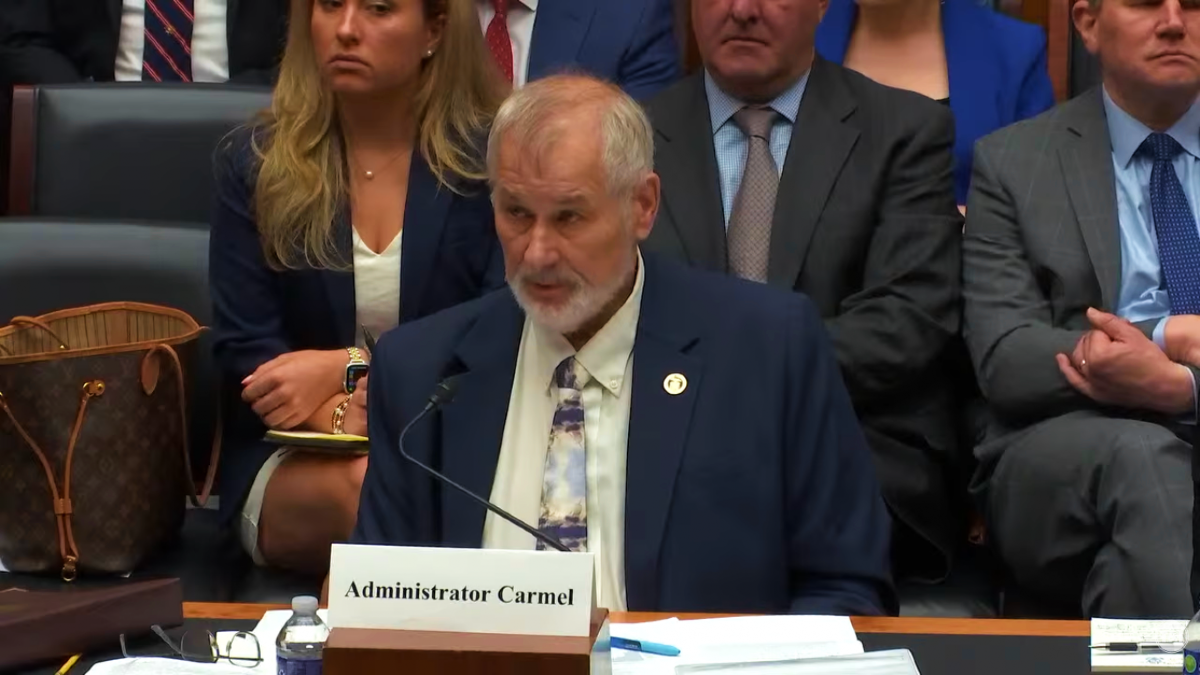
Meanwhile, at a hearing of the House Subcommittee on Coast Guard and Maritime Infrastructure on 3 June, Maritime Administrator Stephen Carmel was grilled about the Jones Act waiver.
Calling the waiver “useless”, Ranking member of the House Committee on Transportation and Infrastructure, US Representative Rick Larsen (Democrat-Washington) said it did not support the administration’s Maritime Action Plan nor the Jones Act, which he called “one of the legs to support US shipbuilding.”
Asked if he agreed with the statement, Mr Carmel said, “The Jones Act waiver was done by the Department of War and Homeland Security, and we were not advised until the end or consulted. But the fact is, it is administration policy, and I support it.”
Mr Larsen responded by calling it “a horrible policy” that had not accomplished the administration’s stated goal of lowering gasoline prices for American consumers. He said the waiver was issued by the administration in the interests of national defence, but that MARAD records showed that several internationally flagged vessels that had been deployed in Jones Act service listed had indicated national security interests as “non-applicable”.
But Mr Carmel once again explained that MARAD was not involved in the waiver process. “The way this works under 501a, we are not involved in that process at all. We are not consulted before a waiver is issued. We are not officially told about it until 10 days after the voyage ends.”
It was a difficult spot for Mr Carmel, a graduate of the USMMA, mariner, shipping executive, and a life-long supporter of the Jones Act and US maritime industry.
Mr Larsen said, “President Trump issued the longest Jones Act waiver in history. We all know it has done nothing to lower gas prices—but what has it done? It has halted investment in U.S. shipbuilding. It’s stolen jobs from American mariners. It’s allowed Chinese state-owned vessels to operate in an unprecedented fashion in US waters.”
Endangering private investment
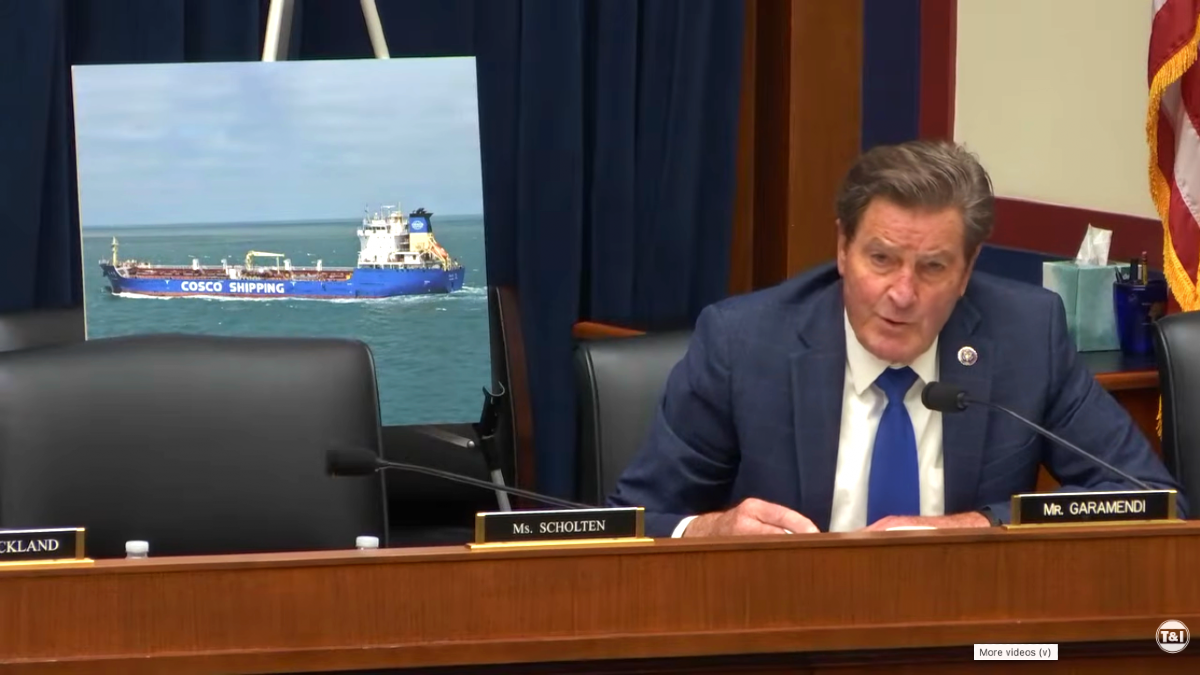
Representative John Garamendi (Democrat-California) pulled no punches when assessing the waiver’s impact. “Waiving the Jones Act has disrupted domestic commercial vessel contracts, prompting shippers to favour foreign-flag vessels,” said Mr Garamendi, pointing to a COSCO Shipping bitumen/asphalt. The Chinese-flagged tanker Jin Zhou Wan sailed from New Orleans, calling at New Haven, Connecticut, on 28 May, carrying a cargo of asphalt under the temporary Jones Act waiver. The voyage was first highlighted in a social media post by the American Maritime Partnership.
“We have some issues with the waiver. It is endangering private investment in shipbuilding, including a planned US$1 billion capital raise. The private sector is closely monitoring whether our government is truly committed to an American-built, crewed, and flagged maritime industry.”
The hearings took place just days before the 106th anniversary of the enactment of the Merchant Marine Act of 1920, popularly known as the Jones Act, which was marked on 5 June. On that day, Representative Salud Carbajal, the ranking Democrat on the Coast Guard and Maritime Transport Subcommittee, sent letters to the international owners that operated vessels under the Jones Act service under the waiver, seeking information about their use of the waiver, compliance with US federal and state law, and the impacts on American maritime jobs and domestic shipping capacity.
“While this Administration may play fast and loose with the law, your requirements under the law are clear. Even when operating under a Jones Act waiver, every vessel that operates in the domestic trades must comply with all other federal and state statutes,” wrote Mr Carbajal.



Related to this Story

Events

Maritime Regulations Webinar Week
 16 Dec 2025
 GMT - ONLINE
Floating energy: successfully unlocking stranded gas using FLNGs and FSRUs
24 Feb 2026GMT - ONLINE
© 2026 Riviera Maritime Media Ltd.


