


Business Sectors
Business Sectors
Events
Contents

Register to read more articles.
US LNG bunkering: gains and gaps
A US Department of Energy policy shift catalyses projects, but vessels, ports and shipyards will need to catch up with growing demand


The US Department of Energy’s (DOE) Order 5233‑A (February 2025) removed a material regulatory brake on approvals and risk allocation for ship-to-ship (STS) LNG bunkering in US waters, by confirming that ship‑to‑ship (STS) LNG bunkering in US waters is not an “export” under the Natural Gas Act; the change has rebalanced risk for developers, although it does not itself deliver barges, tanks or a workforce.
“DOE Order 5233-A confirms STS LNG bunkering is not an export, removing a material brake”
The change is a major driver in the expansion of the US LNG bunkering landscape. Growth remains concentrated in a handful of hubs and constrained by a shortage of dedicated bunker vessels and qualified domestic yard capacity, according to Bridging The LNG Infrastructure Gap: What’s Holding North America Back?, a report issued by the organisers of the LNG Bunkering Summit 2025, North America.
Active US bunkering operations
Jacksonville, Florida (JAX LNG /Eagle LNG). Jacksonville remains the most capable US bunkering hub, serving dual‑fuel container ships via truck‑to‑ship and shore‑to‑ship modes. The operation’s daily bunkering service is presented at about 1,363 m³/day. Supporting assets include Eagle LNG’s Maxville small‑scale plant (processing about 6,246 m³/day) with storage up to about 45,425 m³, and the Talleyrand station offering about 1,893 m³ of bunkering capacity for operators such as Crowley. Together, these figures explain why Jacksonville can support routine cruise and cargo calls with lower logistics friction than at other US ports
Port Fourchon, Louisiana (Harvey Gulf/Shell). Fourchon established the US Gulf’s first STS capability focused on offshore support tonnage. The facility uses vacuum‑insulated tanks of about 379 m³ each and operates across two sites, each with about 1,022 m³ storage and transfer rates up to about 1.893 m³/min. The operator estimates more than 1,000 bunkering operations to date, with marine transfers supported by a 4,000 m³ articulated tug‑barge (ATB) system. Fourchon’s metrics highlight robust operational experience, but also the reliance on ATB rather than self‑propelled bunker ships in the Gulf.

Tacoma, Washington (Puget LNG/PSE). Tacoma functions as a stable West Coast hub for TOTE Maritime Alaska’s Orca‑class vessels, delivering from an on‑port plant with about 946 m³/day liquefaction and about 30,283 m³ storage. There is no dedicated US bunker ship home‑ported here, but the predictable industrial load and integrated plant logistics have created a reliable node for recurring calls.
Port Miami, Florida (Shell/Q‑LNG Transport). Miami performs STS bunkering by barge due to the absence of shoreside LNG tanks. Shell’s chartered Q‑LNG 4000 ATB (4,000 m³) has serviced cargo and cruise tonnage; Seaboard Marine’s Seaboard Blue was first bunkered in March 2023, with subsequent operations including MSC World America ahead of its inaugural season in April 2025. Miami’s model demonstrates that cruise‑led demand can be met via mobile supply, albeit with scalability constrained by barge rotation and berth windows.
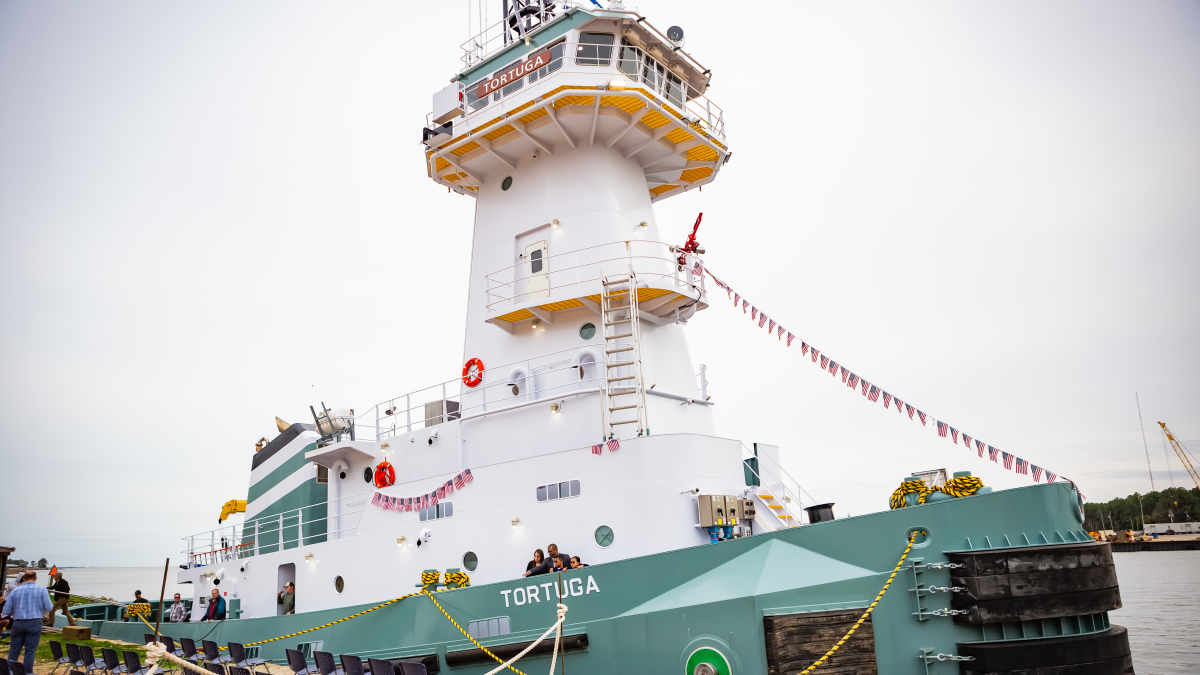
Port Everglades, Florida (Seaside LNG/JAX LNG). Everglades conducts STS deliveries using Seaside LNG’s Clean Everglades ATB (5,500 m³, four 1,375 m³ Type‑C tanks) drawing fuel from the JAX LNG plant. Houston-based Seaside LNG and its maritime transport arm, New Polaris Energy, took delivery in March 2024 of the newbuild ocean tug Tortuga as part of a new LNG bunkering ATB unit.
Built by Alabama shipbuilder Master Boat Builders, the 2,983-kW ocean tug is the power unit for Clean Everglades. Seaside LNG took delivery of Clean Everglades from Fincantieri Bay Shipbuilding, Sturgeon Bay, Wisconsin in October 2023.
The barge completed the port’s first cruise bunkering for Sun Princess in November 2024 and has served LNG‑fuelled cargo calls (for example, Crowley’s Quetzal in April 2025). As with Miami, dependence on a travelling ATB underscores the region’s reliance on Jacksonville’s production base.
On the US West Coast, the only dedicated US LNG bunker ships currently operating are Seaspan Garibaldi and Seaspan Lions, with Seaspan Baker slated to follow. The pair already in service provide a combined about 7,600 m³ and have executed STS operations at Long Beach (December 2024) and Vancouver (March 2025). By contrast, there are no self‑propelled LNG bunker vessels on the US East or Gulf coasts, limiting flexibility and raising time‑and‑place risk where trucking and ATBs remain the fallback.
Proposed and in‑development capacity
Texas City/Galveston, Texas, Galveston LNG Bunker Port (GLBP). Galveston LNG Bunker Port (GLBP) is the first dedicated Gulf Coast bunkering terminal to secure full federal and state construction permits (May 2025). Phase 1 start-up is targeted for late-2027 at 1,363 m³/day, with a Phase 2 expansion to 2,726 m³/day, enabled by two 11,356 m³ storage tanks (total 22,712 m³). The developer set indicates planned integration of e‑LNG supply from 2028, positioning GLBP as both a capacity and compliance platform for trades touching Houston, Galveston and Texas City. The scheme is framed as a Gulf test case for scalable, barge‑served marine fuel with a power-electrified terminal backbone.
Beyond the GLBP development, the LNG bunkering pipeline is thin. Current active nodes are Jacksonville (1,363 m³/day service), Tacoma (946 m³/day), Port Fourchon (about 900 m³/day equivalent), and cruise/cargo STS activity at Miami and Everglades driven by ATB supply; GLBP rises to 2,726 m³/day when Phase 2 completes. The gaps between these nodes are material for liner schedules and seasonal cruise demand, particularly on the Atlantic seaboard and across the central Gulf.
Cautious approach
The DOE’s clarification, that STS LNG bunkering within US territorial waters does not constitute an “export” under the Natural Gas Act, reduced approval friction for STS bunkering, and a broader set of federal initiatives seeks to revive US maritime industrial capacity. Yet the Bridging The LNG Infrastructure Gap: What’s Holding North America Back? report is explicit that port authorities remain cautious about sponsoring or funding permanent LNG bunkering infrastructure, and that new capacity is mainly developer‑led, rather than port‑sponsored. Pre‑2025 ambiguity on export status deterred capital; the policy reset helps, but conversion into financed assets will require multi‑year programmes and credible counterparties for vessels and tanks.
“Outside the US West Coast, the US lacks self-propelled LNG bunker ships and ATBs fill the gap”
Investment faces three structural constraints: vessels; shipyards; and workforce. Outside the US West Coast, the US lacks self‑propelled LNG bunker ships; East and Gulf coasts depend on ATBs and trucking, limiting operational reach. On the shipbuilding front, despite the announcements from the current Administration, the US produces about 0.2% of global cargo tonnage and would require long lead times, licensing and facility upgrades to qualify for LNG‑capable construction at scale; proposed tariffs on imported cryogenic systems add uncertainty. Finally, there is a shortage of about 4,000–5,200 specialised personnel, while an about seven‑year qualification pathway slows the ramp‑up in both yards and operations.
These factors inflate capital expenditure for Jones Act‑compliant bunker units and elongate schedules, even as demand for LNG bunkering capabilities increases.




Related to this Story
Events
Maritime Regulations Webinar Week
 16 Dec 2025
 GMT - ONLINE
Floating energy: successfully unlocking stranded gas using FLNGs and FSRUs
24 Feb 2026GMT - ONLINE
© 2026 Riviera Maritime Media Ltd.


