


Business Sectors
Business Sectors
Events
Contents
Register to read more articles.
Record quarterly crude tanker contracting pushes global orderbook to multi-year high
Tanker newbuilding activity has recorded its strongest quarterly performance on record, pushing the global orderbook to a 17-year high


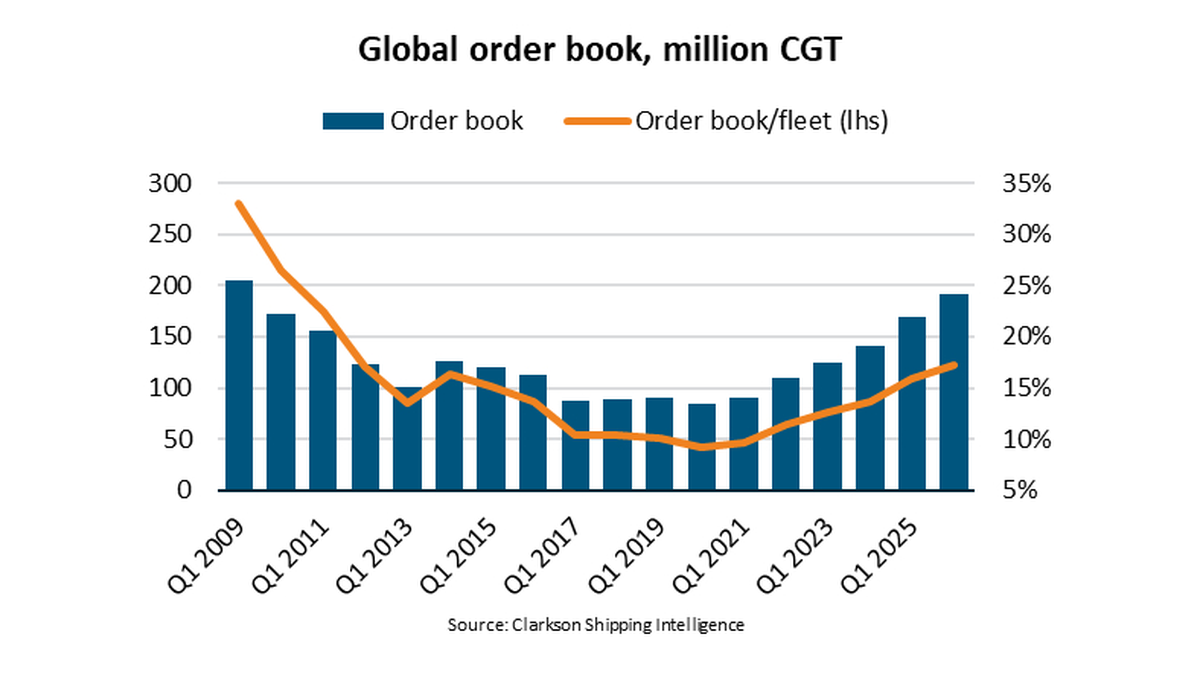
According to BIMCO shipping analysis manager Filipe Gouveia, tonnage under construction reached 191M compensated gross tonnes (CGT) by the end of Q1 2026.
“This is equivalent to 17% of the global fleet, the highest ratio since 2011. The orderbook has been boosted by increased newbuilding contracting throughout the 2020s and, more recently, by the highest quarterly crude tanker contracting in history,” Mr Gouveia said.
The CGT figure reflects a 17-year high in the orderbook, while the ratio to the active fleet points to a 15-year high.
BIMCO data shows that between January and March 2026, newbuilding contracting rose 40% year-on-year to 17.6M CGT, driven by a tripling of tanker orders and a rebound in LNG carrier contracting. Overall, tankers accounted for 32% of total contracting, the highest share since Q2 2017.
Riviera recently reported that new tanker orders in Q1 were primarily concentrated in the VLCC and Suezmax segments, with Greek shipowners playing a key role in driving activity.
“So far in the 2020s, newbuilding contracting has been 47% higher than the average seen during the 2010s, supported by stronger market conditions in the larger segments, a growing global fleet and an increased need for fleet renewal,” Mr Gouveia noted.
This has, in turn, driven up newbuilding prices and extended delivery timelines, with 57% of vessels contracted so far this year scheduled for delivery after 2028.
At the segment level, BIMCO data indicates that the orderbook-to-fleet ratio for crude tankers has risen to 22%, while product tankers stand at 19%.
“These newbuildings are expected to support fleet renewal, as 21% of the crude tanker fleet and 17% of the product tanker fleet are now over 20 years old – the age at which recycling is typically considered,” the analysis said.
In comparison, the container vessel orderbook has reached 37% of the active fleet, while LNG carriers stand even higher at 40%.
“Only 4% of the container fleet and 8% of the LNG fleet are over 25 years old, although these segments are expected to see stronger demand growth,” BIMCO added.
China on top
Chinese shipbuilders continue to dominate global ordering activity. According to BIMCO, they secured 70% of contracts in Q1, while South Korean yards accounted for a further 20%.
BRS Shipbrokers’ annual review highlights the leading players, with China’s Hengli Group recording significant growth and now holding the second-largest global orderbook.
In contrast, Japan continues to lose ground, securing just 1% of new orders – the lowest share since at least 1996 – reflecting capacity constraints, long lead times and declining competitiveness.
According to BRS data, order intake at Japan’s largest builder, Nihon, slowed sharply in 2025, with only 28 vessels contracted compared with 88 in 2024.
Potential downside risks
Mr Gouveia noted that, over the medium term, already elevated orderbooks across several major shipping segments could weigh on future contracting activity.
“Long lead times at shipyards and high newbuilding prices, combined with market uncertainty surrounding Red Sea and Strait of Hormuz sailings, as well as alternative fuel availability, could also negatively impact contracting,” he said.
Riviera’s Tankers 2030 Conference will be held in Singapore, 19-20 November 2026. Use this link for more information and to register for the event.


Related to this Story


Events

Maritime Regulations Webinar Week
 16 Dec 2025
 GMT - ONLINE
Floating energy: successfully unlocking stranded gas using FLNGs and FSRUs
24 Feb 2026GMT - ONLINE
© 2026 Riviera Maritime Media Ltd.


