


Business Sectors
Business Sectors
Events
Contents

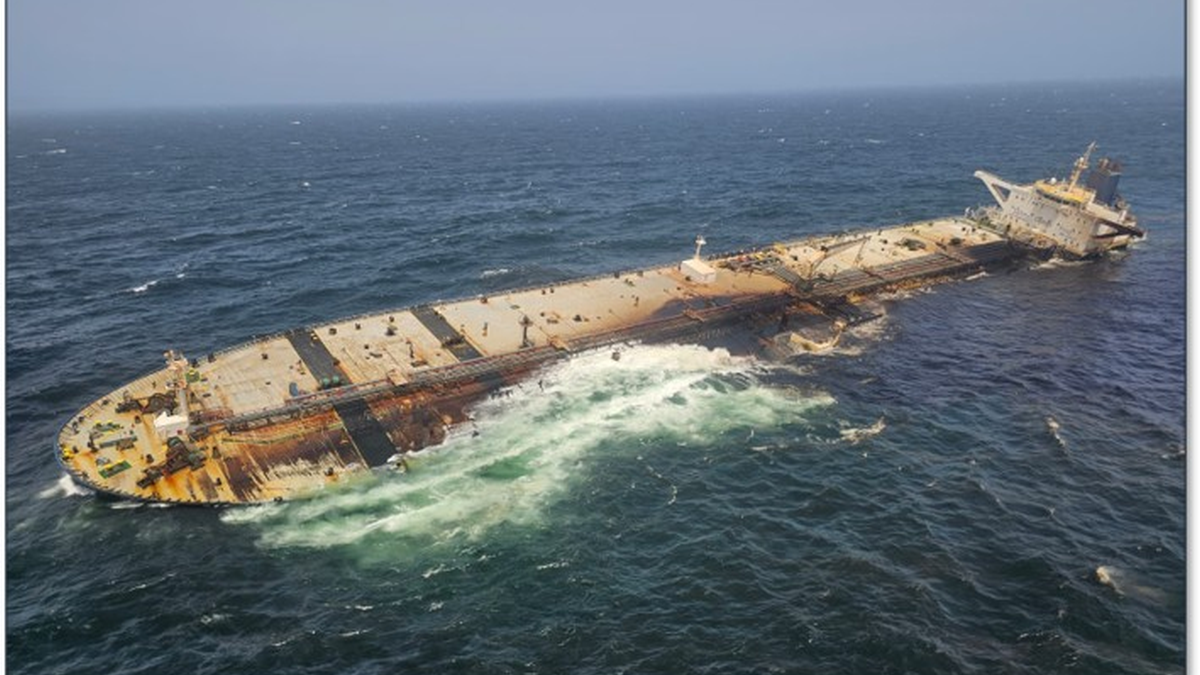
Salvage response begins on grounded tanker spilling crude off Oman two months after attack
A maritime security group Ambrey has been engaged to salvage the damaged tanker, Caroline Bezengi, and has contracted an oil spill response company for support


Emergency response vessels are on their way to salvage a Suezmax tanker grounded off the Omani coast and spilling its cargo of sanctioned crude oil.
Maritime security group Ambrey said it had been engaged in the salvage of the stricken tanker, Caroline Bezengi, and had contracted an international oil spill response company for support.
The international maritime risk and response company said it had mobilised salvage support vessels and specialised personnel to the scene to prevent further environmental damage from the growing oil spill in the Dhofar Governorate.
This 2001-built, 81,085-gt tanker was transporting around 800,000 barrels of crude oil from Russia’s Black Sea port of Novorossiysk when it was reportedly attacked by an explosive device in June.
It subsequently grounded on 30 June in the vicinity of the Hallaniyat Islands, causing an oil spill that covers hundreds of square miles in a protected marine area, according to satellite imagery.
Ambrey said it was working diligently with all relevant stakeholders, including in the Sultanate of Oman as part of the salvage operation.
It has mobilised salvage vessels, aircraft, an experienced team of specialist personnel and over 100 tons of equipment, with the support of the Royal Air Force of Oman (RAFO), to the damaged tanker.
The response is being undertaken during the annual monsoon season, creating a challenging offshore environment, with adverse weather and sea conditions influencing vessel stability, safety, the pace of operations and access to the site, according to Ambrey.
“This is an extremely challenging situation, compounded by adverse weather conditions associated with the Khareef monsoon,” said Ambrey director of global response Ed Wollaston.
“However, we have deployed the leading experts in each aspect of the response and have mobilised the appropriate supporting equipment, aircraft and vessels,” he said.
“We are working around the clock to mitigate the environmental impact of the situation.”
Ambrey is supported by the Omani state, including the Ministry of Transport, Communications and Information Technology, the Environment Authority and the RAFO.
International non-governmental organisation Greenpeace published satellite imagery analysis from its German chapter saying the oil spill from the Russian shadow fleet tanker Caroline Bezengi, “has accelerated and is now estimated to have spread across roughly 600 km2.”
It added that “large stretches of Al Qibliyah Island’s shoreline appear to have been affected, while additional oil slicks extend far out to sea, further polluting and damaging this protected marine ecosystem.”
The 274-m, 159,168 dwt tanker has reportedly been leaking oil since it ran aground in June, following a suspected limpet mine attack that resulted in the flooding of the engineroom.
“Urgent action is needed to contain the spill and prevent further harm to marine life and local livelihoods,” Greenpeace said.
Oman’s Ministry of Transport and Environment Authority said it was handling the incident “to mitigate any impacts on the environment,” saying “specialised technical teams are continuing to monitor developments and implement the necessary procedures in accordance with the approved emergency response plans and competencies, with the aim of reducing any impacts on the marine environment and navigational safety.”
No party has taken responsibility for attacking the vessel. Caroline Bezengi was listed on the automatic identification system as flying the Cameroon flag but was among 39 vessels de-listed from Cameroon’s ship registry in June, according to Reuters.
The ship is subject to sanctions imposed by the European Union, Ukraine, the UK, Canada and Switzerland.





Related to this Story

Events

Maritime Regulations Webinar Week
 16 Dec 2025
 GMT - ONLINE

Floating energy: successfully unlocking stranded gas using FLNGs and FSRUs
24 Feb 2026GMT - ONLINE
© 2026 Riviera Maritime Media Ltd.


