


Business Sectors
Business Sectors
Events
Contents
Register to read more articles.
Svitzer upgrades batteries on hybrid-propulsion tug fleet
AP Moller Holdings subsidiary upgrades hybrid propulsion on four diesel-electric tugboats working at a large Australian LNG export terminal


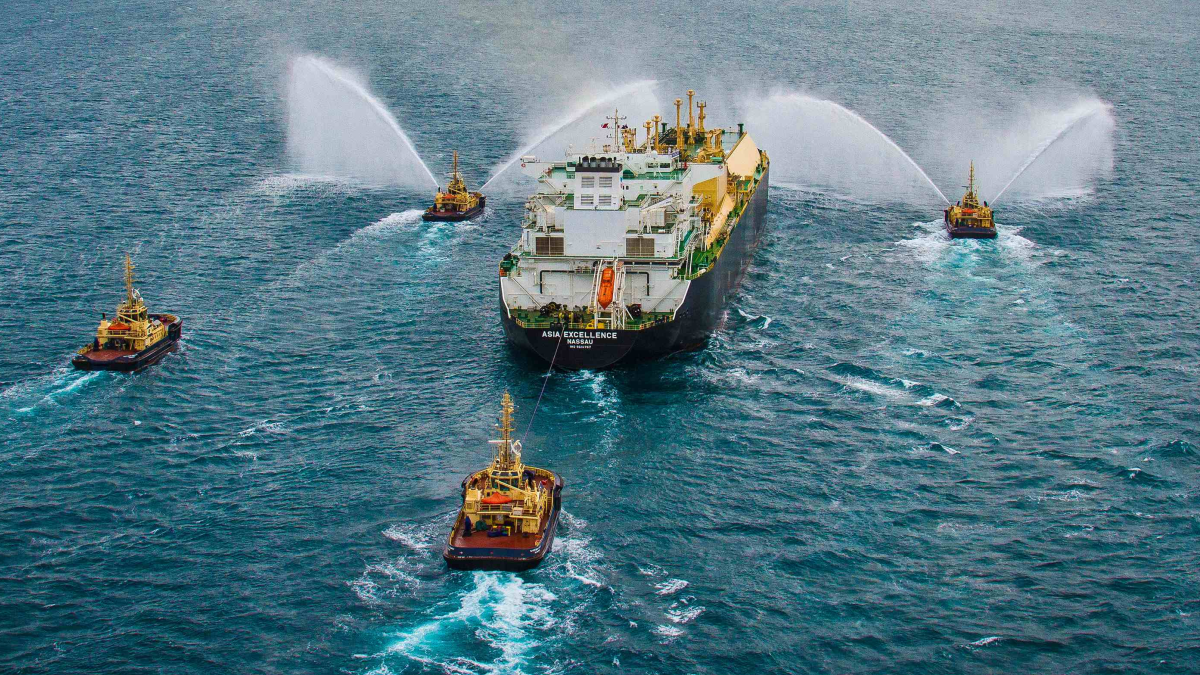
Svitzer has invested in its fleet of escort tugs supporting gas carriers at Chevron’s Gorgon LNG production and export plant in Australia to prolong their life and enhance low-emissions operations.
The AP Moller Holdings subsidiary replaced the batteries on four 33-m azimuth stern-drive tugs to provide higher capacity and faster charging, enabling increased electric propulsion at the terminal in Barrow Island in Western Australia.
These tugs – Svitzer Boodie, Svitzer Dugong, Svitzer Euro and Svitzer Perentie – were built with 80 tonnes of bollard pull and diesel-electric propulsion for the Gorgon terminal in 2012. Their hybrid propulsion systems had batteries that were charged by the two diesel engines and could be used to supplement the diesel power or replace it, cutting carbon emissions and noise.
Svitzer’s hybrid vessels can operate on one engine or purely on battery power while maintaining full steering and manoeuvrability when lower levels of power are required.
These tugs also have electric deck equipment, minimising the risks of oil spillage associated with hydraulic machinery, fuel tanks protected by a double-skin arrangement, solar panels for water heating and a water recycling plant on board.
AYK Energy supplied new batteries that are more powerful, longer lasting and quicker to charge due to their different chemistry.
This battery renewal project involved removing and recycling the old nickel manganese cobalt (NMC) batteries, replacing them with energy storage technology incorporating lithium iron phosphate (LFP), which has greater energy density.
In total, AYK built more than 5 MWh of battery capacity as part of its deal with Svitzer, equating to 1.3 MWh on each tug of energy storage that takes just 1.5 hours to fully recharge.
AYK Energy founder Chris Kruger, who managed the original battery installation for the diesel electric tugs and these retrofits, said battery technology has advanced considerably since 2012.
“It is brilliant to be working on these four Svitzer tugs again, which are real trailblazers as some of the first diesel-electric hybrid tugs ever built,” Mr Kruger said. “The key now is to make them even more effective using the latest battery innovations. These new Aires batteries are not only much more powerful, they are safer, cheaper to buy, easier to install and maintain, and they can run for much longer periods.”
AYK produced these energy storage modules at its automated manufacturing plant in Zhuhai, China.
“NMC has been the most commonly used battery chemistry because of its supposed greater density, but its chemistry is known to be much more dangerous and more costly than LFP,” Mr Kruger said.
“AYK is now showing that LFP can outperform NMC and deliver greater energy density, higher safety and better value. The technology is here, it is proven and it works,” he said.
“Marine batteries can play a fundamental role in decarbonising the maritime industry right here and now. More operators should consider switching to batteries as part of their decarbonisation targets.”
The 28th International Tug & Salvage Convention, Exhibition & Awards will be held in Gothenburg, Sweden, in association with Caterpillar, 19-21 May 2026. Use this link for more details of this industry event and the associated social and networking opportunities.
Related to this Story

Events

Maritime Regulations Webinar Week
 16 Dec 2025
 GMT - ONLINE
Floating energy: successfully unlocking stranded gas using FLNGs and FSRUs
24 Feb 2026GMT - ONLINE
© 2026 Riviera Maritime Media Ltd.


