


Business Sectors
Business Sectors
Events
Contents
Register to read more articles.
Turning up the volume on underwater-radiated noise
Research has improved simulating and measuring underwater-radiated noise (URN) and paved the way for predictive analysis, writes ABS HETC,St John’s, Newfoundland and Labrador principal engineer Dan Oldford and senior engineer Ed Moakler


The issue of URN from ships and its impact on marine life has been on the maritime industry agenda for many years, though it has rarely achieved a high profile.
URN is not just a problem confined to communication between mammals and fish. It has potentially negative impacts on all types of marine life, including coastal communities that rely upon healthy oceans for their subsistence and livelihoods.
While ports can impose speed limits to mitigate the problem, reducing power by itself may not deliver the quieter seas that are needed in remote and sensitive sea areas.
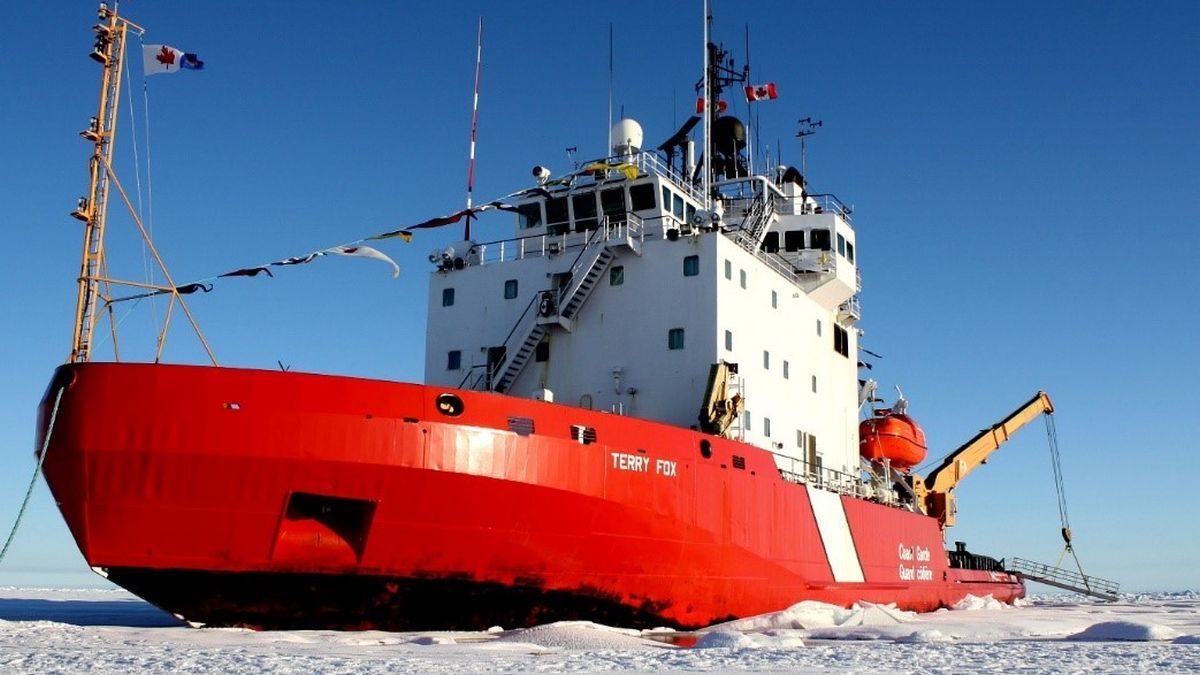
To understand the issue in more detail – and be able to predict it with greater accuracy – the ABS Harsh Environment Technology Center (HETC) located in St. John’s, Newfoundland and Labrador partnered with Memorial University of Newfoundland (Memorial) and eSonar, to research and develop predictive models for the URN generated by icebreaker CCGS Terry Fox.
The research proved successful in accurately measuring and understanding the URN created by CCGS Terry Fox and developed a prototype for a means of reporting the generated URN, that can be used by the master to make changes to the ship’s operational profile in real time when in sensitive locations.
Looking ahead, the researchers believe the same principles can be applied to assessing URN from plan drawings, enabling designers and builders to model and predict the noise created by ships before steel is cut and propellers manufactured.
URN impacts
The main culprits for URN on ships are cavitation caused by propellers, large ship machinery that causes vibration via the seats and mounts, the noise generated from the movement of the ship through water and other structural noise from ship loading.
There have been many studies showing the link between URN and disruptions across the entire marine environment, but it is particularly detrimental to marine mammals and fauna.
For marine mammals, the frequency of the ship noise is in the range of their communications and when loud enough, causes permanent damage internally to both animals and fauna. Seismic activity and sonar are especially harmful.
To date, IMO has produced only guidelines on URN and the EU directive, though some ports are being proactive. For example, the port of Vancouver has asked vessels to reduce speeds and avoid certain areas where marine mammals have been reported, which has led to approximately 90% of all ships voluntarily complying with the request. The Port of Vancouver also has the EcoAction programme, which reduces fees for vessels that have a quiet vessel notation, such as the ABS UWN or UWN+ notations.
The best way to combat the problem is to improve understanding of the various sources of URN, develop models to evaluate it and then create solutions to reduce vessel URN with minimal commercial impact.
Transport Canada’s Quiet Vessel Initiative was developed and launched in 2019 to research and test the most promising, safe and efficient quiet-vessel designs, retrofits and operational practices. ABS and Memorial established a partnership – the HETC – in 2009, researching many different topics with a focus on ice and cold climate operations.
Having already committed significant resources to the topic of URN, including guidance on underwater and airborne noise, ABS partnered with high-fidelity marine and subsea environmental data technology company eSonar to evaluate URN in more detail.
This project was divided into three stages. The first was a large set of simulation work, the second was field experiments and third, the initial development and prototyping of a commercially available URN measurement system.
A major source of URN is structural vibration due to the operation of the vessel. For this project, The Canadian Coast Guard (CCG) provided the heavy icebreaker CCGS Terry Fox. The ship’s significant vibration and noise is generated by its two controllable pitch propellers, ice repeatedly impacting the side of the vessel, or slamming in harsh seas.
ABS has previously performed numerous different assessments and simulations for CCGS Terry Fox and was thus able to leverage highly accurate 3D and finite element models.
The ship also presented a timely opportunity as it had a scheduled refit where its propellers, engines and gear boxes would be upgraded, and hull and propulsion system renovated.
Performing the URN measurements and condition assessment ahead of the drydock provided a baseline before the refit. Through other research projects, the goal is to perform another set of comprehensive URN measurements, allowing the researchers to try and quantify the effect of modern propulsion machinery compared with older technology.
The noise generated from icebreaking is not well studied and with the vessel already having the technology installed, there is potential to do another measurement campaign during the next icebreaking season.
There were some significant challenges to the process when measuring URN from an icebreaker, due to its design. Icebreakers have hull forms which have a shape optimised for icebreaking. This consequently makes their hydrodynamic performance significantly worse than open ocean ships. Due to the decrease in hydrodynamic performance, more noise is generated. There is very little URN data for icebreakers and before this project, it was not clear if the current mathematical models would be appropriate for an icebreaking hull form.
CCGS Terry Fox has twin screw controllable pitch propellers, while most cargo ships are fixed pitch single screws. Being able to control the pitch allows the master to run at a constant power and better control the speed of the vessel. For icebreaking operations, this is ideal as it reduces the likelihood of becoming stuck in the ice as the vessel is already operating at high power.
Open water ships generally have fixed pitch propellers, and thus must reduce their power to slow down. Due to operating at higher power and controlling the speed with the propeller pitch, icebreakers generally produce more noise. To date, very little research has been done to measure icebreaker URN. This research project set out to prove that the current state of the art could be used to model this complex, powerful vessel, proving to the wider maritime community that accurate prediction can be achieved.
The project sought to prove empirical testing methods so that they could be better tuned and utilised during all phases of the design stage to reduce URN. As such, ABS performed three distinct levels of simulation and calculation, ranging from empirical tools alone (low fidelity) up to fully coupled computational fluid dynamics (CFD) (high fidelity).
Low-fidelity testing employed ABS PropNoise, an inhouse tool that uses semi-empirical formulas to predict ship-induced URN including the influence of propeller cavitation utilising four noise prediction models.
Key inputs include the number of propellers and number of blades, propeller diameter, revolution rate and disc area. Shaft submergence depth and other parameters including ship speed, displacement, block coefficient as well as cavitation-related parameters such as the cavitation swept area and the propeller revolution rate at cavitation inception are considered.
Two tools were used for the medium fidelity measurements. ABS utilised its membership of the Cooperative Research Ships (CRS) group and leveraged its empirical cavitating tip vortex tool which was used to determine the URN due to tip vortex cavitation. ABS also used the CRS dynamic bubbles tool to predict and analyse broadband cavitation noises due to the sheet cavitation off the propeller blades. A further tool, PROCAL, was used to predict the unsteady sheet cavitation on propeller blades operating in a ship wake, which could also result in hull-pressure fluctuations.
Although there is more than one computational fluid dynamic acoustic method to determine a vessel’s hydroacoustic signature, they all require significant amounts of computing power.
To achieve a high-fidelity method, the project team opted for a hybrid approach, where CFD was used to generate the input data for the hydroacoustic model and a separate simulation performed to determine the URN.
From the CFD simulations, the research team were able to extract the fluid flow around the hull and the propeller, see the fluid being accelerated across the propeller plane and extract the cavities on the blades.
The cavitation pattern was very similar to the medium-fidelity analysis, capturing the tip cavitation and the cavity near the blade root which validated the medium-fidelity model and gave confidence in the high-fidelity CFD flow results.
Taking measurements
The research team performed field measurements using a GPS-enabled stabilised surface buoy and three hydrophones connected in series at known distances. The team also used a conductivity, temperature and depth instrument to better calibrate the measured data.
On board the ship, the team used accelerometers on the diesel engine foundation of engine number four, and on the foundation of genset number one to measure the structure-borne noise measurements. Similarly, accelerometers were placed in the double bottom, in way of the propellers to try and isolate the noise generated by the propellers.
The tests were performed in Conception Bay, during a rare calm down off the coast of Newfoundland. The team performed a series of tests at varying speeds, measuring the URN via the hydrophones in the water column and accelerometer data on the engine and generator sets. The testing was done in accordance with the ABS Guide for Underwater Noise and External Airborne Noise.
The research team compared the measured URN with those predicted by the three levels of calculation and simulation. Overall, there was very good agreement, especially with the medium and high-fidelity simulations, with the lower semi-empirical method proving to be a ’ceiling’ type tool that can be used in the early design stages for predicting URN.
Practical application
Through the technology partner eSonar, an initial design and prototype of an all-in-one commercially available and affordable URN measurement system was developed.
The system developed under this project comprised an eight-channel analogue to digital wideband receiver, with a processor that has built-in machine-learning capability. The system is energised via power-over-Ethernet, making it incredible easy to integrate with existing systems, and allowing it to share its data in real time via the Ethernet connection to a remote signal processing, analysis and display system.
The accelerometers employed are piezoelectric shear type, which are small and easily mounted in multiple locations. There are several ways to attach the sensors, and the adopted approach proved that simply cleaning the surface and using a high-quality cyanoacrylate adhesive is more than sufficient for the frequencies being measured.
eSonar, supported by Memorial, is developing the display, calibration, signal processing and analysis applications required, making this an emerging off-the-shelf solution.
Moving forward
The project group achieved its goals, but how can other researchers and companies leverage it to help vessels reduce their URN?
Completing the off-the-shelf URN measurement system will make these systems more accessible and through further research projects, allow for commercial vessels to have these systems installed, providing the master with operational information to allow them to reduce their noise output. The more systems that become available and installed will increase the amount of available URN data, allowing for further refinement of mathematical models and prediction processes.
In addition to providing an accurate assessment of the URN generated by CCGS Terry Fox, the project demonstrated that in future it will be possible to take plan drawings or a 3D digital ship model and predict with accuracy the URN it will produce. The ability to accurately predict URN on more complex vessel designs will contribute to a wider reduction of this form of marine pollution.
As an industry, shipping has developed numerous successful solutions for pollution prevention and mitigation as well as carbon reduction. When it comes to other types of pollution such as noise and light, there is more work to be done.
By better understanding the behaviour of URN we will be able to predict and prevent it, making a meaningful and lasting contribution to a more sustainable shipping industry.
Sign up for Riviera’s series of technical and operational webinars and conferences:
- Register to attend by visiting our events page.
- Watch recordings from all of our webinars in the webinar library.
Related to this Story


Events

Maritime Regulations Webinar Week
 16 Dec 2025
 GMT - ONLINE
Floating energy: successfully unlocking stranded gas using FLNGs and FSRUs
24 Feb 2026GMT - ONLINE
© 2026 Riviera Maritime Media Ltd.


