


Business Sectors
Business Sectors
Events
Contents
Register to read more articles.
First zero-emissions, all-electric tug readied for Singapore
The 50-tonne bollard e-tug Eon has been named in ceremonies at the shipyard, marking a milestone for the port and southeast Asia


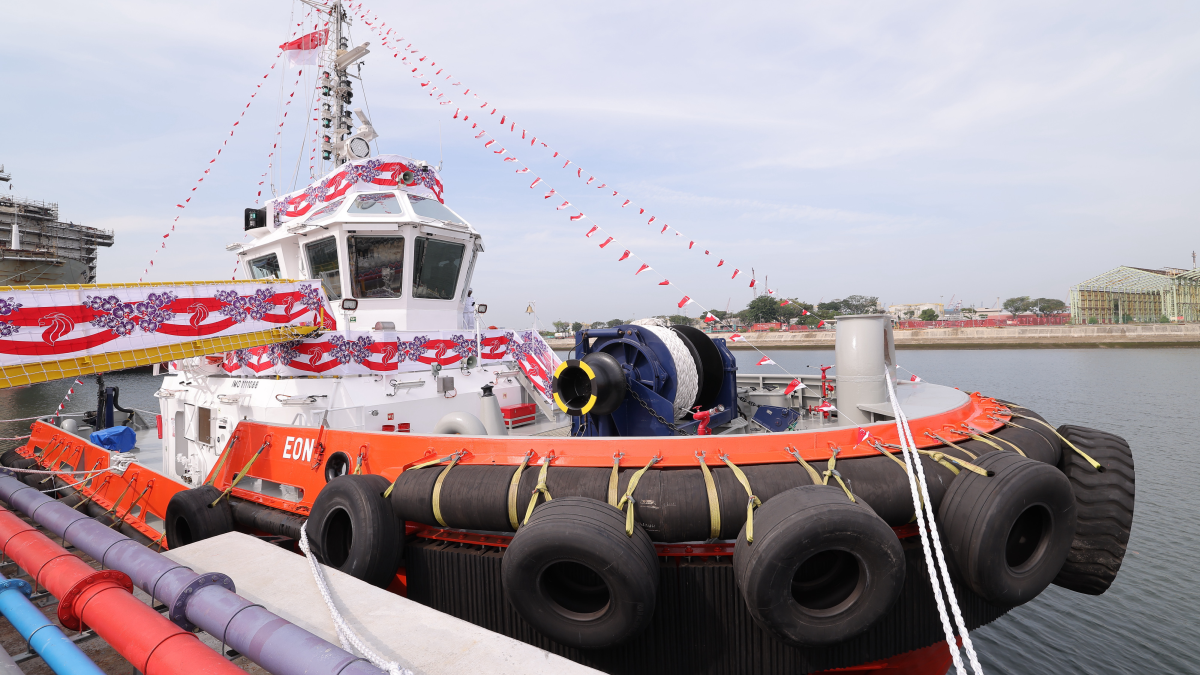
Singapore’s newest zero-emissions vessel and one of the first of its kind in southeast Asia, the all-electric harbour tug, Eon, was named in ceremonies by the Coastal Sustainability Alliance (CSA) on 23 February. Led by Kuok Maritime Group (KMG), CSA is an industry collaborative aimed at reducing CO2 and greenhouse gas emissions.
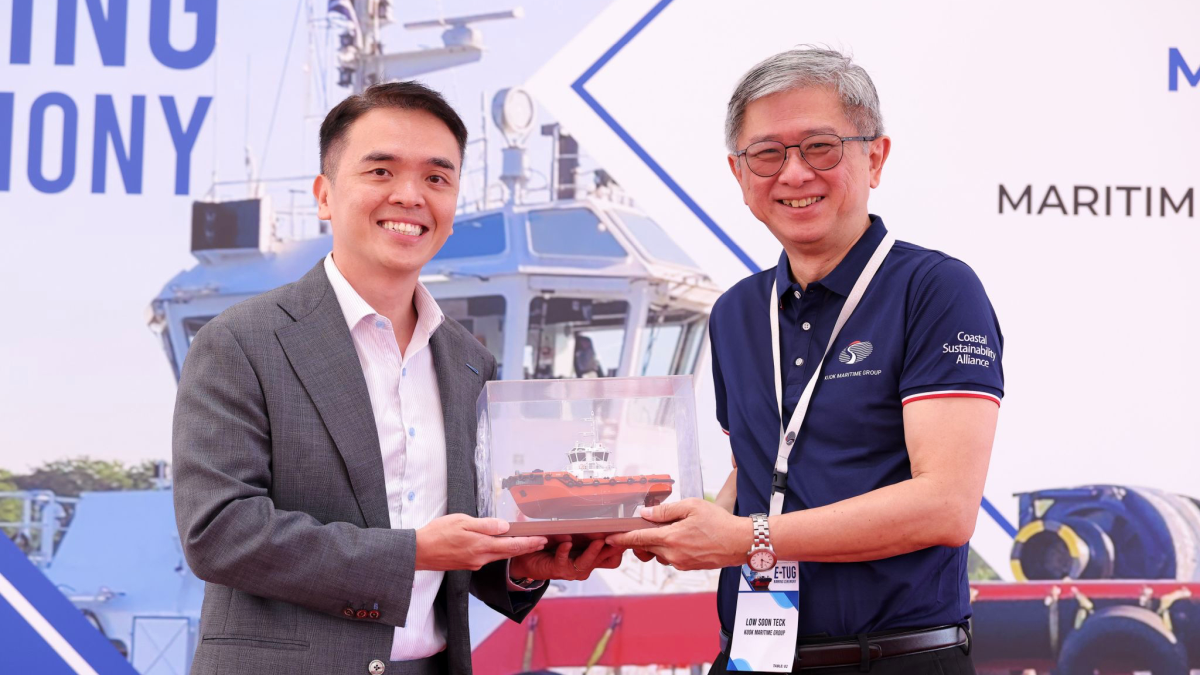
Ashlynn Loo served as the vessel’s godmother during ceremonies at PaxOcean’s new shipyard at 5 Jalan Samulun in Singapore. Among the dignitaries on hand was Maritime and Port Authority of Singapore (MPA) chief executive, Ang Wee Keong, who called the 50-tonne bollard pull tug “a significant milestone in Singapore’s maritime decarbonisation journey.”
MPA is requiring all new harbour craft to be fully electric, capable of using B100 biofuels, or be compatible with net-zero fuels by 2030. There are currently about 1,600 diesel-powered harbour craft operating in the city-state’s port.
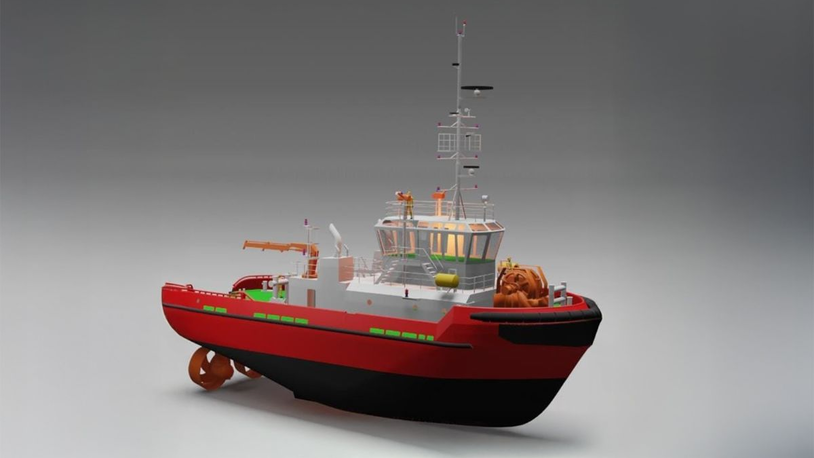
Eon is the first e-tug designed to operate in Singapore’s port waters, and its construction was supported by MPA’s Maritime Innovation and Technology (MINT) fund. Built to Bureau Veritas class and register in Singapore, the 29-m tug has a bollard pull of 50 tonnes and accommodation for up to 10 crew. It is powered by two 1,500-kW fixed-pitch azimuth thrusters, combining high manoeuvrability with zero-emissions operations.
The keel for the tug was laid on 5 February 2025, the same day the alliance launched its first fully electric supply boat, Voltai. Built to Bureau Veritas and RINA dual class, the 26-m e-supply boat has the capacity to carry 40 tonnes of cargo and “can achieve 60% energy savings over a conventional lighter vessel making multiple trips, providing significant cost and carbon emissions reductions for the industry.” Voltai has two 500-kWh lithium iron phosphate (LFP) batteries, allowing it to operate with zero emissions on its ‘milk run’ deliveries to ships.
In the case of Eon, however, the KMG-led CSA chose to equip the e-tug with a 3-MWh lithium-titanate oxide (LTO) battery system. The change in battery chemistry was driven by the vessel’s operational profile. “Our electric fleet adopts different battery chemistries based on operational needs,” said a CSA spokesperson. “While lithium iron phosphate batteries are widely recognised for their strong safety and reliability record, lithium titanate batteries offer enhanced thermal stability and ultra-fast charging for high-duty applications, such as etugs,” added the CSA spokesperson. Additionally, LTO battery technology is projected to have a long operational service life of 20 years.
Safety is also a strong consideration, pointed out CSA: “We deploy industry-proven LFP battery systems where they are best suited and select LTO technology for applications that demand higher thermal margins and rapid charge capability, ensuring safe and reliable operations in every use case.”
ABB supplied and integrated the battery module, onboard DC grid and PEMS power and energy management system to optimise the use of the onboard energy and to support wide variations in power demand, including instant high torque.
“We believe this project will provide a blueprint for further electrification throughout Asia”
ABB’s Marine & Ports division’s business line manager in Singapore, Olli Tuunainen, explained the importance of the project in reducing emissions from harbour operations.
“Tugs are among the industry’s leading candidates for full electrification given their operational profile, relative proximity to charging infrastructure, and the operational benefits they derive from an electric drivetrain, including instant power and enhanced crew comfort.
“We believe this project will provide a blueprint for further electrification in Singapore and throughout Asia,” concluded Mr Tuunainen.
Future readiness
CSA also considered “future-readiness” in the etug’s design, allowing the vessel’s energy storage capacity to be upgraded. Additionally, the vessel’s architecture supports hybrid configurations that can incorporate ammonia, hydrogen, or methanol fuel cells as these technologies mature.
Eon is engineered to deliver instant high torque during towing, with sufficient battery capacity to complete two or more berthing and unberthing operations on a single charge. This is expected to allow shipowners and port users to reduce their Scope 3 emissions by at least 30% per operation, supporting their internal emissions-reduction targets while maintaining high operational performance.
“This vessel is not just a first for southeast Asia; she is a clear demonstration that zero-emission harbour operations are viable today,” noted KMG managing director and chief executive, Low Soon Teck.
“From her launch to her naming today, Eon represents the successful culmination of a shared vision. It demonstrates Singapore’s capability for high-value, innovative shipbuilding and sets a new benchmark for sustainable vessel construction in the region,” said PaxOcean Group managing director and chief executive, Tan Thai Yong.
Electric vessel challenges
While electric vessels equipped with batteries have higher initial capex compared to conventional diesel-powered vessels, CSA said it designed the e-tug for lower opex, as “electric propulsion eliminates the need for major overhauls, fuel refills, and regular engine maintenance”.
The alliance said it studied the operational profile of the intended tug and “rightsized” the battery system to meet the operational requirements. “The e-tug has a large enough battery capacity designed to cater to varying power demands, able to deliver high power when needed, including instant high torque during towing operations. It is designed to complete two or more berthing and unberthing jobs on a single charge,” said CSA.
But operators are hesitant to switch from diesel propulsion to electrically-powered vessels because of range, charging times, and operational viability concerns.
To address those concerns and drive confidence in the technology, CSA said it is actively working with fleet operators “to conduct real-world trials demonstrating performance, cost savings and ease of maintenance of electric vessels.”
Training
CSA’s technical team worked with the shipyard and the OEM to develop a training outline for the core machinery and systems. “Crew will not only be trained in theory, but also receive practical hands-on training covering operational procedures, maintenance and inspection, troubleshooting and emergency response,” said CSA.
“With the delivery of both the fully electric tug and electric supply boat, the KMG CSA will move beyond theory to demonstrate the vessels’ operational visibility in Singapore waters,” it concluded.


Related to this Story

Events

Maritime Regulations Webinar Week
 16 Dec 2025
 GMT - ONLINE
Floating energy: successfully unlocking stranded gas using FLNGs and FSRUs
24 Feb 2026GMT - ONLINE
© 2026 Riviera Maritime Media Ltd.


