


Business Sectors
Business Sectors
Events
Contents

Register to read more articles.

UK offshore rig supply dwindles as market hits ‘critical juncture’
Policy remains the great unanswered question looming over future investment, says Westwood Global Energy Group, RigLogix director, Teresa Wilkie


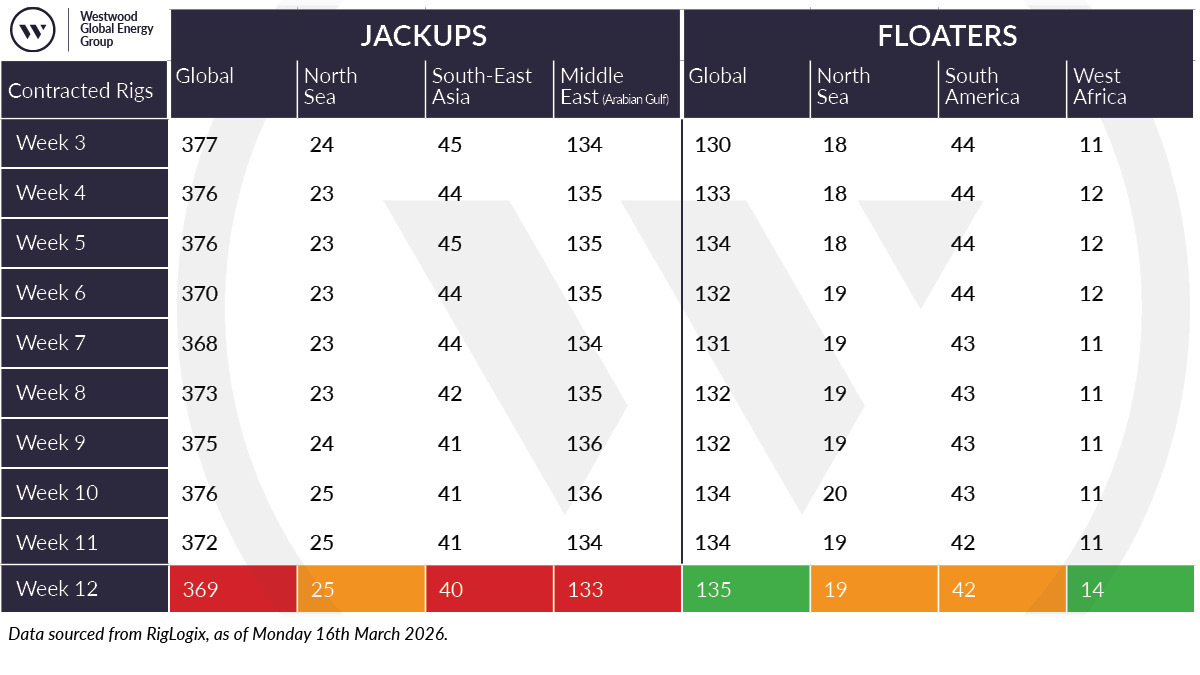
As of mid-March 2026, there was a slight increase in both the global working floating rig (drillship and semisubmersible) and jack-up rig counts when compared with mid-February. For floaters, this was a four-rig increase and for jack-ups, this was a one-rig increase. Global utilisation for jack-ups is currently 85% – a five-percentage point decrease versus a year ago, while floating rig utilisation is at 88%, which is unchanged versus the same period in 2025.
A leaner UK fleet
Today, the UK Continental Shelf hosts just seven semisubmersibles and 14 jack-ups – a combined fleet of 21 units, including those stacked. Every semi currently has work in hand or firm commitments ahead, with one expected to depart for the Falkland Islands later this year. In the jack-up arena, one sits cold stacked, one is ready stacked, and the remaining 12 are either actively working or awaiting near-term deployment.
For anyone who remembers the market a decade ago, the contrast is stark. In March 2016, the UK boasted a formidable 40-rig harsh-environment fleet (22 semis and 18 jack-ups). In the years since, the floating fleet has been hit hardest, collapsing by a staggering 68%. Many 2nd-4th generation semis spent years idle before being retired entirely – a slow fadeout after long periods awaiting work that never came. Others managed to secure second lives abroad, relocating to more promising provinces.
Demand dries up, policy pressures mount
The decline isn’t just about ageing hardware – it’s rooted in dwindling demand. Plug and abandonment programmes have slipped down schedules, while exploration and development drilling continues to retreat. And layered over all of this is a policy environment that has proven deeply challenging for operators.
The Energy Profits Levy (EPL) – setting a headline tax rate of 78% – has cast a long shadow across UK offshore investment. For many companies, it’s been a clear deterrent to committing capital. Though recent media reports hinted at the possibility of an early EPL sunset (currently scheduled to run until 31 March 2030, barring price-triggered deactivation), the Spring Budget offered no relief. Hopes for a policy shift came and went without a glimmer of change.
With the UK’s fleet whittled down, the semisub segment has become not just lean, but practically locked up. Only the two Well-Safe units show any meaningful availability gaps on the horizon, and they are likely to start filling up. Jack-ups, by comparison, offer a touch more breathing room: one marketed rig is fully open today with no firm future work, and Westwood’s RigLogix data points to six more jack-ups potentially becoming available (and free of contract options) through the course of 2026, assuming no extensions or fresh awards materialise.
A market at a crossroads
The picture is clear: the UK rig market is at a critical juncture. Supply has shrunk dramatically, opportunities have thinned, and policy remains the great unanswered question looming over future investment. For now, the global market may be inching forward this year - but for the UK, the story is one of contraction, caution, and an offshore sector waiting for its next chapter to begin.
Riviera’s Offshore Support Journal Conference, Middle East will be held on 8-9 December 2026. Use this link for more information and to register for the event.



Related to this Story


Events

Maritime Regulations Webinar Week
 16 Dec 2025
 GMT - ONLINE
Floating energy: successfully unlocking stranded gas using FLNGs and FSRUs
24 Feb 2026GMT - ONLINE
© 2026 Riviera Maritime Media Ltd.


