


Business Sectors
Business Sectors
Events
Contents
Register to read more articles.
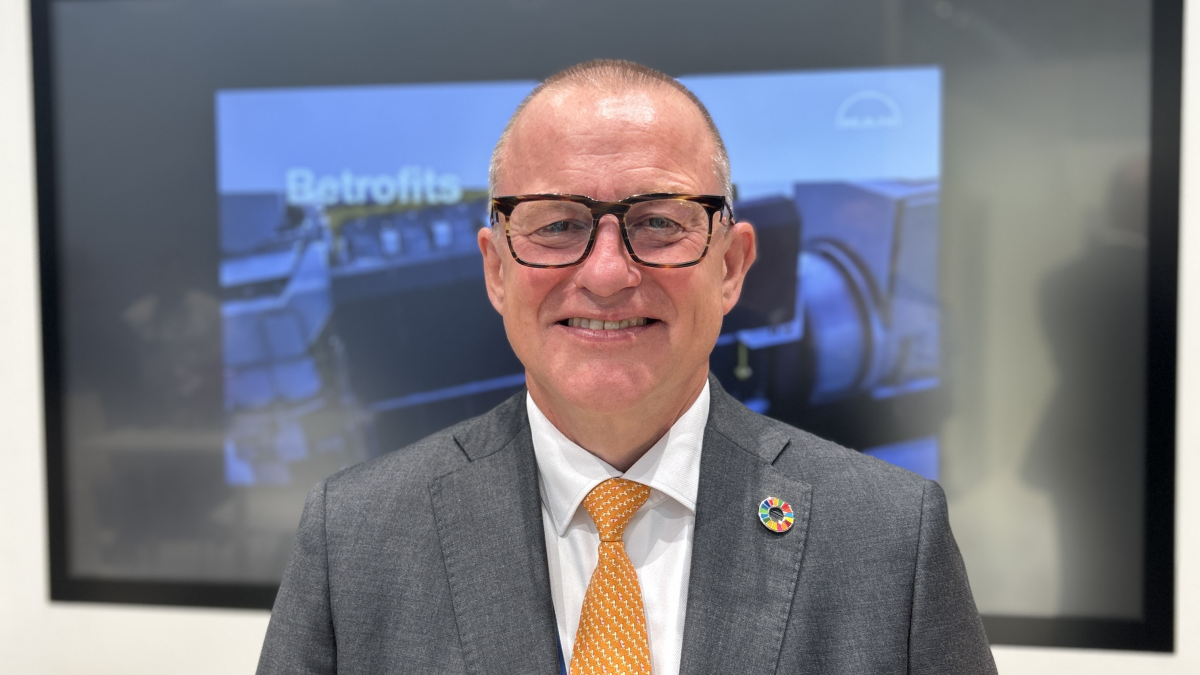
Why MAN Energy Solutions is taking a different approach with its ammonia dual-fuel engine
MAN Energy Solutions senior vice president, head of two-stroke business, Bjarne Foldager details how the Danish engine designer is safely tackling the development of an ammonia dual-fuel engine


While MAN Energy Solutions senior vice president, head of two-stroke business, Bjarne Foldager, sees ammonia as a “great hydrogen carrier” and one of the three low- and zero-carbon fuels that will underpin shipping’s quest for decarbonisation, he is not going to compromise safety to rush the first ammonia dual-fuel engines to market.
“Because of its toxicity, ammonia requires a different risk profile than other dual-fuel engine types that we have developed,” Mr Foldager told Marine Propulsion during an interview at SMM 2024 in Hamburg.
“When we started working with ammonia a few years ago, I think we were afraid of it. But now, all the people involved with the ammonia engine development have received extensive training on how to handle ammonia from a safety perspective,” he says.
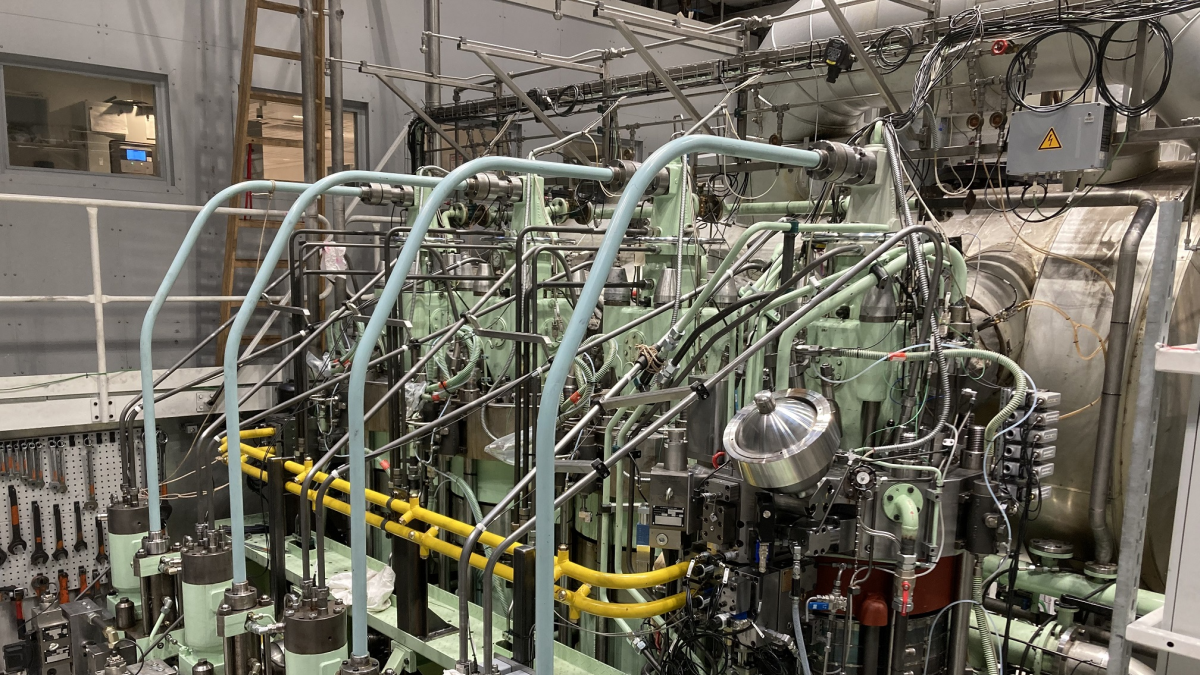
To support the development of its two-stroke ammonia dual-fuel engine, MAN Energy Solutions (MAN ES) has built everything you would see onboard ship at its Copenhagen research centre: a test engine, fuel tank, bunker station, fuel gas supply system, with double wall pipes, the ventilation system, and emergency shutdown system.
Safety at the research centre is job one. “We are testing in the middle of Copenhagen,” says Mr Foldager. “I live 300 metres away, and we have three public schools within 500 metres, a police station and 5,000 apartments within a few 100 metres.”
Combustion tests have been conducted for more than a year on the testbed engine. “The combustion is reliable, it’s repeatable, it’s stable, and has the same efficiency as we see on a traditional fuel engine. We use the Diesel principle, so it’s the same efficiency as we get out of a diesel fuel. Also, the NOx we have seen [is] much lower than what we probably dare to hope for.”
“Ten years from now, the three big fuels will be ammonia, methanol and methane”
While ammonia (NH3) is an excellent hydrogen carrier and does not contain carbon, potential by-products in its combustion include nitrogen oxides (NOx) and nitrous oxides (N2O), both powerful greenhouse gases.
One of the key findings of MAN ES’s research efforts is that NOx emissions are substantially lower than traditional marine fuels. “It’s about 40% of the NOx that you have from diesel combustion,” says Mr Foldager. This is due to cooler temperatures in a combustion chamber. And while ammonia has shown to have good combustion across all loads, there has been ammonia slip, admits Mr Foldager. “We still have a little bit of carryover of ammonia into the exhaust gas, which we are dealing with now in the next development step. We cannot have that. One, green ammonia will be expensive and two, we cannot release ammonia into the atmosphere. So, if we cannot combust it, then we must deal with it in the after-treatment system. The SCR will capture the ammonia, so that’s not in the exhaust,” he says.
Mr Foldager says MAN ES has been injecting 5% pilot fuel, which can be diesel or biodiesel, to ignite and start the combustion process as part of the diesel process.
Commercial projects moving forward
MAN ES R&D has provided it with enough confidence to advance towards commercialisation; it is working with four shipyards and has signed up about 30 ammonia dual-fuel engine projects in China, Japan and South Korea. Mitsui E&S will produce the first ammonia dual-fuel engine at its Tamano Engine Works in Japan. This is the same facility that produced the first LNG dual-fuel Mitsui-MAN B&W ME-GI engine some 11 years ago. The 60-bore MAN B&W 7S60ME-Ammonia engine with selective catalytic reduction (SCR) will be installed in a 200,000-dwt bulk carrier being built at Imabari Shipbuilding for a joint venture of K Line, NS United and Itochu Corp.
“We cannot release ammonia into the atmosphere”
MAN ES delivered an ammonia-ready Cluster 5 Double Layer SCR converter to Mitsui E&S in March. Such systems are typically used aboard cruise ships and cargo ships to reduce NOx emissions by 90%.
The Danish engine designer says one of its MAN SCR control systems is integrated into the overall engine-control system and adapted to the fuel-injection system and turbocharger, enhancing the efficiency and reliability of the entire system. “Up to 2.5 g/kWh of fuel-oil consumption can be saved thanks to the integration of MAN SCR and optimised control strategies compared to the use of an SCR system provided by a third-party supplier. Besides reducing NOx emissions by up to 90%, they also deliver IMO Tier III compliance and increased efficiency in respect to fuel and urea consumption,” says Mr Foldager.
A design for an ammonia fuel supply system from MAN ES sister company MAN Cryo was awarded an approval in principle earlier in 2024 from classification societies, DNV and Bureau Veritas. MAN Cryo developed the system in co-operation with China’s Yada Green Energy Solutions, which the company has previously worked with to develop equipment for LNG and methanol marine fuels.
The first ammonia engine
Once built, the two-stroke ammonia dual-fuel ME-A engine will be tested by Mitsui E&S and MAN ES for about six months before it is delivered to the shipyard — sometime at the beginning of 2026 to “get some sailing experience with ammonia,” he says.
Along with the other very large ammonia carriers and bulk carriers ordered in China and South Korea, MAN ES wants to have a small portfolio of demonstrator projects to accumulate commercial operational experience before rolling out the technology to the broader marine industry.
Concludes Mr Foldager: “The idea is that by 2026 and 2027, we will get ammonia ships on the water, get some experience, get feedback from the crew, and see if there’s anything we need to adjust. Our plan is to have, let’s call it, a relatively slow start with a few projects, and then, ramp up very quickly. By 2030, we expect that ammonia will probably be the one of the biggest fuels that is contracted for newbuildings. We expect 10 years from now, the three big fuels will be ammonia, methanol and methane. Which one will be the biggest, we don’t know, but in 10 years from now, they will probably make out 90% of all contracts in [China, Japan and South Korea].”
Riviera’s Maritime Hybrid, Electric & Hydrogen Fuel Cells Conference 2024 will be held in Bergen, Norway, on 29-31 October 2024. Click here for more information on this industry-leading event.
Related to this Story
Events

Maritime Regulations Webinar Week
 16 Dec 2025
 GMT - ONLINE
Floating energy: successfully unlocking stranded gas using FLNGs and FSRUs
24 Feb 2026GMT - ONLINE
© 2026 Riviera Maritime Media Ltd.


