


Business Sectors
Business Sectors
Events
Contents
Will shipping’s bet on onboard carbon capture pay off?
As alternative fuel uncertainty mounts and regional regulations kick in, the maritime industry looks to clear significant hurdles to make onboard carbon capture a reality


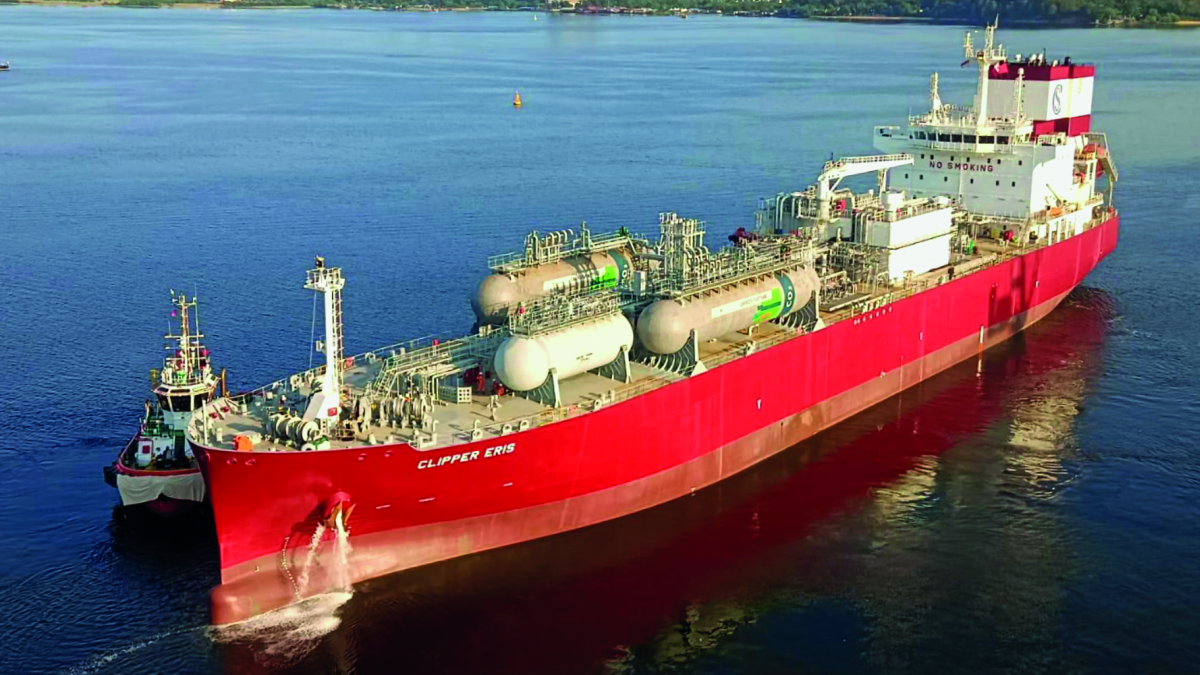
Over the last year, Solvang’s ethylene carrier Clipper Eris has served as a floating laboratory, with the goal of helping shipping turn the corner on onboard carbon capture and storage (OCCS).
Bristling with technology, such as Wärtsilä’s carbon capture system, exhaust cleaning and onboard CO2 storage tanks, the target since the re-equipped vessel was launched in early 2025 was to slash emissions by between 70-80%.
Solvang chief executive, Edvin Endresen, is a believer. “This stands out as one of the more promising solutions for future vessels”, he declared last year.
And in anticipation of Clipper Eris proving him right, Mr Endressen has commissioned another seven Solvang OCCS-installed Panamax-size newbuilds from HD Hyundai Heavy Industries (HD HHI). Due for delivery during 2026 and 2027, these 88,000-m3 very large gas carriers will attract considerable interest amid a widespread uncertainty over future fuels.
Meantime there’s a ferment of activity in onboard carbon capture.
British start-up Seabound is taking the different route of calcium looping – a retrofit decarbonisation system that captures CO2 directly from a ship’s exhaust. Seabound says the technology is 10 times cheaper than other carbon capture methods. Installed near the funnel, it harnesses fumes that react with lime (calcium oxide) pebbles to form calcium carbonate (limestone). Stored in containers, the pebbles are offloaded onshore. Seabound says calcium looping captures up to 95% of CO2 and up to 98% of sulphur.
“This stands out as one of the more promising solutions for future vessels”
After pilot projects, Seabound completed its first full-scale commercial job in early 2026 on a cement carrier, the 5,700-gt UBC Cork managed by InterMaritime and chartered by Heidelberg Cement. Importantly for cost, the system is compatible with HFO.
For Seabound chief executive and co-founder, Alisha Fredriksson, simplicity and compactness are the secret: “We realised that to make carbon capture work on ships, we only had to capture the CO2 onboard. We could save regeneration and liquefaction for land. In doing so, we could minimise equipment onboard to reduce capital expenditure and [avoid] prohibitive space requirements.”
Seabound is also working with energy giants on regeneration facilities near key ports that would service ships unloading captured carbon – but that’s for the future.
What’s wrong with HSFO?
Another technology designed to appeal to cost-conscious ship operators is Value Maritime’s Filtree, a prefabricated plug-and-play system that also promises to capture carbon from HFO-fuelled engines. The carbon is stored in onboard tanks – “CO2 batteries” – and repurposed elsewhere, for instance in agriculture that “supports the circular economy”, explains Value Maritime.
Filtree is heading for bigger things. Several coastal vessels, starting with Visser Shipping’s Nordica in 2021, are already running with the system. But in early-2025 Value Maritime installed in Singapore its exhaust-cleaner and carbon-capture technology on Mitsui OSK’s long-range product tanker, the 75,000-dwt Nexus Victoria, its biggest installation to date. This is Value Maritime’s next-generation system that can be scaled up to capture 30% of CO2 emissions. Looking further ahead, Value Maritime is pursuing a strategy of end-to-end carbon capture solutions by integrating with onshore storage and, ideally, utilisation, for instance into the production of synthetic fuel.
“Emissions during land transport were substantial”
Mitsui OSK (MOL) is on a mission with carbon capture under its company-wide Environmental Vision 2.2 roadmap. “This system represents a crucial step in decarbonising vessels that cannot yet transition to next-generation fuels,” said Hiroyoshi Kubo, executive officer of MOL’s tanker unit about Filtree. “Together with Value Maritime we are committed to advancing carbon capture solutions and building a CO2 value chain that contributes to a sustainable, carbon-neutral industry.”
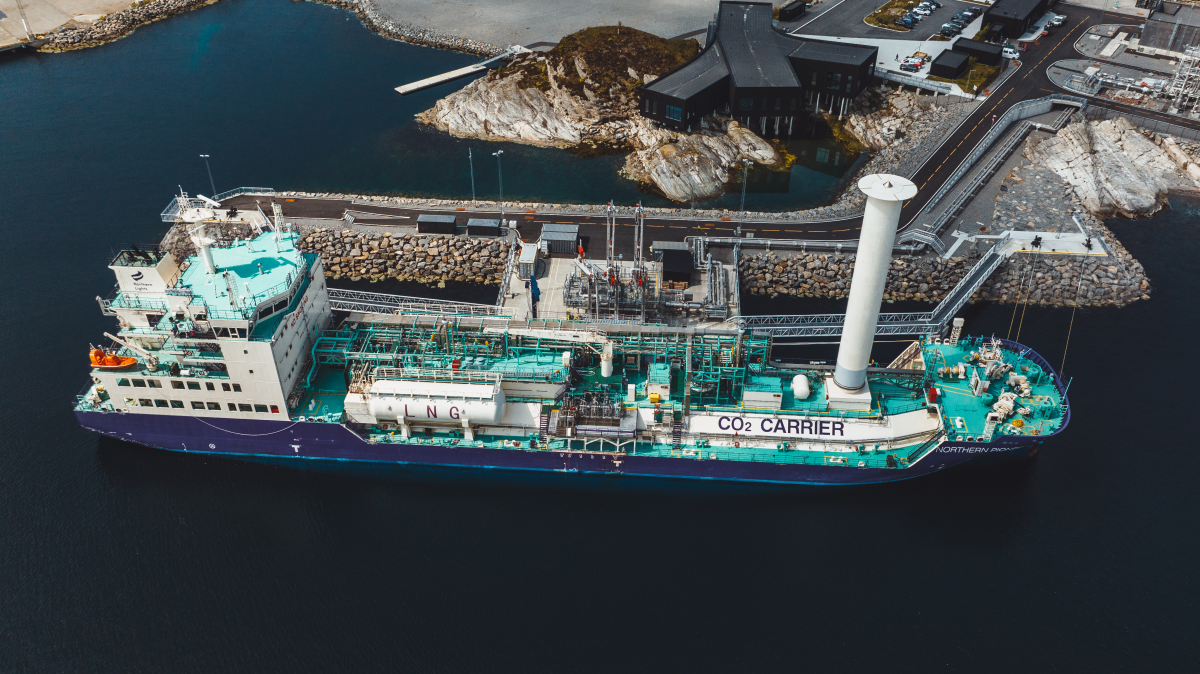
MOL is also plunging into the CO2 tanker business. In January the Japanese group signed long-term charter deals with the fledgling Northern Lights project for two new liquefied CO2 carriers. Said to be the world’s first cross-border CO2 transport and storage business, Northern Lights is a partnership between Equinor, Shell and TotalEnergies. Although this isn’t an OCCS operation, it’s clear that onshore storage will play a big part in onboard carbon capture. The 12,000-m3, ice-class newbuilds are due for delivery from HD HHI in 2028, sailing between Europe and a receiving terminal in Norway.
MOL’s new tankers will be busy. Launched in 2025, Northern Lights expects to ship and store 1.5M tonnes of CO2 a year, rising to 5m by 2028. The CO2 ends up in permanent storage 2,600 m under the seabed of the North Sea via a 100-km-long pipeline.
CO2 tankers
The pioneering CO2 carrier fleet is expanding. Hyundai Mipo is building four dual-fuel, 22,000-m3 capacity tankers for Capital Gas Ship Management that will be fitted with another carbon-stripping technology known as Erma First Carbon Fit. In this process a technology known as amine absorption sucks CO2 from flue gases. The mix is then heated, which separates the CO2 from the solvent. Finally, the CO2 is liquefied by Babcock LGE’s ecoCO2 system and stored onboard in low-temperature containers for offloading.
But offloading where? Although various discussions are going on with major ports such as Rotterdam, the race is on to establish enough storage capacity onshore. There could be too much captured carbon and too many CO2 tankers unless the situation is redressed rapidly, for instance the relative absence of discharge infrastructure.
Yet there’s hope. In the kind of co-operation that observers say is more typical of Asia than Europe, Japanese oil company ENEOS, NYK Line and Knutsen are exploring floating CO2 storage that could, according to NYK executive officer, Tsutomu Yokoyama, “be a game changer, significantly contributing to the reduction of costs and land area required for the liquefaction and storage process, which is a challenge for the commercialisation of CCUS.” ClassNK has already given approval in principle for the design of the FLSU.
OCCS fitted on container ship
Meantime there’s some heavyweight studies going on. Singapore’s Global Centre for Maritime Decarbonisation’s Project Captured research with Ever Top, a 14,110-TEU Neopanamax, the world’s first container ship to be retrofitted with a full OCCS system, is yielding interesting results. In mid-2025, GCMD successfully demonstrated the world’s first ship-to-ship offloading of onboard captured and liquefied CO2, coming up with some valuable lessons.
“We are already seeing huge interest in the market for this solution”
First, this pilot project was able to achieve nearly 8% of savings on a gross capture rate of 10.7%. However it also revealed important inefficiencies that limited savings of GHG emissions, such as the absence of a waste heat recovery system on the vessel that incurred a “fuel penalty” of 5%. If Ever Top had a waste heat system, the penalty would have dropped to 1.5%.
Also because the carbon was offloaded to a truck and transported 2,200 km, emissions during land transport were substantial. However the study concludes that improvements in the process could boost savings to nearly 18%, if the carbon is used rather than permanently stored. And under different scenarios a gross capture rate of up to 40% would be possible and emissions savings would rise as high as 68-71% if the saved carbon was utilised.
OCCS: the way forward?
Meantime there’s Clipper Eris and, on the basis of results from the vessel, Wärtsilä is confident that carbon capture is the way forward – for now: “The following types of vessels will find it particularly interesting: tankers; LNG carriers; offshore vessels; bulkers; and merchant vessels. Before alternative fuels become available at scale, installing a carbon capture system can ensure compliance with mid-term IMO targets while still sailing on fuels that are widely available.”
Wärtsilä believes the pilot project has proven the technical viability of its carbon capture solution and, although the group did not share details, president and chief executive, Håkan Agnevall, is impressed by the reaction: “We are already seeing huge interest in the market for this solution. Ahead of shipping’s net-zero targets, this new technology complements the industry’s ongoing efforts to dramatically reduce emissions from vessels and prevent stranded assets.”
The lessons from Clipper Eris are being incorporated into Solvang’s seven other CCS-ready vessels that will also run on HFO. However, Wärtsilä points out that the technology can be applied to the exhaust from any carbon-based fuel – such as HFO, methanol, LNG and MGO. Concluded Mr Endressen: “CCS provides a significant shortcut for achieving meaningful sustainability.”
And the price could be right. After six years developing its CCS technology, during which it captured 10 tonnes of CO2 a day from one of its marine engines at a research and test centre in Norway, Wärtsilä is confident of its numbers. Inclusive of capital and operating costs, its CCS technology would have a carbon-capture price of €50-€70/metric tonne of CO2 [US$54-$76].
As all operators point out though, there are high hurdles to clear: extra space required for storage; extra fuel required for the capture process (up by 70-100%); and the aforementioned need for offloading infrastructure.
Related to this Story
Events

Maritime Regulations Webinar Week
 16 Dec 2025
 GMT - ONLINE
Floating energy: successfully unlocking stranded gas using FLNGs and FSRUs
24 Feb 2026GMT - ONLINE
© 2026 Riviera Maritime Media Ltd.


