


Business Sectors
Business Sectors
Events
Contents
Register to read more articles.
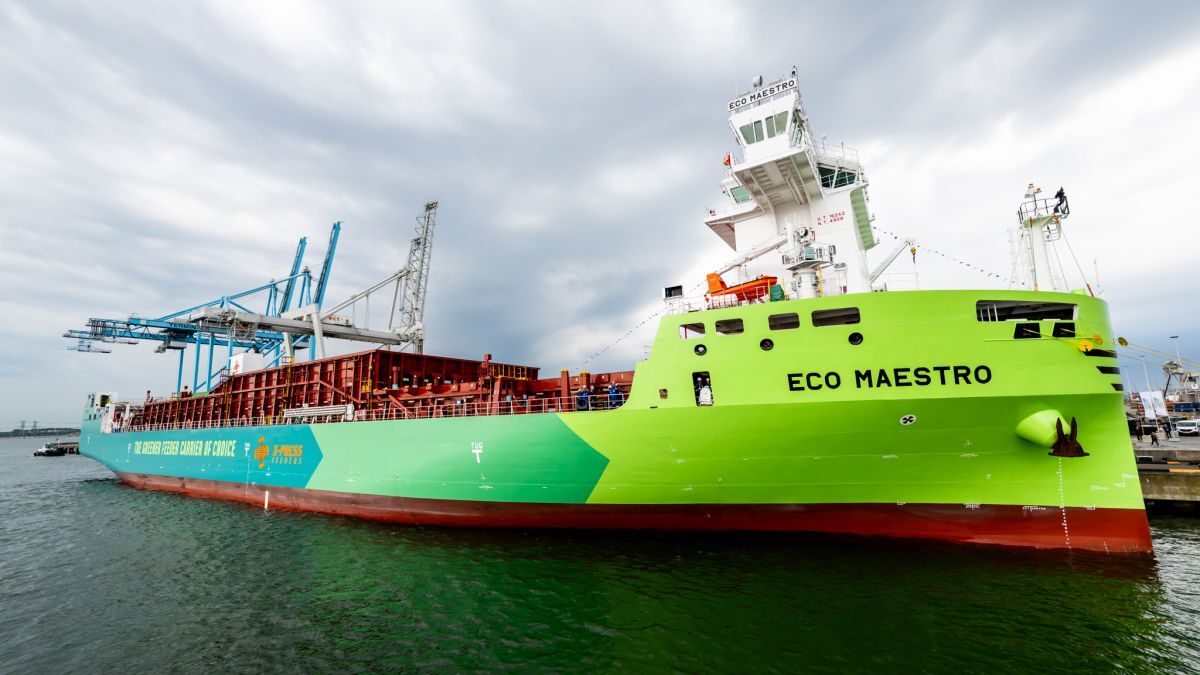
X-Press Feeders starts Europe’s first green methanol network
Eco-Maestro marks the start of X-Press Feeders’ green corridor, 13 more methanol-powered vessels to follow


X-Press Feeders has launched Europe’s first feeder network powered by green methanol.
Founded in Singapore in 1972, the company operates 100 vessels of its own, of between 700-7,000 TEU nominal capacity, with more than 80 regular services.
X-Press Feeders chief operating officer Francis Goh says, “This is a milestone we have been working towards for several years. We have embarked on this journey because of our desire to achieve net zero by 2050. We have a long way to go, but wanted to start taking concrete steps to achieve our goals.”
The launch of the network coincides with the naming and christening ceremony in Rotterdam of the company’s first dual-fuel methanol-powered vessel, on 9 July 2024.
Eco-Maestro is the first of 14 dual-fuel vessels X-Press Feeders has on order. When the vessel was first contracted to Yangzijiang Shipbuilding in China, it was during the pandemic and the signing ceremony had to take place over Zoom.
Mr Goh highlights Eco-Maestro scoops a number of firsts, “It is the first methanol-powered vessel to be built in China… We are the first container feeder operator to use green methanol-powered ships and we are providing the first feeder network on methanol in Europe. We are inspired to lead the way and show customers this is possible and ask them to use our services and be part of our journey to achieve sustainability in shipping.”
X-Press Feeders’ fleet of 14 vessels will be delivered through this year and next, culminating in the full suite in early 2026.
Asked about the main challenges, Mr Goh says, “There were various challenges along the way, but nothing we couldn’t overcome. Shipyards are not experienced in building such vessels, so it was a learning process as we went along.”
By running on green methanol, the vessels will emit 65% less CO2 emissions on the main engine propulsion compared with conventional marine fuel.
X-Press Feeders’ first methanol-powered green corridor incudes the Green Finland X-PRESS and the Green Baltic X-PRESS. OCI Global is supplying the green bio-methanol, which is produced from decomposed organic matter, such as waste and residues.
The feeders have been designed specifically for operating in Europe. They are able to take 45-ft containers – which are popular in Europe – and four of the vessels are Ice Class 1A, so in winter can journey to Finland and the North Baltic.
The hub port is Rotterdam, which is where the ships will bunker. Mr Goh comments, “The routes we are running are short and very efficient and aside from using methanol, they don’t consume much fuel.”
He adds, “In terms of timings, it comes together with the ETS in Europe, and we have started receiving more interest from customers. Many of them want to voluntarily reduce their carbon footprint.”
The vessels have 350-tonnes capacity of methanol. The journeys of the vessels will comprise 90% methanol and 10% conventional marine fuel as a pilot fuel, due to technical requirements.
The new green corridor is just the start for X-Press Feeders. “We want to expand; it is a question of customer demand and port infrastructure – we need to use ports that support our fuelling requirements. Methanol is a chicken and egg situation; methanol suppliers do not know where we need methanol. We are definitely open to operating more green feeder services as long as the structure is there to support us.”
He adds, “We would like to see more ports in Europe supplying methanol to give us more options to operate feeder networks in different ports.”
An important point in this respect is the memorandum of understanding (MoU) X-Press Feeders signed with six European ports: the Port of Antwerp Bruges (Belgium), Port of Tallinn (Estonia), Port of Helsinki (Finland), Port of HaminaKotka (Finland), Freeport of Riga (Latvia) and Klaipeda Port (Lithuania).
Mr Goh comments, “The port MoU is a good partnership to have so they can support us in the future. Today, we have methanol at Rotterdam, tomorrow there will be other ports for supply too. It is great for us to have understanding and share information [with the ports]. Basic information is important to share, such as how many tonnes of methanol they have at any given point in time. They need to do the groundwork to set up the infrastructure.”
In terms of price, Mr Goh explains two units of methanol are used to produce the same energy as one unit of conventional marine fuel.
But he emphasises, “Fuel is only one aspect of the shipping cost. While methanol is more expensive than conventional fuel, but if you look at the total shipping cost, it is not a lot more.”
Indeed, X-Press Feeders has been looking into costs and he explains the analogy, “How much does it cost for the end consumer to save on carbon emissions? On a route from Rotterdam to Finland, it costs the consumer the equivalent of 0.025 cents for a pair of shoes to be shipped. It is negligible and that is how we can translate it to the consumer. It is not headline numbers that scare us.”
The company is also working with different governments to see if subsidies are available.
Evergreen is X-Press Feeders’ first contracted customer for the green network.
Mr Goh says, “Other customers are engaging with us. Since we first pressed the button 2.5 years ago, every time we take concrete steps such as ordering green methanol, we have had customers ringing us up expressing interest.”
Asked about whether the company was interested in retrofitting existing vessels to methanol propulsion, he says, “Not every existing vessel is fit for retrofits. Ships that have been built ready to be retrofitted are better, as those are easier to retrofit.”
Asked about other fuels, he says, “When we placed the order the [methanol] technology was ready, and we could find ship designers, shipyards, suppliers and naval architects who were agreeable to join us. But we are open to other pathways to achieve net-zero targets, whether that be through fuels or technology.”
At the moment, hydrogen and LNG do not work for X-Press Feeders’ ship sizes as they take up too much space, which means less capacity to carry containers.
On ammonia, he said the company is interested. “In the next few years, the technology will be ready. But it is not available yet. Then we have to talk about port infrastructure.”
But alternative fuels are not the only approach the company is taking on its decarbonisation journey.
One of these steps is fleet renewal. “We have taken steps to renew our fleet. Today, 60% of our vessels are below the age of five years – only 20% of the global fleet is below five years. New vessels consume 40% less fuel and produce less emissions compared with older vessels [this is the case even with marine standard fuel].
The company recently took delivery of 12 7,000-TEU eco vessels, which are 40% more efficient.
Other strategies being adopted are to operate more efficient routes with weather data, especially avoiding routes that lead to higher fuel consumption.
Mr Goh adds, “We are installing energy-saving devices, which give us a lot of data. Hull cleaning is a very big factor for us.” The company is also using technology and digitalisation and is considering installing carbon capture and storage systems in some vessels.
It has installed wind reflectors on its 7,000-TEU vessels that operate in Asia, which reduces fuel consumption by around 2%.
Summing up, Mr Goh says, “Our journey to sustainable shipping is open to all partners and customers. We welcome them and urge them to come on board and join us and our network. Together we can achieve net-zero targets.”
Riviera’s Maritime Decarbonisation Conference, Europe 2024 will be held in Amsterdam, 24 September 2024. Click here for more information on this industry-leading event.
Related to this Story
Events

Maritime Regulations Webinar Week
 16 Dec 2025
 GMT - ONLINE
Floating energy: successfully unlocking stranded gas using FLNGs and FSRUs
24 Feb 2026GMT - ONLINE
© 2026 Riviera Maritime Media Ltd.


