


Business Sectors
Business Sectors
Events
Contents
Register to read more articles.
Class takes the lead in passenger ship net-zero charge
Class societies are playing a major role in the latest cutting-edge projects and ship designs that aim for decarbonisation in the passenger vessel sector


A new study, wind power, methanol and new technology are some of the areas in which class societies are steering the passenger ship sector in its quest to decarbonise.
Class society RINA is working with Cruise Lines International Association (CLIA) to carry out a comprehensive global investment plan study aimed at steering the cruise sector towards a sustainable future.
The research, commissioned by CLIA, will provide a worldwide scenario focused on the cruise sector, mapping real-time energy needs, infrastructure and regulations with foresight scenarios extending to 2050.
The study represents a major step in the cruise industry’s commitment to align with the IMO 2030 and 2050 environmental goals. It will cover all areas of the world outside Europe and will focus on a holistic view of the cruise industry’s infrastructure and regulatory needs worldwide. It aims to provide clarity on the current status and future developments in fuel infrastructure and deployment over the next 5-10 years.
A significant emphasis will be placed on the impact of itineraries and operations of cruise ships, considering various energy carriers both in navigation and at port.
RINA head of passenger ships excellence centre Maria Garbarini says, “One of the main issues is to convince governments to have a plan of investment, and to create infrastructure worldwide. To do that, CLIA needs to have a clear idea of what is underway currently, both short term and long term, and the cruise sector’s energy needs should be forecast. There are different regulations and targets for decarbonisation, from IMO to regional initiatives.”
RINA’s study is focused on a global plan to decarbonise the cruise sector and achieve climate neutrality - Europe will be covered in a separate study. The global boundaries are determined by the jurisdiction of IMO, with priority given to countries closely connected to current and known future itineraries.
Ms Garbarini explains, “We will look at this in terms of infrastructure, the imposition of any regulation taxes and funding opportunities. We will analyse the availability of alternative fuels and electricity, the whole logistics chain and understand the gap to cover, explaining, ‘this is the situation, this is what is missing’.
“We need to refuel worldwide, so we need to be aligned on what is available in these areas, and push for the infrastructure to be available.”
The study will cover a short-term perspective, mid-term (2030) and longer term (2050).
Speaking about the separate study on Europe, she explains the situation is very different in Europe to the rest of the world, with different funding opportunities, regulations, and with most cruise ships built there, it is necessary to direct funding vehicles towards new technologies to be installed on board.
She adds, “Europe has a better-defined situation. Strategies are clear, regulation is clear, there is already a structure for managing the energy transition.”
Ms Garbarini sums up, “Shipping is a microcosm and cruise is a small part of that. We are not driving the choice of green fuels for the planet, but we need a clear idea as it is a special sector, and shipowners are waiting for instructions. It is hard to build a ship for alternative fuels without having an idea of how the future will be.”
Meanwhile, infrastructure development is continuous, regulatory framework is under development and there are many geo-political influences that change the course of development. But the provision of data and analytics by CLIA’s and RINA’s study will help bridge the gap here.
Ms Garbarini underlines the importance of the sector working together and not being in competition because, “There are such stringent targets to keep and so huge an economic impact that working together is the only solution”.
Wind propulsion, zero emissions
Bureau Veritas (BV) is classing a range of cutting-edge cruise ships, ranging from those using wind power to fuel cells and more.
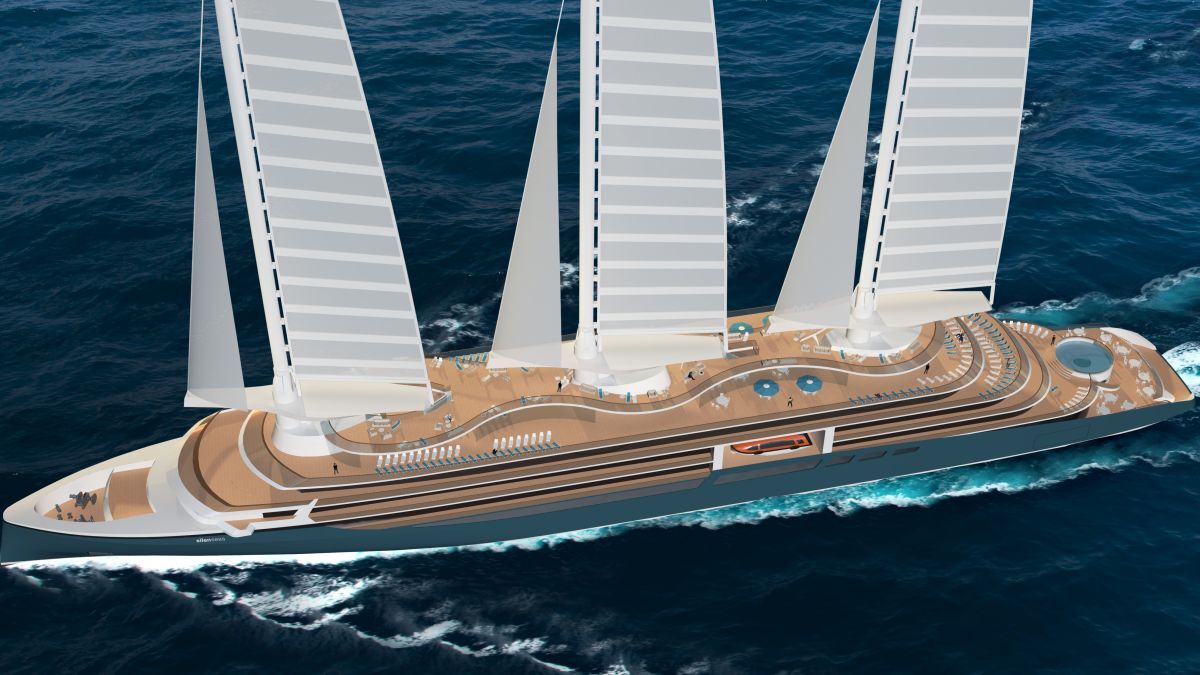
One of these is Accor’s Orient Express Silenseas project. Being built by Chantiers de l’Atlantique, the ship will use patented solid sail technology. Made of composite articulated panels able to fold automatically, the sails will be combined with dual-fuel engine propulsion.
Bureau Veritas global market leader, passenger ships and ferries, Andreas Ullrich says, “It is a very interesting project. It has always been my dream to see a new sailing ship. The aim is to use 50% wind propulsion and to do this, the route was analysed in the design phase. It will use automated sails, the first design of its kind for a cruise ship. This means there is less crew engagement, meaning less risk and the sails will always automatically be in the right wind direction.”
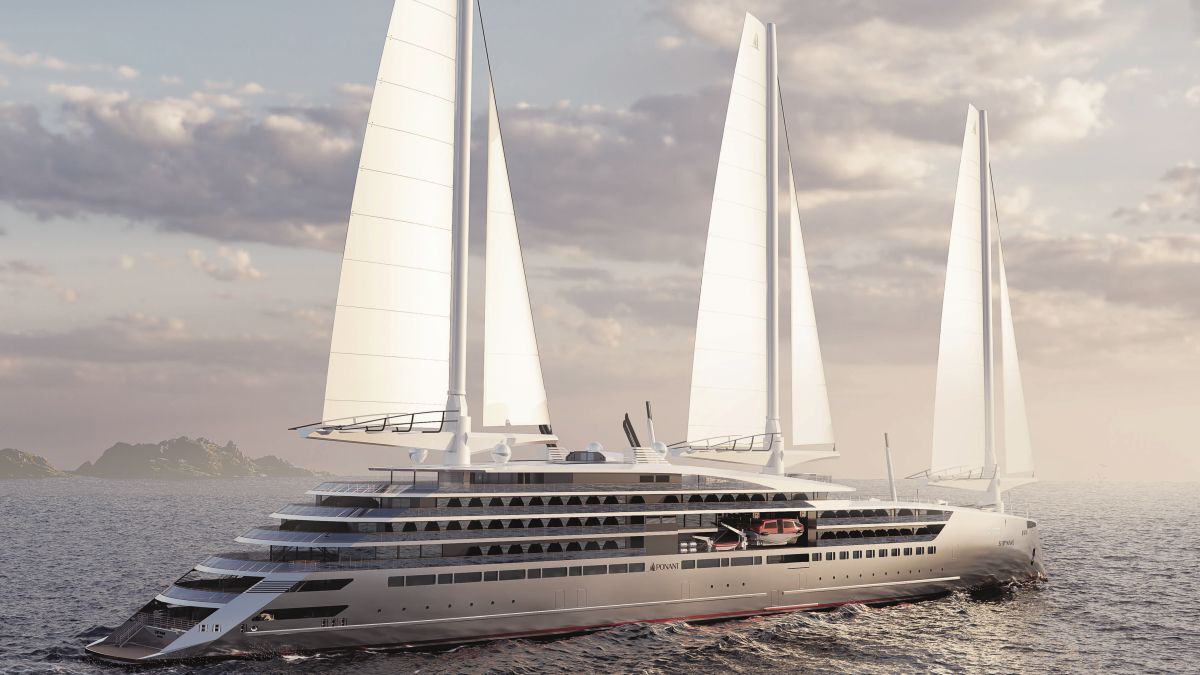
BV is also partnering with Ponant on its Swap2Zero project. Here, the aim is for zero CO2 emissions in operation by combining six major decarbonisation technology building blocks, including fuel cells. Mr Ullrich says, “It is a fascinating project, and we are proud to work on this. It is an eye-catching project combining all the currently feasible technologies for the future in one ship. There is wind power, solar power, two types of fuel cells, LNG and hydrogen. This is, of course, a challenge.
An important way to mitigate the risk is to make sure all the different energy providers talk to each other. There are still some challenges to solve but we are optimistic.”
BV is classing MSC Cruises’ MSC World Asia, due to be delivered in 2026. It will become the fourth LNG ship to join the MSC Cruises’ fleet.
Mr Ullrich comments, “LNG is a good transitional fuel and there have been pilots for green LNG. MSC Cruises’ recent one was very successful. It is a good option and availability is growing, but is it where cruise operators need it?”
Examining different alternative fuels and their potential for the cruise sector, Mr Ullrich explains BV is working on methanol-ready projects. “The biggest challenge is still availability. The technology is there, methanol is available, but it is grey. Green methanol is limited, and a large factor is price, in a market that is price sensitive.”
Other challenges include that energy content is lower than other options.
Mr Ullrich points out the potential for methanol combined with LNG, or for a ship to be converted from LNG to methanol. “The tank and pipe systems can be converted for the use of methanol,” he says.
Turning to hydrogen is an option. Mr Ullrich comments, “There is a lot of risk to consider today, including how to store it. Current regulations say to place the tank on an open deck, you need to consider this on a cruise ship. The energy content is quite low, and it is very expensive.”
Sign up for Riviera’s series of technical and operational webinars and conferences:
- Register to attend by visiting our events page.
- Watch recordings from all of our webinars in the webinar library.
Related to this Story
Events

© 2026 Riviera Maritime Media Ltd.


