


Business Sectors
Events

Floating energy: successfully unlocking stranded gas using FLNGs and FSRUs
 24 Feb 2026
 GMT - ONLINE
Contents

Register to read more articles.

Biocide-free biofouling control: driving the transition to safer marine coatings
With regulatory and societal pressure pushing maritime to limit use of biocides, what are the challenges and opportunities of transitioning to biocide-free hull coatings?


Global regulations are increasingly targeting biocide use across all aspects of the maritime industry. Ongoing efforts focus on limiting the deployment of biocides in areas such as coatings, with increasingly vocal demands calling for better biofouling control and a transition towards more sustainable and environmentally viable solutions.
Of course, these concerns exist in a context of economic difficulties and regulatory pressures that are placing a growing strain on the shipping community. These issues were discussed during a recent Riviera webinar, Biofouling management and biocide-free coatings: regulatory pressures and practical adoption, sponsored by GIT Coatings and I-Tech AB.
During the webinar, industry experts, Philippos Sfiris, head of market strategy and vessel performance at GIT Coatings and Dr Markus Hoffmann, technical director at I-Tech AB, discussed issues including the current state of biocide-free solutions, regulatory developments, and the hurdles hampering the transition away from traditional antifoulants.
“Biocide-free coatings are not a panacea”
Highlighting the current state of play, Dr Hoffmann explained that a recent review of type approvals for anti-fouling coatings revealed 95% of products approved by class remain biocidal in content. And while noting that “class approval is not the same as market share,” Dr Hoffmann said this still implied in excess of 90% of coatings currently being applied are biocidal in nature.

Still, biocides are a highly regulated ingredient. The approval time for a biocide can be up to a decade, with costs of tens of millions of euros, explained Dr Hoffmann. “It is a highly regulated market,” he said. “Globally, there are less than 10 biocides available for anti-foulings, and they are heavily assessed on toxicity, efficacy and environmental risk.”
The point being, these ingredients, used properly and monitored effectively, are not necessarily as bad for the environment as some might imply. Furthermore, there is an element of making the best of a bad situation at play when the discussion turns to biocide-free coatings. A bit like free-range eggs, the marketing doesn’t always reflect the reality. Biocide-free coatings are not a panacea; they may contain ingredients that are non-sustainable and, if less effective than their biocidal counterparts, there is a risk that additional hull fouling will result in increased vessel emissions, essentially moving the environmental damage from sea to air, but not necessarily solving it.
“Class approval is not the same as market share”
It is a topic expounded in detail by Mr Sfiris, who began his discussion by observing the traditional approaches taken to the deployment of anti-fouling systems. He explained that too often, operators simply fit and forget about their coatings until a problem emerges that requires their intervention. Unfortunately, this is often too late, as the state of the coating has deteriorated to an extent that cleaning can inflict further, costly damage and increase roughness, with a consequential impact on efficiency. This issue can be aggravated by long idle times, explained Mr Sfiris, when hard cleaning is required, which again, can lead to coating damage and a reduction in lifetime effectiveness.
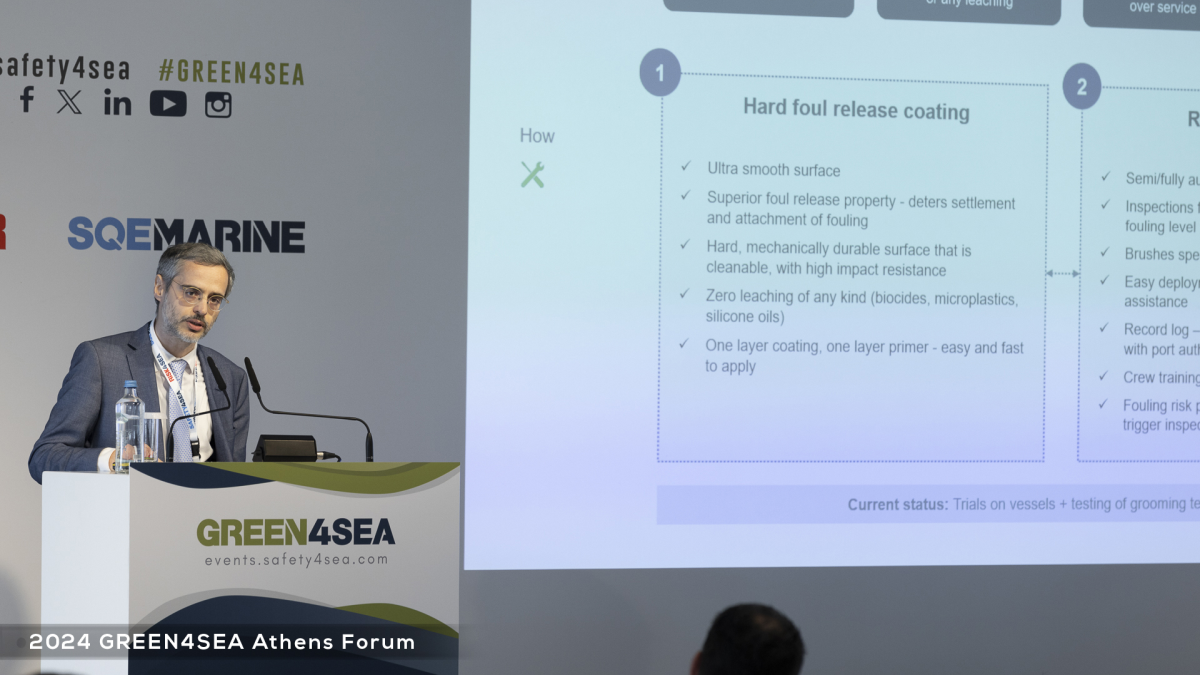
Another approach, noted Mr Sfiris, is perhaps more typical of a new ‘proactive’ mentality, whereby bio-free coatings are applied with a regular maintenance schedule factored in as part of the package. “The idea is that you don’t wait for heavy fouling to accumulate or for performance to drop,” explained Mr Sfiris. “You try to address slime directly, early on in the process, and then manage it as a routine.”
Undeniably, this process is more complex, requiring adherence to a regular schedule, with active crew involvement, but, said Mr Sfiris, “the mindset is shifting and I believe that in the future we will see more of this.”
Indeed, regulation is already moving towards a less voluntary and more standardised approach, with a legally binding framework coming into force towards the end of the decade. “Eventually,” said Mr Sfiris, “the regulation will make this a mandatory obligation.”
A holistic framework
So, with a new mindset in place, reinforced by strict regulatory demands, how will the industry transition away from what might be labelled ‘the old ways of doing things’?
“I think the industry generally, is missing a holistic sustainability framework,” explained Dr Hoffmann. Highlighting that “each stakeholder has a tendency to only optimise their own factors,” Dr Hoffmann stressed the importance of “a balanced framework”, one that recognises and accepts the complexities involved in transitioning towards new systems and processes, but one which also acknowledges the benefits that traditional processes can bring, if used correctly.
“Biocides do still play an important role, helping control and prevent greenhouse gas emissions to air,” he said. “There is an industry trend to reduce biocides and achieve the same performance with less biocides, but it’s a combination of different technologies that will make the difference.”
It’s an approach that is supported by Mr Sfiris, who noted: “It can be done; we can use [different technologies] side by side, with proactive hull management in daily operations.”
But he stressed the importance of industry buy-in, and referred back to the change in mindset required to make the transition work. Gone are the days of ‘fit and forget’, which didn’t necessarily work that well anyway. Instead, a new generation must adopt a more hands-on, proactive approach to monitoring and maintenance.
“The mindset in our industry is shifting,” said Mr Sfiris. “We are moving toward coatings and practices that not only reduce emissions to the air, but also protect our oceans.”
He concluded: “To make it work on an operational basis, we need an in-service support system, with data-driven planning based on a vessel’s operating profile and continuous monitoring of hull condition, through inspections and analysis. This is not a future concept anymore. The combination of biocide-free coatings and proactive grooming is technically and operationally feasible now that we have the right coatings and tools in place.
“We don’t believe in waiting for regulation to force change. With the right technology and planning, there is already an alternative pathway available today. And we’re proud to be part of making that happen.”
To listen to the webinar in full, and to hear expert opinion on a range of additional topics, including regulation, robotic cleaning and economic factors, please click here

A series of audience polls were conducted during the webinar, with the findings shown below:
What do you think is the biggest barrier to implementing proactive hull cleaning in commercial fleets?
A. Port restrictions – 36%
B. Difficulty in planning around trading patterns – 22%
C. Crew involvement – 10%
D. Coating compatibility/durability under frequent cleaning – 32%
When do you think proactive hull cleaning will become a standard practice across commercial fleets?
A. It’s already happening – 16%
B. Within two to three years – 18%
C. Within five years – 11%
D. Not until required by regulation – 55%
What would most help your organisation move from interest to action on proactive hull cleaning?
A. Clearer ROI evidence – 33%
B. More port approvals/service coverage – 19%
C. Proven coating compatibility for regular cleaning – 22%
D. Regulatory clarity – 19%
E. External advisory support – 7%
If you are considering switching to biocide-free underwater hull coatings, when do you expect your fleet to be transitioned over?
A. Three years – 23%
B. Five years – 25%
C. 10 years – 16%
D. More than 10 years – 25%
E. Never – 11%
Biocide-free underwater hull coatings are more sustainable than biocidal underwater hull coatings.
A. I strongly disagree – 9%
B. I disagree – 15%
C. I’m not sure/I have no definitive opinion – 32%
D. I agree – 26%
E. I strongly agree – 18%




Related to this Story




Events

Maritime Regulations Webinar Week
16 Dec 2025GMT - ONLINEFloating energy: successfully unlocking stranded gas using FLNGs and FSRUs
24 Feb 2026GMT - ONLINE
© 2024 Riviera Maritime Media Ltd.


