


Business Sectors
Business Sectors
Events
Contents

Register to read more articles.
Charting the course of a zero-emissions ferry service in New York Harbour
Lessons from its prototype hydrogen fuel-cell-electric vessel in San Francisco are shaping Switch Maritime’s approach for a new zero-emissions commuter ferry for New York City


New low- or zero-carbon fuels, energy sources, engines or digital technologies supporting maritime decarbonisation carry enormous risk. Managing that risk is essential to creating a sound commercial approach to lowering your vessel’s CO2 and GHG emissions.
One way to mitigate the risk of adopting novel technologies is to collaborate with an experienced partner, said Switch Maritime director of commercial and government affairs, Seamus Nolan.
Switch Maritime developed and commissioned the first hydrogen fuel-cell-powered vessel in the US and one of the country’s first zero-emissions vessels in 2024.
“We are a developer of the vessels themselves, and we serve as an operator’s partner to manage all of the complexity and risk associated with bringing these novel propulsion systems and the surrounding fuel supply chains, crew training pieces into operations itself,” said Mr Nolan.
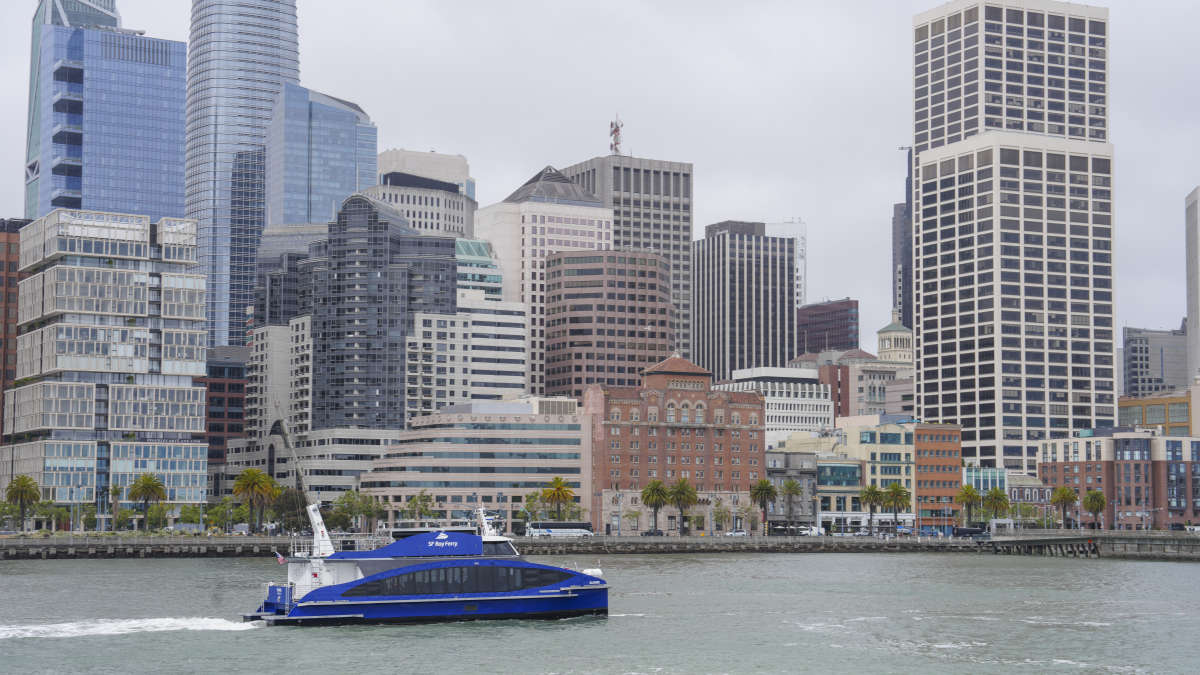
His company’s first prototype vessel, the 75-passenger Sea Change, began ferry service in San Francisco under a pilot project in July 2024. Today, it operates in San Francisco, carrying employees across the Bay using hydrogen fuel cells, batteries and electric motors. For Switch Maritime, the vessel has become both a working ferry and a proving ground for what it takes to bring zero-emissions propulsion into everyday passenger service. It plans to build on its experience to commercially scale up its technology.
“It’s difficult to bring a new piece of technology into operation”
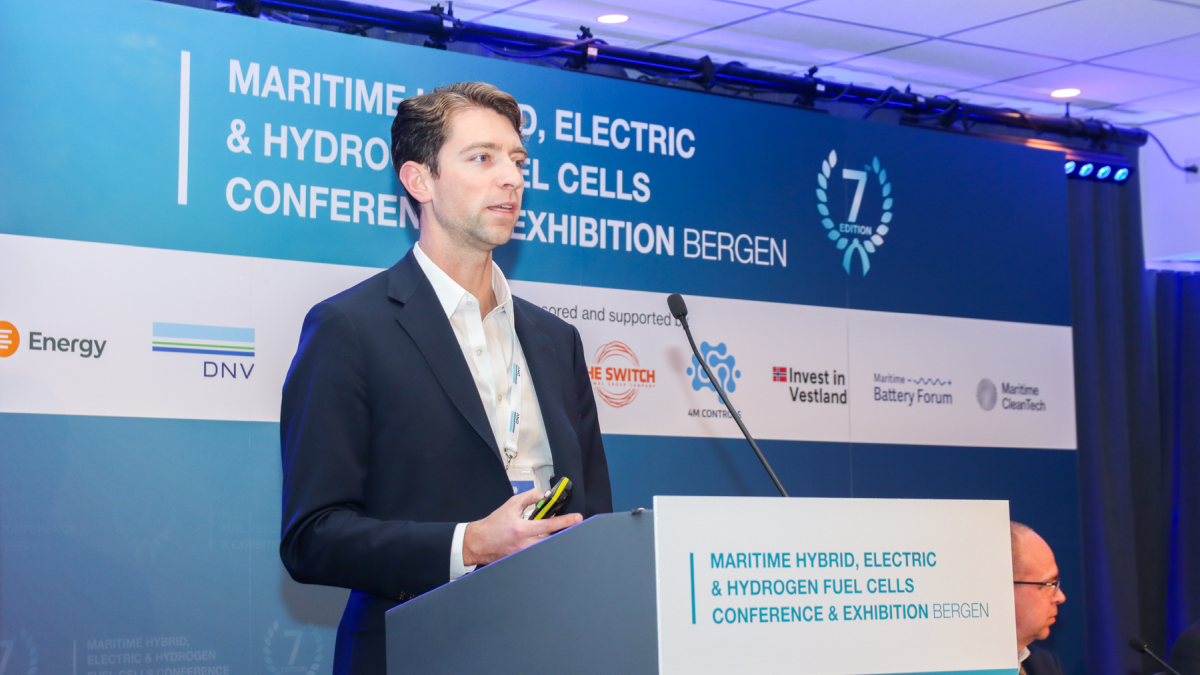
During a presentation at Maritime Hybrid, Electric and Hydrogen Fuel Cells Conference in Bergen in October, Mr Nolan shared the lessons learned from the pilot project, describing the company’s role as more than vessel developer, and rather a turnkey partner.
Speaking to vessel operators at the conference, Mr Nolan said: “You know it’s difficult to bring a new piece of technology into operation. If your core competency is primarily running service for your passengers, your primary responsibility isn’t to innovate and lead on bringing in new types of propulsion systems. That’s where Switch comes in.”
Switch Maritime works with operators on the full package: designing and commissioning vessels; arranging fuel supply; training crews; coordinating maintenance support; securing regulatory approvals; and developing financing approaches.
Bringing hydrogen fuel cells to the marine market
Sea Change’s development began in 2018 as a project associated with Sandia National Laboratories; Switch took responsibility for moving it from technology development into vessel construction, commissioning, and operation.
The ferry uses compressed hydrogen stored onboard to power fuel cells and batteries that drive electric motors. Designed by Incat Crowther, the aluminium-hulled catamaran vessel carries 246 kg of hydrogen storage, a 360-kW fuel-cell system, and 100 kWh of batteries.
Because there is no long-standing regime for a hydrogen fuel-cell-powered vessel, Mr Nolan said the project required close work with the US Coast Guard to establish bespoke vessel-specific design and operating approvals. He said Switch worked “closely with the authorities to build from the ground up the equivalency of safety.”
“Excessive complexity results in multiple points of failure”
Mr Nolan also said that these novel technologies tend to be “more expensive than what operators are used to and there is a risk associated with deploying capital into propulsion technologies and the vessels around them that they do not fully understand.”
Sea Change received its Certificate of Inspection from the USCG in May 2024. Switch had to also coordinate a maritime hydrogen fuel supply chain at the Port of San Francisco.
Switch used the operating data from the vessel’s six-month demonstration in 2024 with the San Francisco Bay Ferry system to refine the propulsion system’s hardware, software, and procedures. In February 2026, the vessel moved into a longer-term service contract with a company, carrying employees between Oakland and San Francisco.
According to Mr Nolan, after Switch made its improvements, Sea Change was operating much like a conventional ferry. He cited 95% service uptime, 126 fuelling cycles, and more than 5,000 operating hours in 2026. The vessel is refuelled using a mobile hydrogen trailer supplied from a production facility within roughly 100 miles (160 km) of the port.
That mobile approach offers flexibility while the market and infrastructure mature. It gives the operator control over when and how much to refuel and makes it possible to work with more than one potential fuel source, said Mr Nolan.
The benefit of a hydrogen fuel-cell-electric system is that it allows for operations that are comparable to a diesel-powered vessel. “Similar speed, similar bunkering frequency, and similar range that an operator would expect,” he said.
The operational lessons
Mr Nolan said among the first lessons learned in developing Sea Change was systems optimisation.
“The integration work was largely done by a team of professors turned technologists. The system is functional but quite complex,” he said. This excessive complexity results in multiple points of failure, “where you have any number of things that could go wrong within the system. You want to minimise those points of failure.”
Switch made changes to reduce unnecessary piping complexity and adjust how fuel cells and batteries were cycled. The aim, Mr Nolan said, is to carry those lessons into future vessel designs.
The second was diagnostic visibility. Crews need to be able to see when equipment is not performing as expected, whether that means a fuel-cell circulation pump or a battery system. Clear system information helps crews and technicians identify likely causes and respond more effectively.
Mr Nolan also emphasised the value of nearby technical support. Switch worked with suppliers on the project that no longer service the equipment in the maritime sector.
“Our battery provider [and] fuel-cell provider are not in the maritime sector anymore. Our propulsion system integrator is also not servicing their maritime systems anymore,” he said.
Mr Nolan said the fuel cells in Sea Change, which are roughly six years old, are nearing the end of their lifecycle, and that replacing a complete system could be considerably more expensive than refurbishing it. Choosing vendors able to provide long-term service, he said, is a key consideration for the next generation of projects.
For future vessels, the company expects to work with providers that have regional service teams and a stronger commitment to maritime applications.
Finally, the technology requires continuous crew training. Existing crews bring valuable maritime experience, but they may default to familiar procedures unless new practices are reinforced. Mr Nolan called for comprehensive, repetitive, hands-on training – not just preparation for an inspection, but ongoing workforce development that helps prevent human-error-related reliability problems.
A zero-emissions ferry for New York
Switch is building on its experience with Sea Change to commercially scale up its technology.
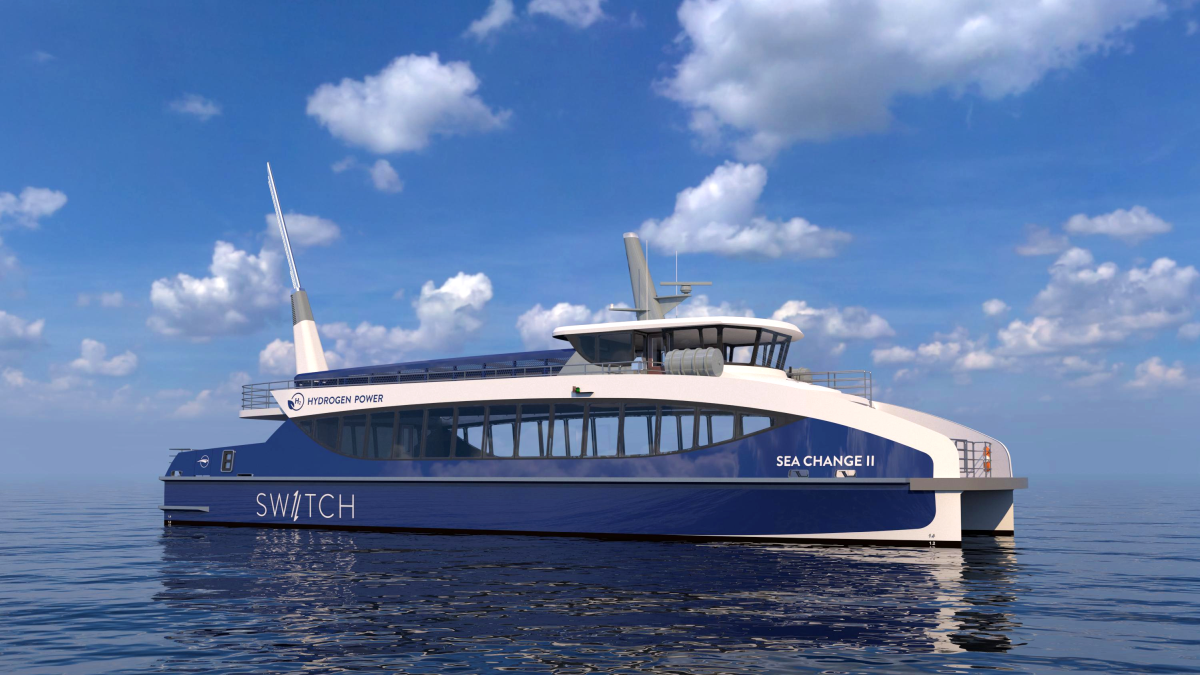
“Our next vessel is now at the point where it’s construction ready. Called Switch 150, the vessel is twice as large and twice as fast as Sea Change, but relies on the same technical and regulatory underpinnings,” said Mr Nolan.
Switch 150 has now moved a step closer to reality. In October, Switch said it reached a Design Basis Agreement (DBA) with the USCG for the 150-passenger hydrogen fuel-cell-electric-powered commuter ferry. The DBA provides a clearly defined framework for the vessel’s construction, commissioning and operation.
Designed by Incat Crowther, the Switch 150 will have an integrated hydrogen fuel-cell-electric propulsion and hydrogen storage system, enabling the vessel to perform high-frequency, high-intensity ferry operations. Unlike an all-electric battery-powered vessel, it will not require increased dwell time or altered service to account for vessel charging and will eliminate the requirements for shoreside charging infrastructure and power grid upgrades.
IMO’s Interim Guidelines for the Safety of Ships Using Hydrogen as Fuel served as an important foundation for the DBA process for the Switch 150, adding more structure to the process while reducing time to approval.
Hydrogen storage systems developer, Hexagon Purus, operational advisor, Hornblower Marine, hydrogen propulsion system design and safety specialist, LH2 Shipping, fuel-cell system developer and manufacturer, PowerCell Group, and propulsion system integrator, SEAM worked closely with the owner and ship designer on the project.
Switch received US$2M from the New York State Energy Research and Development Authority (NYSERDA) in 2025, supporting the development of the hydrogen fuel-cell-electric-powered ferry for New York Harbor. The company worked with NYC Ferry and marine engineering firm KPFF on a techno-economic comparison of diesel, battery-electric, and hydrogen-fuel-cell-electric operations.
The analysis found that battery-electric service could require additional vessels to cover charging time, as well as substantial charging infrastructure investment in a grid-constrained urban environment. Hydrogen, by contrast, was presented as a more gradual, “drop-in” transition: an operator could begin with one vessel and initially fuel it from a trailer.
According to Mr Nolan, hydrogen is less costly than battery-electric service in the conservative case examined, while still carrying a total-cost-of-ownership premium over diesel. Switch is exploring on-site hydrogen production to reduce transportation costs and narrow that premium. The company’s stated goal is to begin construction of the vessel next year, and bring the Switch 150 into service in 2029.
Sea Change’s significance, said Mr Nolan, was that it demonstrated how a novel system can move from a pilot into regular passenger service – and what must be in place for that transition to work.




Related to this Story

Events

Maritime Regulations Webinar Week
 16 Dec 2025
 GMT - ONLINE

Floating energy: successfully unlocking stranded gas using FLNGs and FSRUs
24 Feb 2026GMT - ONLINE
© 2026 Riviera Maritime Media Ltd.


