


Business Sectors
Business Sectors
Events
Contents
Register to read more articles.

Getting shipping's GHG emissions reductions back on track
ABS senior vice president, global engineering and digital product development, and chief technical officer, Patrick Ryan sees a ‘big role’ for alternative fuels, digitalisation and AI in achieving IMO 2030 emissions-reduction targets


Despite a 21% improvement in the carbon intensity index (CII) score of the global fleet over the last five years, the total amount of greenhouse gases emitted by ships continues to grow, making it unlikely the IMO 2030 emissions reduction targets will be met.
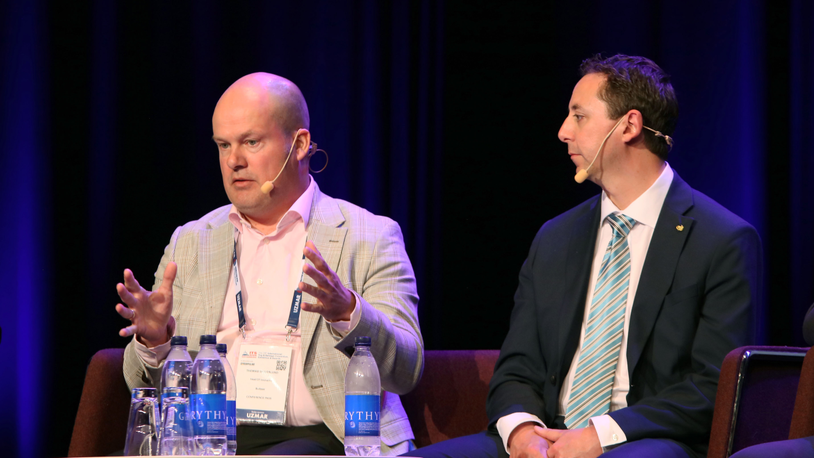
This sobering assessment was shared by ABS senior vice president, global engineering and digital product development, and chief technology officer, Patrick Ryan, who examined shipping’s decarbonisation efforts since it began reporting its fuel oil consumption through IMO Data Collection Systems in 2019.
“The fleet is indeed getting much cleaner,” Mr Ryan told delegates during his presentation at CMA Shipping 2025. But he noted the global fleet is also expanding. He said the global shipping fleet has grown from 1.3Bn tonnes in 2019 to 1.6Bn tonnes as of 2024. During that same five-year timeframe, greenhouse gas (GHG) emissions have increased from 1.01 gigatonnes of CO2e to 1.06 gigatonnes of CO2e.
Given this reality, “It does seem unlikely that the top-down calculated target of 0.64 gigatonnes by 2030 is going to be achievable even with the most aggressive assumptions.”
So, what can shipping do to move the needle more aggressively on reducing the carbon intensity of the global fleet? “Technology has a big role to play,” he observed.
First, he sees alternative fuels, and particular LNG, playing a significant role in reducing shipping’s GHG emissions. According to ABS data, 53% of the current orderbook is LNG or LNG dual fuel-capable when you include LNG carriers.
“Biofuels had a big year” as a drop-in fuel, recording a 70% growth year-on-year, according to Mr Ryan. “But it still only represents 0.2% of the total fuel consumption in our industry.”
Turning to ammonia and methanol, he said “green flavours” of these fuels – (produced using renewable energy) or “blue”(using carbon capture) make up less than 1% of the total fuel production, while hydrogen could have a role in shortsea shipping.
Nuclear: not a near-term reality
A naval architect who spent more than two decades in various ship design, programme management and engineering leadership roles at the largest US nuclear shipyard before joining ABS, Mr Ryan weighed in on the “hot topic” of the day – merchant ship nuclear propulsion.
“It is not a near-term reality.” He said Gen 4 nuclear reactors at sea are “a solid decade away.”
Digital investments
Where efficiency gains can be made today is with digital solutions. “If you are not investing in digital technologies, now is the time,” he said. “And the biggest game-changing digital technology out there right now is AI.”
Artificial intelligence can take advantage of data that is being collected by thousands of sensors that were installed on ships for condition-based maintenance. But he said ABS is talking with clients about “using this data, not just for maintenance, but also to drive the operation of the rotating machinery and the engines aboard these vessels at their peak efficiencies.”
Riviera’s Marine Fuels Webinar Week will be held from the week commencing 7 April 2025. Click here to register for this free-to-attend event.

Related to this Story


Events

Maritime Regulations Webinar Week
 16 Dec 2025
 GMT - ONLINE
Floating energy: successfully unlocking stranded gas using FLNGs and FSRUs
24 Feb 2026GMT - ONLINE
© 2026 Riviera Maritime Media Ltd.


