


Business Sectors
Business Sectors
Events
Contents
Register to read more articles.
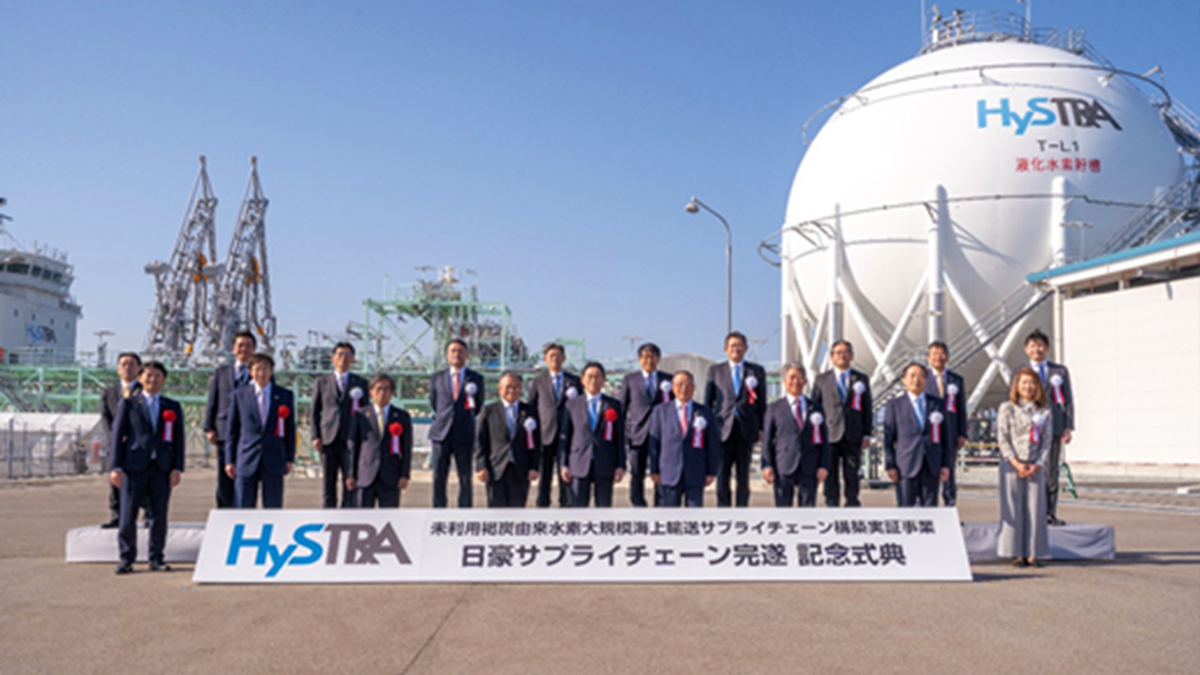
LH2 carrier completes 9,000-km voyage transporting liquefied hydrogen
The completion of the world’s first international maritime transport of liquefied hydrogen was celebrated during a recent ceremony at Kobe LH2 Terminal in Kobe, Japan


The 9,000-km voyage between Australia and Japan was undertaken by the world’s first liquefied hydrogen (LH2) carrier Suiso Frontier, to demonstrate the viability of long-distance maritime transport of liquefied hydrogen. The project saw the LH2 carrier sail from Japan to Port of Hastings, where it was loaded with blue hydrogen produced from Australia’s unused brown coal from the Latrobe Brown Coalfields, using carbon capture to collect the CO2 produced as a by-product in the process for sequestration underground. Once liquefied and loaded on board, Suiso Frontier returned to Japan.
The project is supported by a Japanese consortium called the HySTRA joint venture. Partners in the project are Iwatani Corp, Kawasaki Heavy Industries (KHI), Shell Japan, Electric Power Development Co (J-POWER), Marubeni Corp, Eneos Corp, and K-Line. Japan’s national research and development agency NEDO supported the project. The joint venture has developed technologies to produce and transport large volumes of liquefied hydrogen, conducting demonstration tests between Japan and Australia to establish processes around the safe loading, offloading and storage of hydrogen. Insights from the demonstration voyage will also guide the development of international safety standards and codes for transporting liquefied hydrogen.
Now under the ClassNK register, Suiso Frontier was launched in 2020. It has an overall length of 116 m, beam of 19 m, depth of around 11 m, and a capacity of 1,250 m3.
For the voyage, Suiso Frontier departed Japan December 2021 and arrived in Australia January 2022. The ship was loaded with liquefied hydrogen produced from coal in Victoria, Australia, and returned to Japan February 2022, unloading the cargo to a landside storage tank.
The HySTRA joint venture partners will continue to gather data and findings and collaborate with various parties to promote this project and contribute to the development of a commercial hydrogen supply chain, as more industries explore hydrogen as a new energy source.
The small carrier is part of Japan’s big vision for implementing its national hydrogen strategy to displace fossil fuels in transport, power generation, industry and other sectors to reach its ambitions of net-zero emissions by 2050.
The Marine Propulsion Webinar Week will be held from 11 April 2022. Register your interest and access more information here


Related to this Story
Events

Maritime Regulations Webinar Week
 16 Dec 2025
 GMT - ONLINE
Floating energy: successfully unlocking stranded gas using FLNGs and FSRUs
24 Feb 2026GMT - ONLINE
© 2026 Riviera Maritime Media Ltd.


