


Business Sectors
Business Sectors
Events
Contents

Register to read more articles.
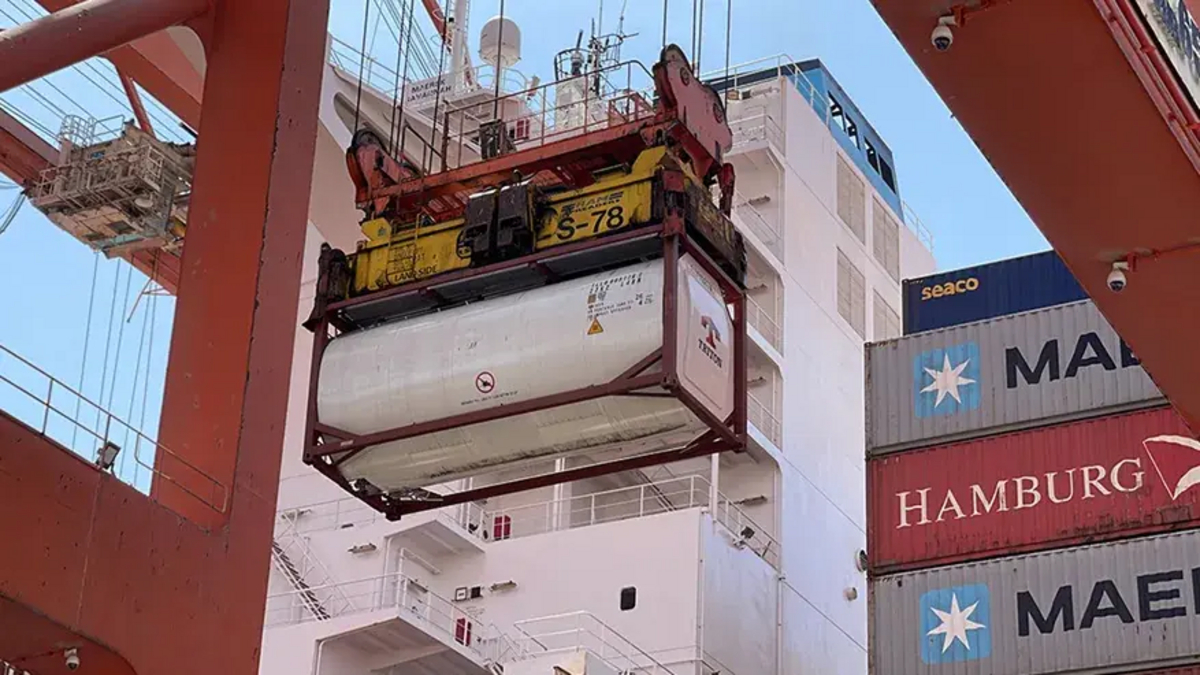
Maersk trials freshwater delivery scheme
A project led by three former seafarers now with AP Moller–Maersk has delivered fresh water from vessels to two ports


Now the company believes the project could play a more significant impact in water-scarce regions. UNICEF estimates that up to 4 Bn people – almost two-thirds of the world’s population – experience severe water scarcity for at least one month each year, and half of the world’s population could be living in areas facing water scarcity by as early as 2025.
Cargo ships at sea are equipped with freshwater generator systems that produce clean drinking water by distilling sea water using heat energy harnessed from their engines.
Traditionally, this system has been used to generate water for consumption only on board the vessels. However, the excess water produced has been overlooked. This project hopes to optimise the process and store the excess water in tank containers before delivering it to ports.
Maersk claims each vessel can fill two tank containers on an average sea voyage between two ports. With the process optimised and tank containers stored at the right location on board, two tank containers with a combined capacity of 50,000 litres can be filled with fresh water. Among the first pilot runs were the deliveries at the Port of Colombo in Sri Lanka and Port of Salalah in Oman, of two tank containers, each filled with 25,000 litres of fresh water.
In Sri Lanka, the water quality was tested by a government laboratory, The Ceylon Institute of Scientific & Industrial Research, to meet the World Health Organization standards.
Maersk added that a Life Cycle Assessment study was conducted by the Danish Technical University to provide insights into the project’s environmental impact, and compared it favourably against traditional tanker truck water delivery methods.
Port of Salalah chief executive Keld Christensen said the project could be the start of many more ships moving across the world and replicating the same model delivering fresh water at scale.
“The possibility to generate, store and deliver fresh water from our ships presents a unique opportunity to address water scarcity. The successful conclusion of the pilot deliveries is a testament to the innovative capabilities and perseverance of our team. The next step for us would be to explore the possibilities of expanding our efforts to more ports and collaborate with beneficiary stakeholders worldwide,” said Maersk head of fleet management and technology, Leonardo Sonzio.
Sign up for Riviera’s series of technical and operational webinars and conferences:
- Register to attend by visiting our events page.
- Watch recordings from all of our webinars in the webinar library.
Related to this Story
Events

Maritime Regulations Webinar Week
 16 Dec 2025
 GMT - ONLINE
Floating energy: successfully unlocking stranded gas using FLNGs and FSRUs
24 Feb 2026GMT - ONLINE
© 2026 Riviera Maritime Media Ltd.


