


Business Sectors
Events
Floating energy: successfully unlocking stranded gas using FLNGs and FSRUs
 24 Feb 2026
 GMT - ONLINE
Contents
Multraship supports European civil construction projects
Tug fleets supported tunnel installations beneath the Scheldt River, and Princess Elisabeth Island’s construction in Belgium in 2025


Growing project complexity is pushing towage providers into earlier, more technical roles in huge civil engineering projects, including planning, risk management and offshore execution.
As Europe continues to deliver large, complex infrastructure projects involving major waterways, project towage is increasingly shaping how and when construction moves forward.
What was once treated as a supporting marine service has now become a highly specialised discipline that influences feasibility, sequencing, and acceptable risk levels, particularly as projects move offshore or into heavily congested waterways.
According to Multraship Towage & Salvage commercial manager Jan-Andries Arts, the most notable shift in recent years has been driven by the increasing complexity of these projects.
“As projects become more complex, there is a growing demand for combined project scopes,” he explains.
“Clients are not only chartering tugs, [catamaran workboats] and other specialised equipment, including floating sheerlegs such as Cormorant, but are also increasingly relying on qualified and highly experienced tow masters.
"These tow masters play a central role in validating methods, training crews and co-ordinating operations during the execution phase.”
This evolution of project towage requirements was demonstrated in two recent projects in northern Europe in which Multraship was involved, where the original scope for towing services became more complex and required critical alterations as the project progressed.
The first involved the construction of the Scheldt Tunnel in Antwerp, Belgium, which is being built as an important part of the new motorway around the port city.
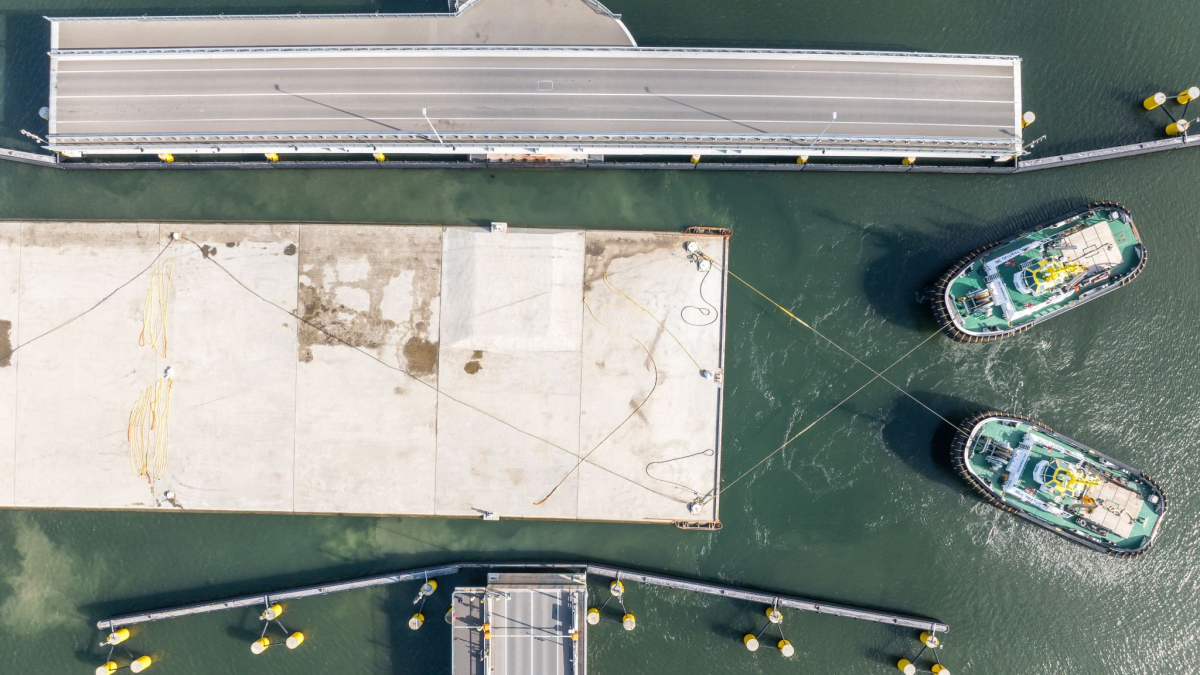
The project reached a critical milestone in H2 2025, with the successful delivery and sinking of eight concrete tunnel elements, each weighing around 60,000 tonnes, by specialised tugs and craft.
The second project was the first phase in the construction of the Princess Elisabeth Island energy development in the North Sea, 45 km off the coast of Ostend, Belgium.
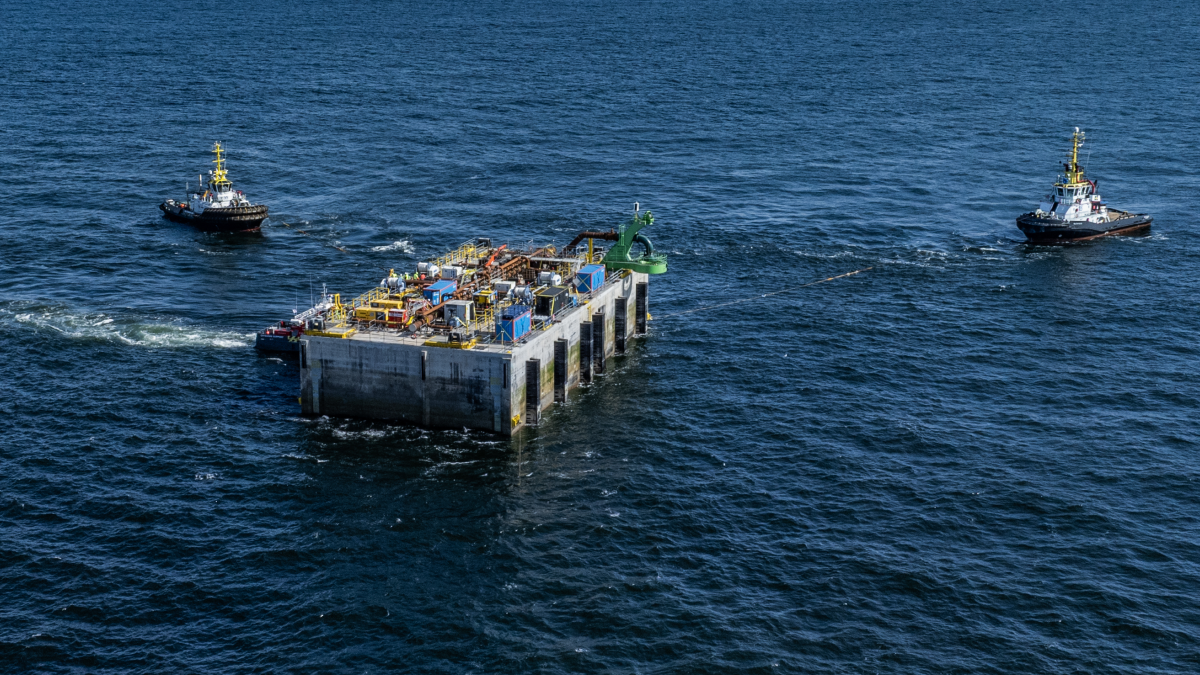
Eleven concrete caissons, each weighing more than 22,000 tonnes, were delivered and installed to form the outer walls of the island.
The second phase of the project, to install several more concrete caissons, will commence in Q2 2026.
Both the Scheldt Tunnel and Princess Elisabeth Island projects presented challenges, such as submerging the concrete tunnel elements in a heavily congested waterway and installing caissons in unpredictable North Sea weather more than 24 nautical miles offshore.
These projects showed how complex and detailed infrastructure projects have become, said Mr Arts.
In the case of the Scheldt Tunnel, the 160 m-long concrete elements had to be towed almost 60 nautical miles from Zeebrugge to the Doel dock in Antwerp by Multraship vessels, were then prepared for immersion and towed out to the site.
They were positioned within the operating range of the shore-based winch systems and held on standby during the immersion phase, explained Mr Arts.
Meanwhile, for Princess Elisabeth Island, the 22,000-tonne caissons, measuring 58-m long and 32-m high, required millimetre precision to form a secure, watertight outer wall for the island.
To ensure they were as prepared as possible, tow masters and vessel masters simulated the operational phases of each element to assess proposed methods, identify and mitigate potential risks and determine realistic timeframes, said Mr Arts, adding that simulations are now vital for complex scenarios that involve multiple tugs.
"To ensure we were as prepared as possible, Multraship’s methods were further developed into detailed and phase-specific planning, based on weather patterns, currents, tidal conditions and other environmental factors,” he noted.
“Tow masters need to know when and how to deviate from the original scenario if there are immediate changes to weather conditions,” Mr Arts added.
“We deliberately test and simulate these scenarios ahead of any major project to ensure we are aware of and able to handle any potential risks. The potential outcome if simulations did not take place could be catastrophic,” he added.
This emphasis on method discipline and preparation is central to modern project towage. Low-speed manoeuvrability, hydrodynamic behaviour, and towline load management have become critical factors, particularly where environmental forces interact with confined operating spaces.
These risks are often underestimated outside the towage sector but are dominating planning and execution at the project level, said Mr Arts.
Co-ordination with other stakeholders is another defining feature. Multraship was closely involved in discussions with authorities, pilots, and other parties throughout the extended preparation and planning period of these projects.
This early engagement helped ensure that agreed methods were workable in practice, compliant with local regulations, and could be executed safely by all crews once operations commenced.
“We support our clients as fully as possible to achieve a technically and operationally workable solution,” Mr Arts explains.
“For these projects, the areas were also very dense transport routes, so methods had to warrant maximum availability of the waterways for other traffic. Authorities needed to be convinced that the methods were safe and that all risks were mitigated.”
Changing operational windows
Flexibility during execution remains essential, even with extensive preparation. Strict weather limits were defined for both projects, supported by feasibility assessments and formal go or no-go procedures ahead of each phase.
Despite intensive monitoring, conditions occasionally changed, and operational windows closed unexpectedly.
In such cases, towage operations had to be rescheduled at short notice, increasing the need for skilled tow masters capable of responding quickly to changing project requirements.
During these periods, Multraship’s tow masters and project co-ordinators played an important role, maintaining clear communication with a large number of stakeholders while ensuring that agreed safety measures were consistently applied throughout the operation.
“On more than one occasion we had last-minute cancellations due to weather, where we had to reschedule all operations in record time,” said Mr Arts. “We also supported clients in sourcing equipment and services when capacity or specific knowledge was not available.”
Reflecting on lessons learned, Mr Arts highlighted both strategic and operational gains that Multraship is looking to take to its next projects.
“On a macro level, our team built up additional experience, which leads to more efficient preparation and execution in future projects,” he said.
“On a micro level, our lessons-learned system after each phase resulted in safer execution and shorter lead times, sometimes within the same project.”
As Europe’s infrastructure continues to expand offshore and beneath waterways, the role of project towage is becoming defined by early technical involvement, strict discipline, and close integration with construction planning.
For key players such as Multraship, this represents not a departure from traditional towage but its evolution into a core element of modern infrastructure delivery.
The 28th International Tug & Salvage Convention, Exhibition & Awards will be held in Gothenburg, Sweden, in association with Caterpillar, 19-21 May 2026. Use this link for more details of this industry event and the associated social and networking opportunities.
Related to this Story
Events

Maritime Regulations Webinar Week
16 Dec 2025GMT - ONLINEFloating energy: successfully unlocking stranded gas using FLNGs and FSRUs
24 Feb 2026GMT - ONLINE
© 2024 Riviera Maritime Media Ltd.


