


Business Sectors
Business Sectors
Events
Contents
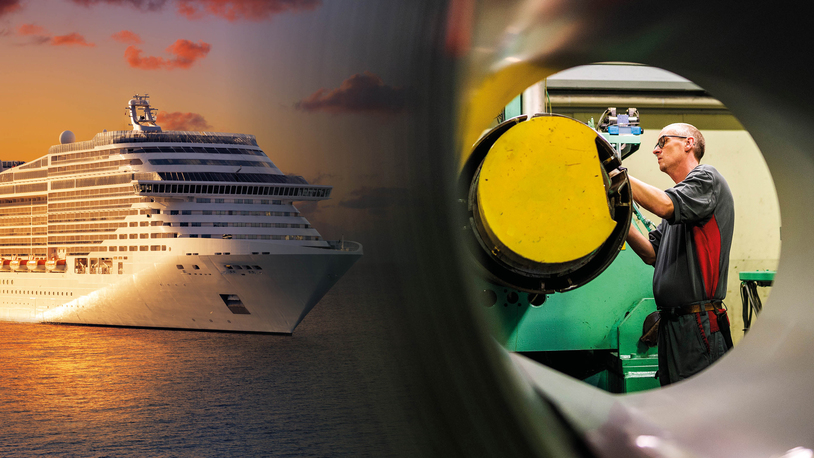
Sewage systems meet new IMO standards


Aco Marine has launched two wastewater treatment systems that will meet IMO Resolution MEPC 227(64), adopted by the Marine Environment Protection Committee in October 2012 and due to come into force on 1 January 2016. The resolution defines discharge requirements and test protocols for passenger ships in special areas. At present, only the Baltic Sea has been made a special area.
The new treatment systems are updated versions of Aco Marine’s existing Clarimar MF and Maripur NF systems, which are aimed at different segments of the shipping market. The superyacht fleet is a key target for the Maripur system, which is also suitable for ferries, a spokesman for the company told Marine Propulsion.
The Clarimar product has a more robust structure, he explained, and is being marketed towards commercial vessels, in particular cargo ships, offshore vessels and other specialist craft.
Speaking during the SMM exhibition in September, Aco Marine’s managing director Mark Beavis said that the Clarimar MF met the treatment standard without using chemicals or chlorine in the treatment process.
Instead, it uses Aco Marine’s established ACO-MF filtration technology with a new self-cleaning filtration element, which it calls a bio-sword. This combination treats waste water effectively, to well below the mandatory levels, the company said. Treated effluent is then disinfected by a UV lamp.
“The use of the new bio sword has enabled us to reduce the volume of the activation chamber and the overall footprint of the system without impacting the capacity and performance of the unit,” Mr Beavis said. It can treat up to 37.8m3 of waste water per day.
Similar technology is used in the Maripur NF unit, which can treat up to 57.5m3 of waste water per day. Unlike the Clarimar MF, which is made from a durable polymer material that is described as light weight and corrosion resistant, the Maripur NF is made from 316 stainless steel.
There are only a limited number of ship wastewater treatment plants on the market that meet IMO’s requirements, Mr Beavis said. “This is largely due to the fact that systems that have hitherto relied on dilution as a part of the treatment process will have difficulty in meeting the new testing and sampling standards of the resolution. Dilution is not a solution to pollution,” he said.
Lack of enforcement hinders IMO standard
Resolution MEPC 227(64), which will set standards for sewage discharges for new passenger ships from 1 January 2016, will suffer from a lack of enforcement, believes Mark Beavis, managing director of Aco Marine.
“The policing of regulatory compliance is always an issue and enforcement can of course be improved upon,” he told Marine Propulsion. A similar point has been made in the past by Wärtsilä. An article published in its In Detail technical journal during 2013 noted the lack of enforcement measures in the resolution and cited a report from one IMO member state that had surveyed the performance of sewage treatment plants on 32 ships. “None of the ships satisfied even the most relaxed MEPC.2(VI) rules adopted in 1976,” Wärtsilä reported.
“The IMO rules alone many not be enough,” Mr Beavis said, since many local requirements set even more stringent rules. So when buying treatment systems, “it is a case of buyer beware. You cannot take everything at face value,” he said.
Nonetheless, “regulation is key to keeping the seas clean,” believes Norway’s Jets Vacuum. “Without stricter regulation, there is no real incentive for most shipowners to invest in cleaner technology and less incentive for suppliers such as ourselves to fund research into cleaner treatment technology,” Even Fylling, sales manager in its Ship & Offshore Division, told Marine Propulsion. MP
Related to this Story

Events

Maritime Regulations Webinar Week
 16 Dec 2025
 GMT - ONLINE
Floating energy: successfully unlocking stranded gas using FLNGs and FSRUs
24 Feb 2026GMT - ONLINE
© 2026 Riviera Maritime Media Ltd.


