


Business Sectors
Business Sectors
Events
Contents

Register to read more articles.
Novel carbon capture system and ammonia carrier design get green light
Japanese concept designs for OCCS and ammonia-powered gas carrier receive approvals in principle, advancing their development


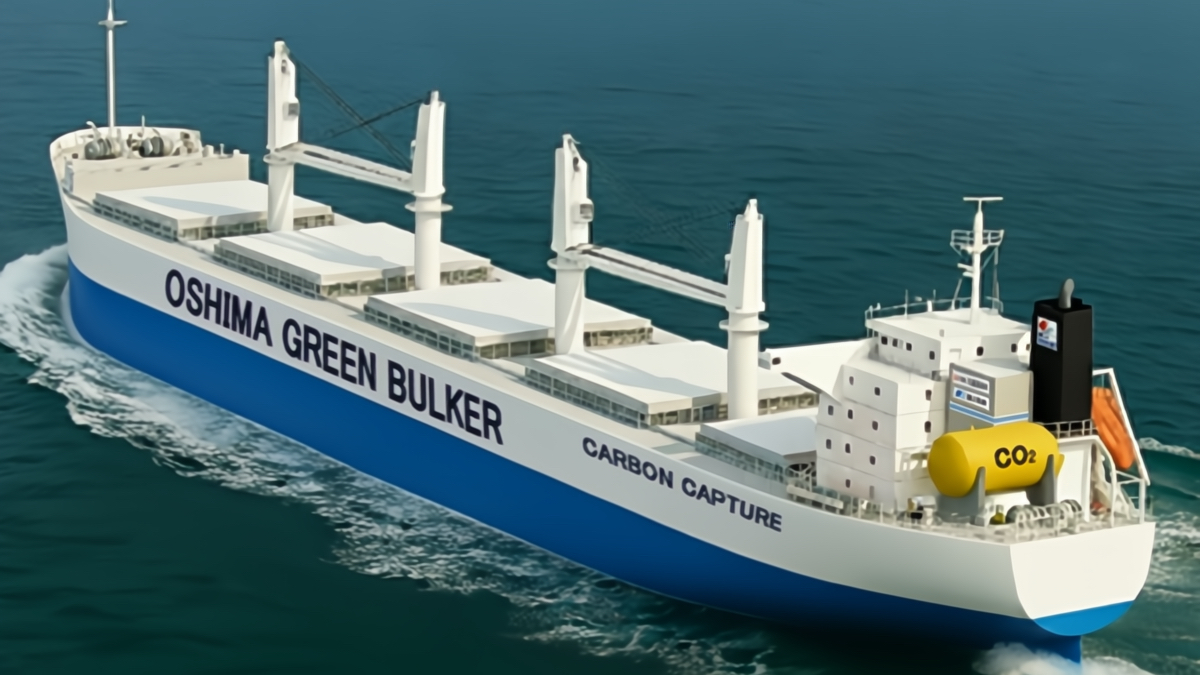
Concept designs for a dry bulk carrier equipped with a membrane-based onboard carbon capture and storage system (OCCS) and for an ammonia-powered 83,000-m3 ammonia carrier with an IMO Type B independent tank, developed by Oshima Shipbuilding, have been awarded approvals in principle (AiPs).
Awarded by ClassNK, these AiPs signify that the novel designs by the Japanese shipbuilder meet the Japanese class society’s regulatory and safety guidelines, allowing them to proceed to further development.
Oshima Shipbuilding and Fuji Electric received the AiP for the dry bulk carrier design fitted with the OCCS. The AiP was awarded in accordance with ClassNK’s Guidelines for Onboard CO2 Capture and Storage System (Edition 2.0), published in October 2025. These guidelines outline the requirements for OCCS using membrane separation technology, which is anticipated to have a lower power demand and require less installation space than amine absorption, according to the class society.
Separately, Oshima Shipbuilding was granted an AiP for its 83,000-m3 ammonia carrier with an IMO Type B independent tank. An IMO Type B independent tank is defined in the International Code for the Construction and Equipment of Ships Carrying Liquefied Gases in Bulk – commonly known as the IGC Code – and offers advantages in cargo capacity and outfitting efficiency, but also requires a significantly higher level of engineering sophistication than other cargo tank types. ClassNK conducted its review of this concept design based on Part N of its Rules and Guidance for the Survey and Construction of Steel Ships, which incorporates the IGC Code, along with relevant guidelines.
Riviera’s CO2 Shipping, Terminals and CCS Conference, APAC will be held in Kuala Lumpur on 30 March 2026. Use this link for more information and to register for the event.





Related to this Story


Events

Maritime Regulations Webinar Week
 16 Dec 2025
 GMT - ONLINE

Floating energy: successfully unlocking stranded gas using FLNGs and FSRUs
24 Feb 2026GMT - ONLINE
© 2026 Riviera Maritime Media Ltd.


