


Business Sectors
Business Sectors
Events
Contents
Register to read more articles.
Offshore charging field trial to commence in 2025
Offshore charging concepts will be trialled on windfarms in 2025 with battery-powered service and transfer vessels to enable all-electric boats to be used offshore


When offshore charging equipment is proven to be feasible, owners of support vessels can invest in battery-hybrid and all-electric assets.
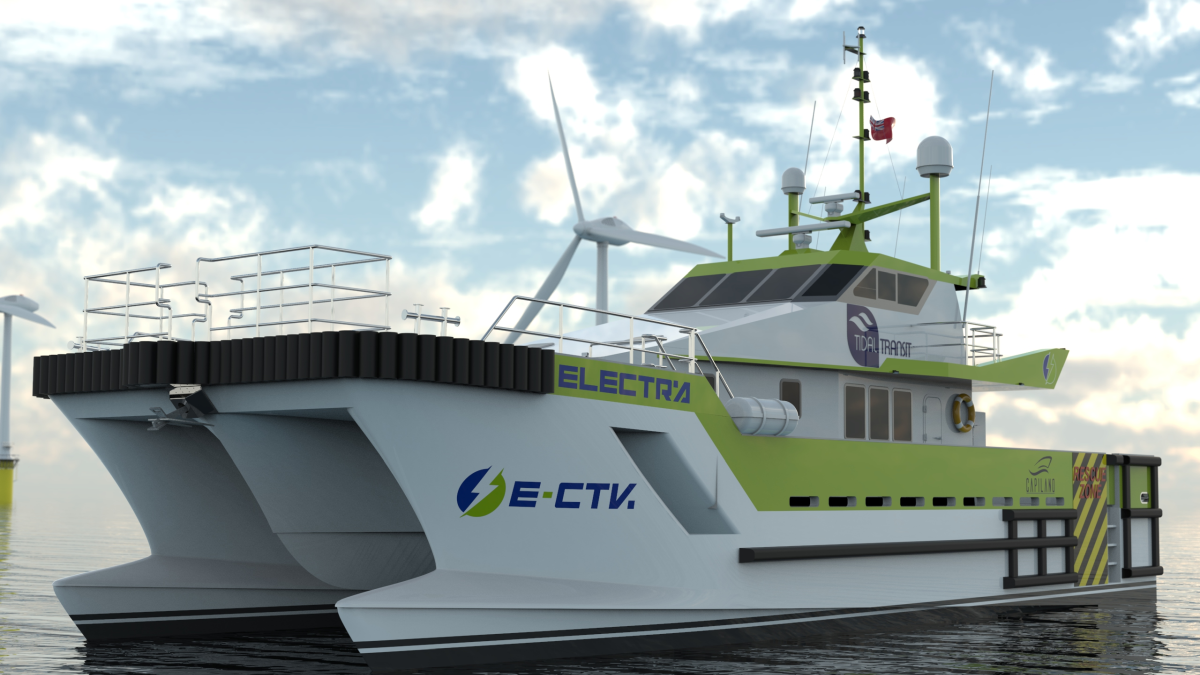
A consortium of companies intend to trial an offshore charging system on a North Sea windfarm in 2025 with a crew transfer vessel (CTV) retrofitted with connection ports and batteries.
Tidal Transit is working with Goodchild Marine Services, Artemis Technologies and MJR Power & Automation on a project to retrofit diesel-powered CTV Ginny Louise with more than 3.4 MWh of battery capacity, electric motors and propulsion pods. The finished vessel, e-Ginny from Goodchild’s facilities, will be not produce any emissions, and will be near-silent when operating on these Corvus Energy batteries.
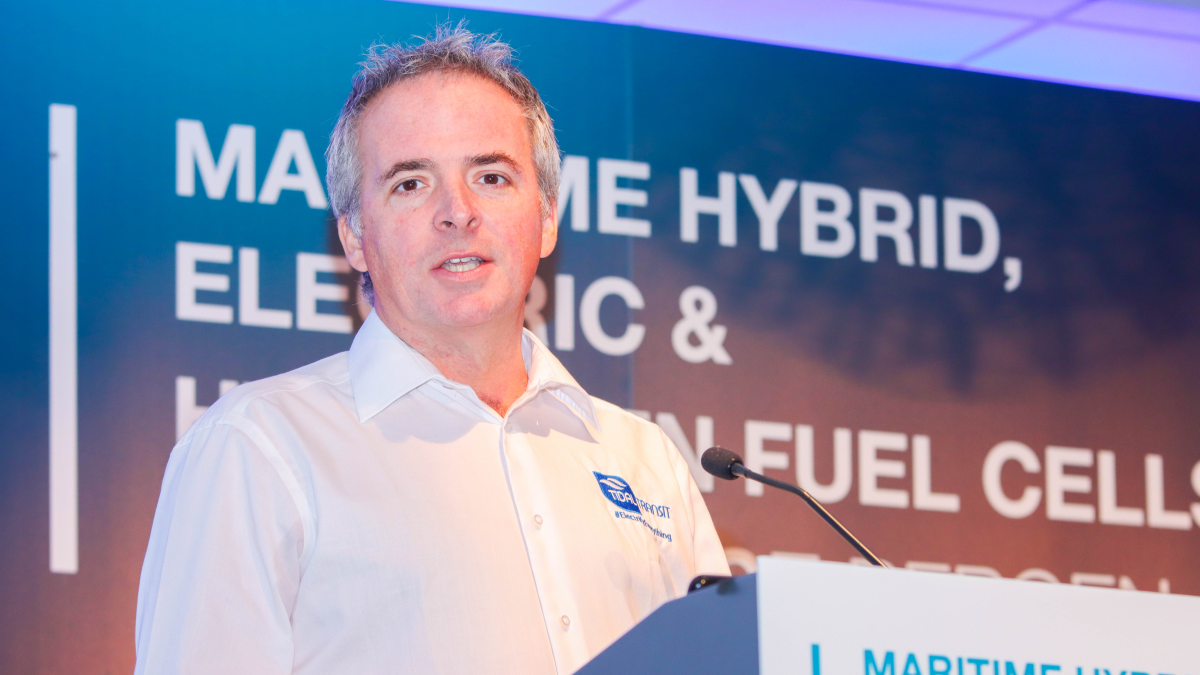
It will then be used to test an offshore wind turbine based-charger from MJR and an onshore charging station from Artemis in 2025, said Tidal Transit director and co-founder Leo Hambro.
“The retrofit is already well underway and we expect e-Ginny back in the water in March 2025 and to commission MJR’s charger in May 2025,” said Mr Hambro at Riviera’s Maritime Hybrid, Electric & Hydrogen Fuel Cell Conference, which took place in Bergen, Norway.
“This is a three-year demonstration, but it would take just three months to prove this works. We would encourage the UK government to shorten the demonstration period and then we can sell what we are trying to do earlier.”
The retrofit and offshore charging trial is receiving from £6.3M (US$8.0M) in funding from the Zero Emissions Vessel and Infrastructure competition, as part of Innovate UK and the Department of Transport’s strategic plan to develop, deploy and operate clean maritime solutions.
Ginny Louise is being outfitted with Volvo IPS30 propulsion, four Danfoss motors and energy management system, 3.4 MWh of batteries, all into a 20 m catamaran. “We are going from fixed pitch to quad thrusters,” said Mr Hambro.
Offshore charging will also be available to provide power to service operation vessels (SOVs) working in windfarms once these concepts are proven. SOVs are now being built with battery hybrid propulsion and engines ready to run on alternative fuels to diesel.
GC Rieber Shipping is awaiting delivery of the first of two Windkeeper SOVs from Cemre shipyard in Turkey in Q3 2025.
Both vessels are being built with a small waterplane area twin-hull (SWATH) design and are prepared for offshore charging, said GC Rieber chief technical officer Gjert Florvog.
He said these Windkeeper SOVs are equipped with DC grids and propulsion technologies to reduce fuel consumption and be ready for future conversion to an alternative fuel.
“Electric is the easiest way to get the power, but we need infrastructure to be available, and a viable and strong business,” said Mr Florvog.
“There is a super-grid out there, but it is difficult to get connections for SOVs. New windfarm projects need to look at opportunities for offshore charging. It is important to establish infrastructure to build and develop now, to get away from marine gasoil.”
Damen Shipyards has developed battery-hybrid SOV designs and partnered with MJR to test offshore charging. Its SOV 7017 vessel will have 15 MWh of batteries, while its commissioning vessel of CSOV 9020 design would include 25 MWh of energy storage.
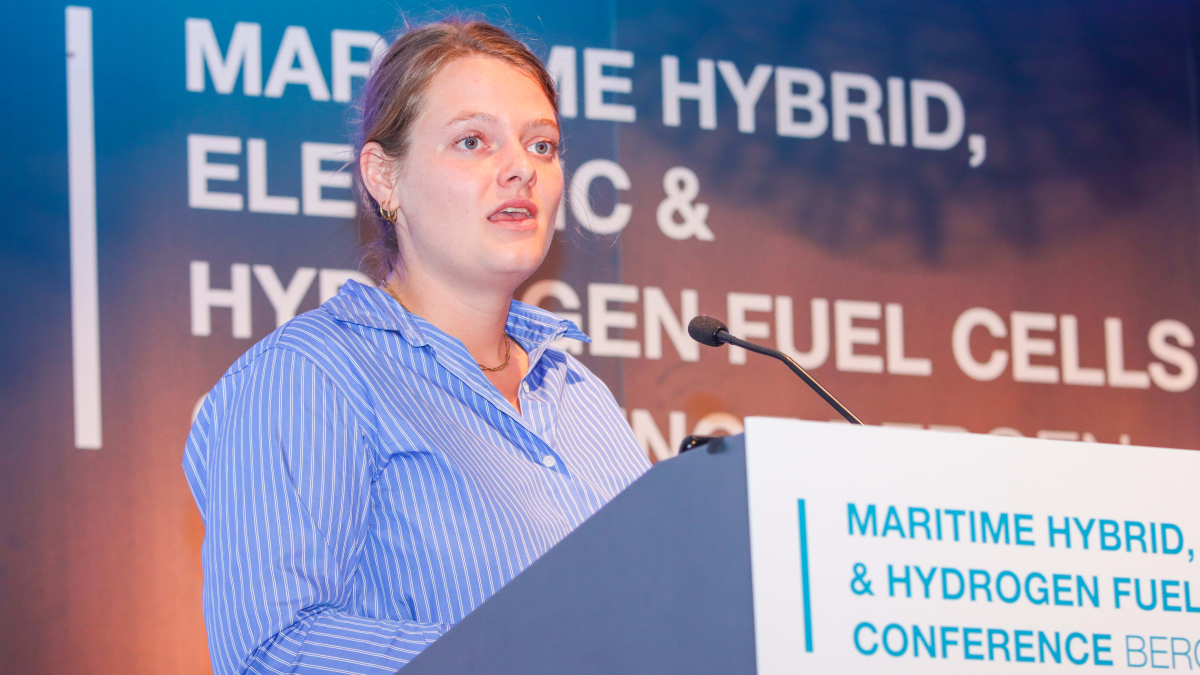
Its SOV design includes a 3D motion-compensated gangway to grab the cable from the charger, then pull it to the vessel for the power connection, said Damen design and proposal engineer Rebecca Belmer.
“This would be all automated and if the vessel drifts off the turbine, then the vessel can emergency release the cable and sail away,” she said.
It is envisioned an SOV would drop off technicians and use its idle time to charge, so it is ready to pick them up again. “How this would work in a 24-hour day would depend on the number of charge points, drop off tasks, time waiting for work, the installed battery capacity, power demand on the vessel and the operating profile,” said Ms Belmer.
The Maritime Hybrid, Electric & Hydrogen Fuel Cell Conference took place in Bergen, Norway, on 29-31 October 2024, looking at key trends, regulations, class rules and the development of zero-emissions ecosystems.
Riviera’s Maritime Decarbonisation Conference, Americas will be held in Houston, Texas, 4 December 2024. Click here for program information, tickets, or to register your interest in this industry-leading event.

Related to this Story


Events

Maritime Regulations Webinar Week
 16 Dec 2025
 GMT - ONLINE
Floating energy: successfully unlocking stranded gas using FLNGs and FSRUs
24 Feb 2026GMT - ONLINE
© 2026 Riviera Maritime Media Ltd.


