


Business Sectors
Business Sectors
Events
Contents
Register to read more articles.
Shipowners invest in green newbuildings to cut fleet emissions
European Union carbon regulations are driving demand for newbuild commercial ships running on alternative fuels


Most ships are still built to use conventional fuel oils, including those with very low sulphur levels, but this is changing as owners are encouraged to prepare for low-emissions fuels.
99.5% of the existing global fleet operates using fossil fuels, but an increasing number are being ordered at shipyards to run on alternative fuels such as methanol, LPG and LNG.
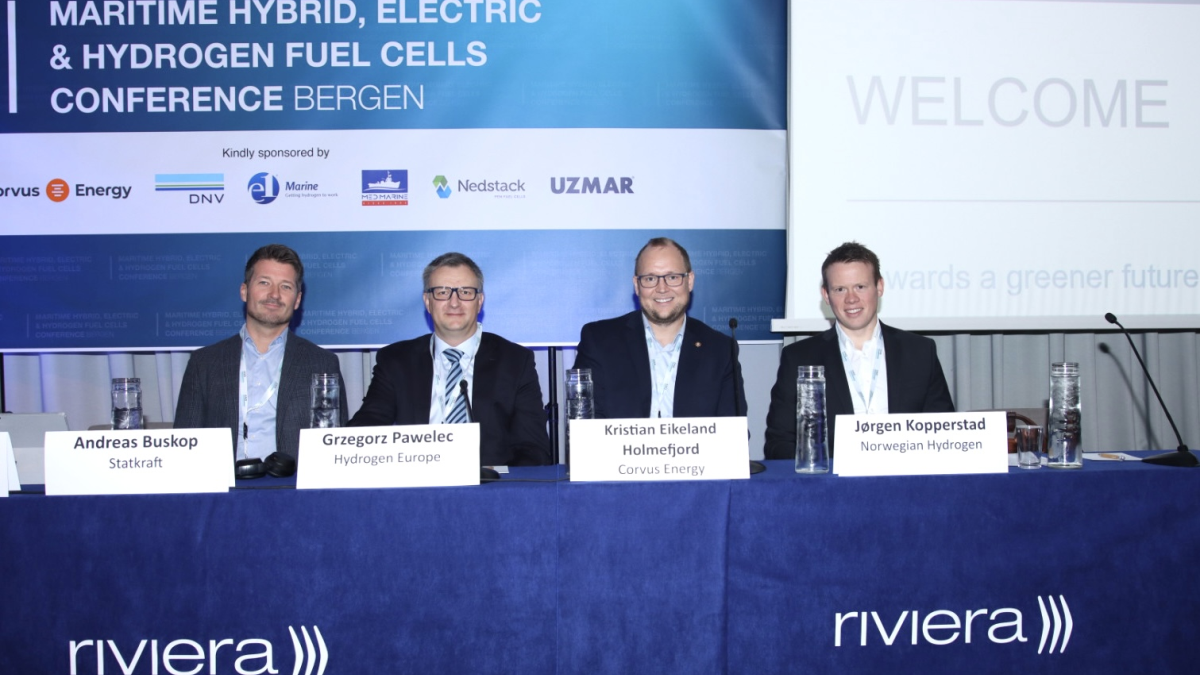
“On order, 83.8% are on conventional fuels,” said Norwegian Hydrogen head of maritime infrastructure Jørgen Kopperstad at Riviera Maritime Media’s Maritime Hybrid, Electric & Hydrogen Fuel Cells Conference in Bergen, Norway, 17-19 October 2023.
“And for new contracts signed in 2023, 78% are on traditional fuels. So, we are seeing step by step progress in maritime.”
Many of the ships on order will have dual-fuel engines enabling them to operate on green and conventional fuels, depending on availability and prices. “Things are really happening now,” said Mr Kopperstad. “It is primarily led by container shipping because of regulatory pressures, particularly EU’s emissions trading scheme and Fit for 55 incentives.” There are also several gas carriers on order that will use LPG and LNG fuels.
One reason is the cost of operating on conventional fuels and sailing into European ports once the EU ETS is implemented. Mr Kopperstad calculated it could cost a large container ship US$8M per year in carbon taxes under the scheme.
Hydrogen Europe director of intelligence Grzegorz Pawelec said there is funding to encourage the development of green fuels and construction of ships operating with low or zero emissions.
He said the calls for funding development work for 2023 are now closed, but there will be more funds available for projects in 2024 under EU programmes such as Horizon Europe for proof of concept, pilot projects and demonstrations.
Mr Pawelec expects EU ETS innovation funding to support the roll-out of green power technologies across shipping fleets.
He said compressed hydrogen is good for ferries and vessels operating on short and fixed routes. “But for larger ships and longer routes, compressed hydrogen becomes unfeasible and we need to look at other options,” said Mr Pawelec.
This could be liquid hydrogen, methanol and ammonia. The EU ETS innovation fund will enable shipping companies to invest in newbuilds using alternative fuels providing finance to support the higher capital costs and up to 10 years of operations.
While existing projects are demonstrations, real-life fuel-cell products are required for the wider industry to adopt these propulsion and power systems.
Corvus Energy has developed a commercial hydrogen fuel cell based on proton exchange membrane (PEM) technology developed by Toyota. The first Corvus Pelican PEM fuel cells will be installed on a fishing and training vessel in 2024, said Corvus executive vice president and project director for fuel cells, Kristian Eikeland Holmefjord.
“Our Pelican fuel-cell system is designed for life at sea with flexibility and modularity for scaling up for larger ships,” he explained.
“Our first will be installed in Q3 2024 on Hvinde Sande which already has batteries, and will have compressed hydrogen and fuel cells for zero emissions for when the vessel is not able to operate only on batteries,” said Mr Holmefjord.
Corvus developed the system with safety in mind. This includes using gas-safe design principles with the fuel cells enclosed within an inert atmosphere to prevent hydrogen ignition and pressure-safe enclosures to mitigate leakage risks.
“Safety in marine is different to safety on land,” said Mr Holmefjord. “We must make sure there are no safety issues.”
Riviera Maritime Media’s Maritime Decarbonization Conference, Americas will be held 12-13 December 2023 in Houston, USA. Use this link for further information and to register your interest
Related to this Story

Events

Maritime Regulations Webinar Week
 16 Dec 2025
 GMT - ONLINE
Floating energy: successfully unlocking stranded gas using FLNGs and FSRUs
24 Feb 2026GMT - ONLINE
© 2026 Riviera Maritime Media Ltd.


