


Business Sectors
Business Sectors
Events
Contents
Register to read more articles.
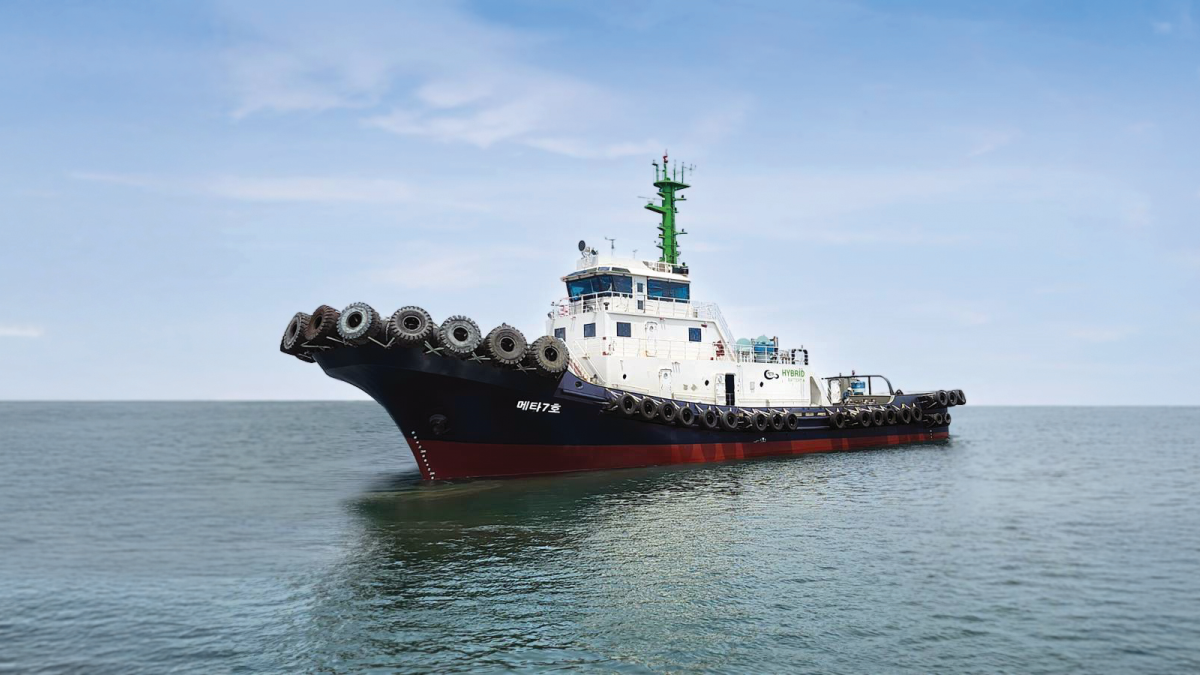
South Korea’s first electric tugboat unveiled
Emissions from docking and ship towage have been reduced in Busan Port with the introduction of battery-electric tug Meta 7


Towage in one of the largest and most polluted ports in South Korea is becoming greener with the introduction of a battery hybrid tugboat.
DongSung shipyard built Meta 7 as the first tug with hybrid-electric propulsion to handle, assist and dock ships at Busan Port, which faces increasing pressure to reduce air pollution. The port is known for its poor air quality, which is largely due to emissions from ships, so using electric tugboats such as Meta 7 will help to mitigate this problem by reducing the exhaust of harmful pollutants.
Meta 7 started operations in Q3 2024 and is seen as a pioneering project, demonstrating the potential of electric propulsion in the maritime industry. By reducing emissions and improving air quality, the vessel can help to create a more sustainable and environmentally friendly port environment, says owner Meta Tug’s vice president Hong Jae Kim.
“Since its deployment in Busan this summer, battery hybrid tug Meta 7 has shown promising results. By utilising battery power for up to one hour during transit operations, we have successfully reduced emissions and improved air quality, contributing to a more sustainable and environmentally friendly port environment.”
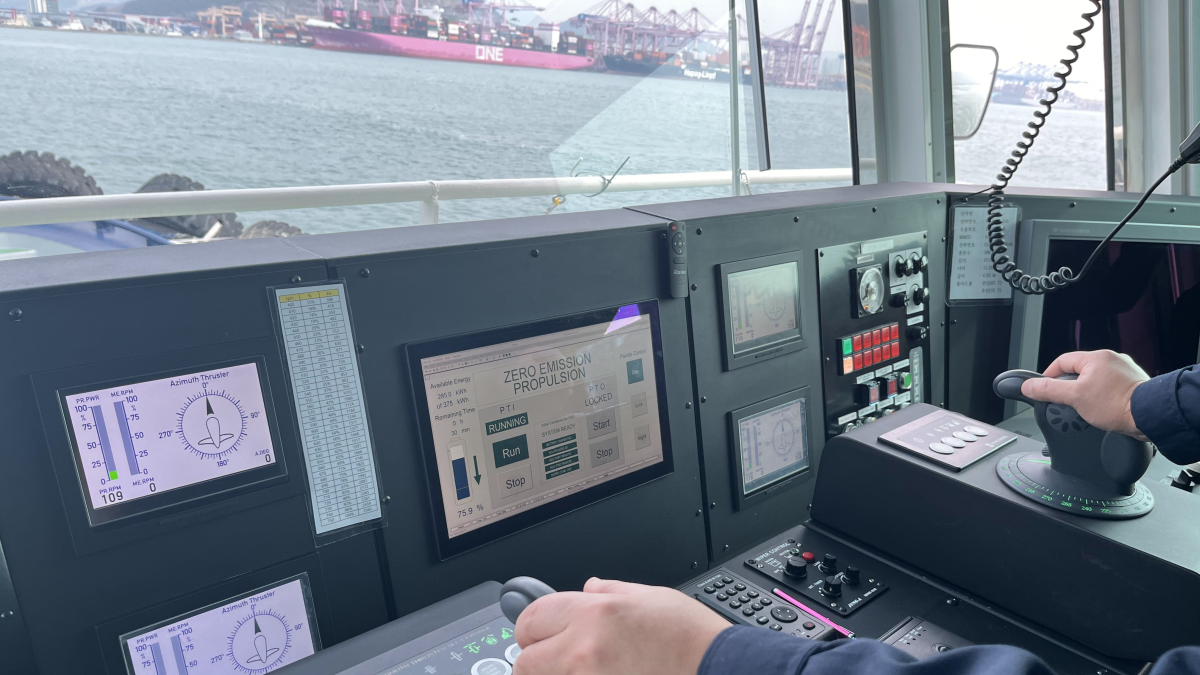
Meta 7 has an energy storage system, distribution system for direct current (DC), a transformer and connection for shore power charging, plus it has a power take-in (PTI) unit and a diesel engine to drive power to the two azimuth thrusters.
“While the diesel engine remains in use and automatic hybrid mode conversion is not yet applied, the PTI mode has proven beneficial by lowering fuel consumption and easing maintenance due to the reduced operating time of rotating machinery,” says Mr Hong. “As the demand for cleaner and more efficient vessels grows, we anticipate seeing more electric tugboats such as Meta 7 in the future.”
Another hybrid-electric tugboat is near completion in South Korea as part of the Sunjin project to operate in Ulsan Port, and another for Gunsan Port is scheduled for commissioning and delivery in 2025.
These vessels all feature hybrid systems and propulsion from Kongsberg Maritime for reducing emissions and improving ship manoeuvring and docking in harbours and terminals.
Meta 7’s hybrid-electric propulsion combines 646 kWh of batteries with a diesel engine to generate electricity running twin Kongsberg US 255 S P30 azimuth thrusters with electric induction motors and a fixed-pitch propeller. The electric motor can be used to propel the vessel independently or in conjunction with the diesel engine.
Kongsberg integrated the power and propulsion system and supplied its K-Power DC electrical system with the energy storage modules, transformer, connection for shore charging and the K-Chief 700 automation and controls.
When operating on electric power, Meta 7 produces no emissions, a significant advantage over traditional diesel-powered tugboats. By reducing its reliance on diesel fuel, Meta 7 is helping to improve the air quality in Busan Port and contribute to a more sustainable maritime industry.
“Meta 7 is designed to operate on full electric power for most of its tasks, including berthing and unberthing operations,” says Kongsberg Maritime team manager for LNG and energy, Hyeon Ho Hwang.
“This is made possible by the vessel’s advanced battery system, which can store enough energy to power the electric motor for extended periods. Generally, the tug can operate for one hour for normal speed transit operations.”
Kongsberg Maritime vice president for regional sales in South Korea and Japan, Kyu Sung Jung, says there are several benefits from Meta 7 operating on full electric, including reduced emissions.
“This is particularly important for tugboats, which often operate in confined spaces near residential areas,” he says.
“The reduction in smoke emissions will help to improve air quality and reduce the impact of port operations on local communities. As the demand for cleaner and more efficient vessels continues to grow, it is likely we will see more electric tugboats and other electric marine vessels being introduced in the years to come.”
Following the delivery of the three hybrid-electric tugs in South Korea, the vessel operators and system provider will monitor their activities and emissions to gain a greater understanding of the savings and costs of battery-hybrid systems.
Busan Port, located on the southeastern coast of South Korea, is a major international shipping hub. The port handles a wide range of marine traffic, including container ships, bulk carriers, tankers, and roro vessels. In recent years, there has been a significant increase in the number of ultra-large container ships calling at the port, driven by the growth of global trade.
Riviera’s TUGTECHNOLOGY ‘25 will be held in Antwerp, 22-23 May 2025. Click here for more information on this industry-leading event.

Related to this Story
Events

Maritime Regulations Webinar Week
 16 Dec 2025
 GMT - ONLINE
Floating energy: successfully unlocking stranded gas using FLNGs and FSRUs
24 Feb 2026GMT - ONLINE
© 2026 Riviera Maritime Media Ltd.


