


Business Sectors
Events
Floating energy: successfully unlocking stranded gas using FLNGs and FSRUs
 24 Feb 2026
 GMT - ONLINE
Contents

US tariff tussle: supply chain disruption, trade deal uncertainty and shipping impacts
Analysts see a US Supreme Court ruling against US President Donald Trump’s tariffs as positive for container trades in the short term


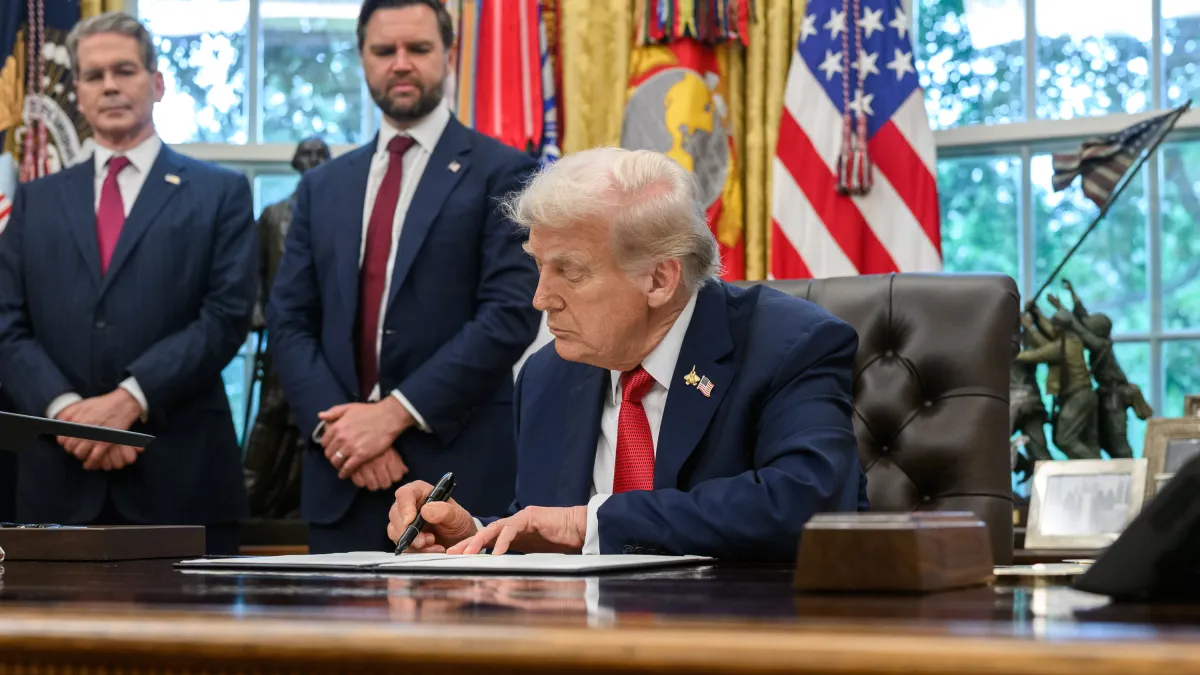
Trade tensions escalated on Friday as US President Donald Trump declared a new global levy in response to a US Supreme Court ruling that prior tariffs imposed by the Trump administration are not legally authorised.
In a 6-3 decision on 20 February, the US Supreme Court ruled that the International Emergency Economic Powers Act (IEEPA) of 1977 did not provide legal justification for the Trump administration’s reciprocal tariffs.
On the same day, the White House announced the termination of certain tariff actions while simultaneously imposing a 10% ad valorem import duty under Section 122 of the Trade Act of 1974, which allows the president to address “certain fundamental international payment problems through surcharges and other special import restrictions.”
Donald Trump described the Supreme Court’s decision as “ridiculous” and later said the US would raise global tariffs to 15%.
Under Section 122, the president is authorised to impose a temporary import surcharge of up to 15% ad valorem for a period not exceeding 150 days, unless extended by Congress, according to a White House announcement on 20 February.
The temporary import duty is set to take effect on 24 February.
As the battle between the executive and legal branches of the US government unfolds, US trade deals with key partners hang in the balance and shippers are once again forced to decipher which tariffs apply to which products.
Looking at the effects of the court opinion on trade volumes and rates, analysts see the ruling as positive for container trades in the short term, with the impact on tanker trades expected to be minimal.
For dry bulk, sources suggest that China could take a different path on its US soya bean purchases, with Beijing entering upcoming negotiations in a stronger position based on the court’s decision.
Navigating the post-ruling landscape
Maritime Strategies International (MSI) director Daniel Richards told Riviera that any tariffs introduced under the IEEPA are now invalid. “All other tariffs implemented since January 2025, including those targeting the steel, aluminium, copper, automotive and lumber sectors, remain in place,” he explained.
According to Mr Richards, the situation for many individual countries is now murky – particularly for those that have negotiated trade agreements with the US over the past year.
“Following the introduction of the new 15% fee, the average tariff level faced by most countries is unlikely to have shifted significantly. However, economies such as Brazil, China and Bangladesh now see an improved situation,” Mr Richards noted.
Questions about refunds for those affected have also arisen.
“The Supreme Court ruling raises questions about potential refund entitlement, but refunds are neither automatic nor guaranteed and will likely take years to achieve,” Reed Smith partner Philippe Heeren told Riviera.
“In the meantime, companies are focused on more immediate concerns: determining which tariffs apply and whether operational adjustments are required,” he added.
“The court ruling and the administration’s response are affecting an already fragile international balance,” Mr Heeren said.
Global trade partners react
Bloomberg reported on 23 February that the European Union plans to freeze ratification of last year’s trade deal with the US. In an interview with Bloomberg, the lead negotiator for the European People’s Party on the agreement said there was “no other option” but to postpone approval until the situation becomes clearer.
Meanwhile, an Indian commerce ministry official told the BBC that India and the US have deferred trade talks scheduled for this week, as both sides assess the implications of the Supreme Court’s decision. Indian officials had been expected to travel to Washington to finalise the terms of the agreement, under which tariffs on Indian goods entering the US were reduced from 50% to 18%, including secondary tariff measures.
In the UK, a spokesperson for Prime Minister Keir Starmer was quoted by The Guardian as saying that the new 15% global tariff is not expected to impact the “majority” of the US-UK economic agreement.
However, British Chambers of Commerce head of trade policy William Bain said in a statement that the “40,000 UK companies exporting goods to the US will be dismayed at this latest turn of events.”
He added: “This will be bad for trade, bad for US consumers and businesses, and will weaken global economic growth. Businesses on both sides of the Atlantic need a period of clarity and certainty.”
Impact on shipping
For shipping markets, the immediate focus is container trades.
Drewry managing director, head of supply chain advisors Philip Damas told Riviera that the new developments could result in lower overall tariffs, potentially boosting US-bound container volumes.
Drewry is currently surveying customers to quantify the magnitude and the duration of the increase in US shipping volumes, as it could mean a surge of imports to the US.
“There could be changes or reactivations of carrier services and rate increases ahead. However, the outlook remains highly uncertain,” Mr Damas said.
In the tanker segment, BRS Shipbrokers said the developments have injected fresh uncertainty into oil markets, particularly in light of delays in finalising a US-India trade deal.
“Any delay could prove a headwind to US crude exports to India given that they were slated to pick up in the wake of the deal,” BRS noted.
Although this suggests that there could be some future shifts in oil flows, the brokerage said the broader macro impact on tanker demand is likely to be minimal.
“Given how most economies have dealt pretty well with the tariffs imposed last year, we do not see the latest uncertainty materially impacting oil consumption,” BRS added.
In dry bulk, BRS head of research Wilson Wirawan said the ruling comes ahead of an April meeting between US and China leaders.
“If emergency tariff authority is constrained, Beijing enters talks with firmer footing,” Mr Wirawan said, arguing that Washington’s ability to deploy broad, rapidly implemented emergency tariffs has been materially weakened.
When tariff escalation capacity is constrained, purchase pledges become less enforceable as a bargaining tool, reducing Beijing’s incentive to ‘buy relief’, he added.
China has reportedly met a closely watched commitment to purchase 12M tonnes (mt) of US soya beans. In late January, President Trump publicly floated increasing that figure toward 20 mt.
Tariff shifts offer gains but risks remain
All in all, while tariff shifts may create opportunities, significant risks persist.
“Shipping could stand to benefit relative to the previous status quo if replacement tariffs are concentrated on high-value, low-volume goods and commodities,” Mr Richards said.
While the ultimate ‘destination’ in terms of the overall average US tariff level may remain unchanged following the Supreme Court’s ruling, he suggested that the ‘journey’ could prove less taxing for the shipping sector.
Overall, he emphasised that the ruling reintroduces uncertainty at a point when the tariff landscape had appeared to be stabilising.
“The Trump administration is likely to be highly motivated to offset any ‘lost’ tariff revenues through alternative measures,” he added.
“From a planning perspective, the administration’s ability to threaten individual countries with tariffs at short notice has now been curtailed. However, it can still introduce extensive tariffs via slower means” Mr Richards concluded.
Sign up for Riviera’s series of technical and operational webinars and conferences:
- Register to attend by visiting our events page.
- Watch recordings from all of our webinars in the webinar library.



Related to this Story

Retrofit fund ties lease payments to performance


Events

Maritime Regulations Webinar Week
16 Dec 2025GMT - ONLINEFloating energy: successfully unlocking stranded gas using FLNGs and FSRUs
24 Feb 2026GMT - ONLINE
© 2024 Riviera Maritime Media Ltd.


