


Business Sectors
Business Sectors
Events
Contents
2024 in LNG shipping and terminals: US market speculation, thriving FSRU sector
The most read stories in the LNG sector in 2024 were often the positive news stories, although one was surprisingly popular given its relatively obscure aspect, but reveals the impact of innovative technology on the sector


FSRU market thrives amid robust long-term LNG demand growth
Drewry Maritime Research senior maritime researcher Pratiksha Negi’s report into the long-term growth in demand for FSRUs was highly popular, portraying a positive outlook for the sector. Ms Negi noted that FSRU capacity will grow at a CAGR of 6%, supported by robust LNG trade growth of 8% between 2024 and 2029.
While Europe’s LNG demand is immediate, Asia seeks long-term growth.
FSRU availability is tight due to an acceleration in European projects and this trend will continue as plans for LNG import projects emerge. Increasing FSRU supply will be challenging due to the unavailability of shipbuilding slots, which will spur demand for LNG carrier conversions.
The outlook is positive, and while Europe’s infrastructure faces potential challenges due to the push towards renewable energy and the attainment of net-zero emissions, the adaptability of FSRUs for future energy carriers such as hydrogen and ammonia offers a strategic advantage.
Conversely, the growing energy requirements in Asia and strategic collaborations underscore a positive FSRU outlook, supported by significant infrastructure expansion and emerging opportunities.
Case study: the world’s largest FSRU starts work
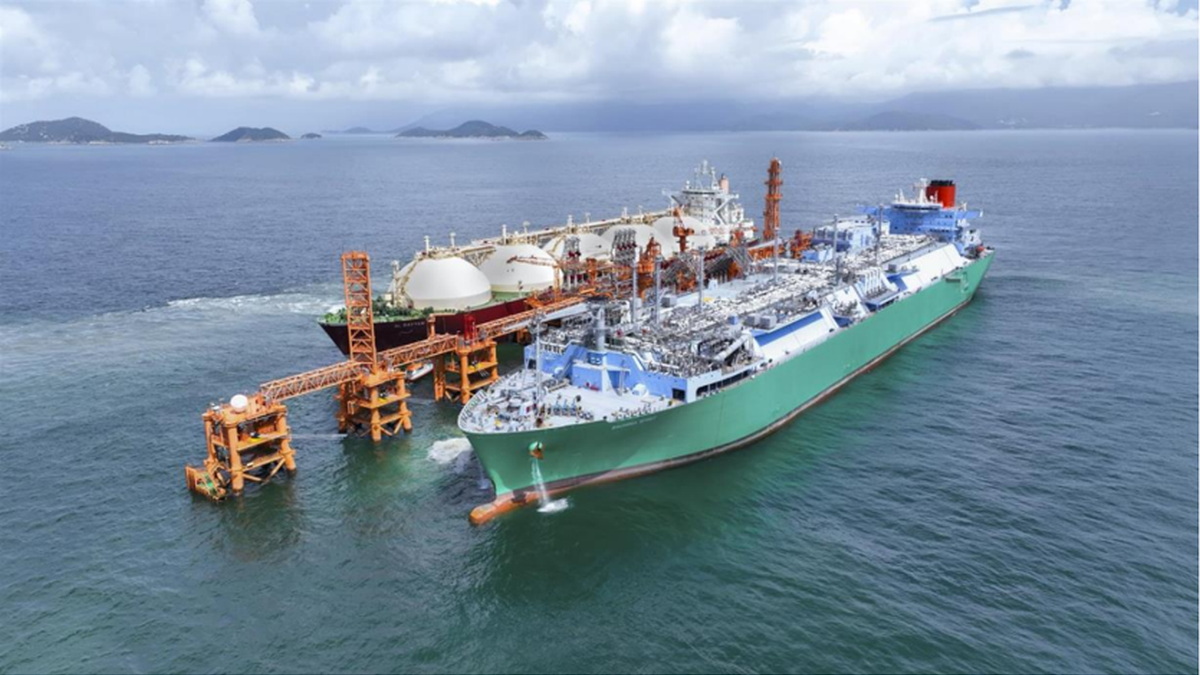
Staying with the FSRU theme, the FSRU Bauhinia Spirit case study on the jetty arrangement also proved popular.
MOL voyage manager Mihails Solovjovs explained at the LNG Shipping & Terminals Conference in November 2023 that the origins of Hong Kong’s FSRU terminal plan grew out of a response to the 2017 Paris Agreement and its Climate Action Plan on decarbonisation and climate change.
Natural gas is a transition fuel that supports Hong Kong’s journey towards its 2050 carbon neutrality target by lowering the carbon intensity of power generation. Hong Kong utility firms CLP Power and HK Electric collaborated to form the Hong Kong LNG Terminal Ltd, a joint venture between the two companies.
MOL’s 2017-built MOL FSRU Challenger was chosen for the project and the vessel’s regasification equipment was enhanced at Keppel Shipyard (now Seatrium) in Singapore in 2022. This included upgrading the FSRU’s original nominal regasification capacity from 540M cubic feet per day (mmcfd) to 600M mmcfd and to increase the maximum from 720 mmcfd to 800 mmcfd.
The scope of the modification project included installing an additional vaporiser skid, medium high-pressure pump, high-pressure manifolds, power supply facility for jetty equipment and cryogenic test. Read the full case study here.
SIRE 2:0: on your marks, get set, go
Perhaps receiving a less positive appreciation, is the ’ticket to trade’ of inspection and vetting, according to the initial feedback from owners and operators.
In September, OCIMF announced SIRE 2.0 is now live and it has withdrawn the SIRE VIQ7 tanker inspection option. This was the start of new era. Vessel operators are now only able to request tanker inspections that use the SIRE 2.0 Compiled Vessel Inspection Questionnaire (CVIQ) which is completed on a tablet device by accredited SIRE 2.0 inspectors. The move to the digitalised inspection programme means every tanker inspection will be tailored to the individual vessel and its risk profile.
These inspections will require vessel operators and their crew to be prepared to respond to any potential inspection questions from the SIRE 2.0 Question Library.
SIRE 2.0 inspection reports contain marine assurance data and provide feedback on all aspects of vessel safety including hardware, processes and human factors. As a result, these inspection reports will enable marine assurance teams to conduct more indepth assessments of the quality of a vessel and its crew.
Technip Energy: election could change US permitting for LNG projects
As far as the development of US LNG exports go, all eyes are on president-elect Donald Trump. The desired outcome was voiced by France-based Technip Energies chief executive Arnaud Pieton who speculated in a company earnings call to investors that the then upcoming US presidential election could result in faster permitting timelines for LNG projects in a news story posted on 4 November 2024.
“A Trump victory could lift the moratorium faster,” Mr Pieton said, while underscoring how energy policies may impact project timelines and market potential.
On the campaign trail, Mr Trump has promised to speed up energy permitting, but analysts have questioned whether another of his policy promises, to apply 60% tariffs on imports from China, would negate any market expansion from faster permitting.
Real-time gas analysis attracts investment
A story that was perhaps surprisingly popular to many was the news that innovative gas analyser technology provider Tunable had attracted investment totalling Nkr40.0M (US$3.7M) from Wilhelmsen and other Norwegian investors. This reveals the depth of interest in having real-time analysis of gas cargoes and gas fuels.
The investment round was led by Wilhelmsen with Skagerak Capital, GTT, Trumpf Venture, MP pension and the Skeie family, and is anticipated to pave the way for Tunable’s expansion into new markets and further development of its product portfolio.
Tunable’s technology was highlighted for its potential to transform how the industry approaches CII ratings, with the real-time gas data solution providing granular insights into gas emissions, allowing for real-time adjustments and long-term strategy improvements.
Sign up for Riviera’s series of technical and operational webinars and conferences:
- Register to attend by visiting our events page.
- Watch recordings from all of our webinars in the webinar library.
Related to this Story

Events

Maritime Regulations Webinar Week
 16 Dec 2025
 GMT - ONLINE
Floating energy: successfully unlocking stranded gas using FLNGs and FSRUs
24 Feb 2026GMT - ONLINE
© 2026 Riviera Maritime Media Ltd.


