


Business Sectors
Business Sectors
Events
Contents
Register to read more articles.

Two-stroke, dual-fuel methanol engine orders continue to soar
Methanol has quickly emerged as a leader in the alternative fuel race to speed shipping’s decarbonisation


This is clear from the latest data shared by leading two-stroke engine designer MAN Energy Solutions, which reported it has secured orders for 78 methanol-burning, dual-fuel ME-LGIM engines.
The latest order is for six MAN B&W G95ME-C10.5-LGIM dual-fuel main engines for six 17,000-TEU container vessels for AP Moller–Maersk that will be built by Hyundai Heavy Industries. Hyundai’s engine machinery division will build the engines in South Korea, which will be capable of running on green methanol when it becomes available.
“The adoption of methanol propulsion is gaining pace, behind which there are several drivers,” noted MAN Energy Solutions senior vice president and head of two-stroke business Bjarne Foldager. Mr Foldager noted that MAN B&W methanol engines are a proven technology and have been in commercial service since 2016.
“Additionally, as a fuel, methanol can be carbon-neutral when produced from renewable energy sources and biogenic CO2. The production capacity of such green methanol is currently increasing significantly; it is also liquid at ambient conditions, which simplifies tank design and minimises costs. Finally, our methanol engine only requires a fuel-supply pressure of 13 bar and a number of manufacturers already offer such fuel-supply systems,” added Mr Foldager.
Recent newbuild orders indicate the shipowners’ view that methanol is a viable path to decarbonisation. DNV principal consultant Martin Christian Wold noted in a social media post that the total number of “methanol-fuelled ships now stands at 66 ships, with approximately 40% of that fleet also transporting methanol as cargo.”
One of the latest orders was placed by SAL Heavy Lift for four 14,600-dwt methanol dual-fuel heavy lift and project cargo carriers. These vessels, developed in co-operation with SAL Heavy Lift’s partner Jumbo Shipping, were ordered from China’s Wuhu Shipyard for the offshore wind market.
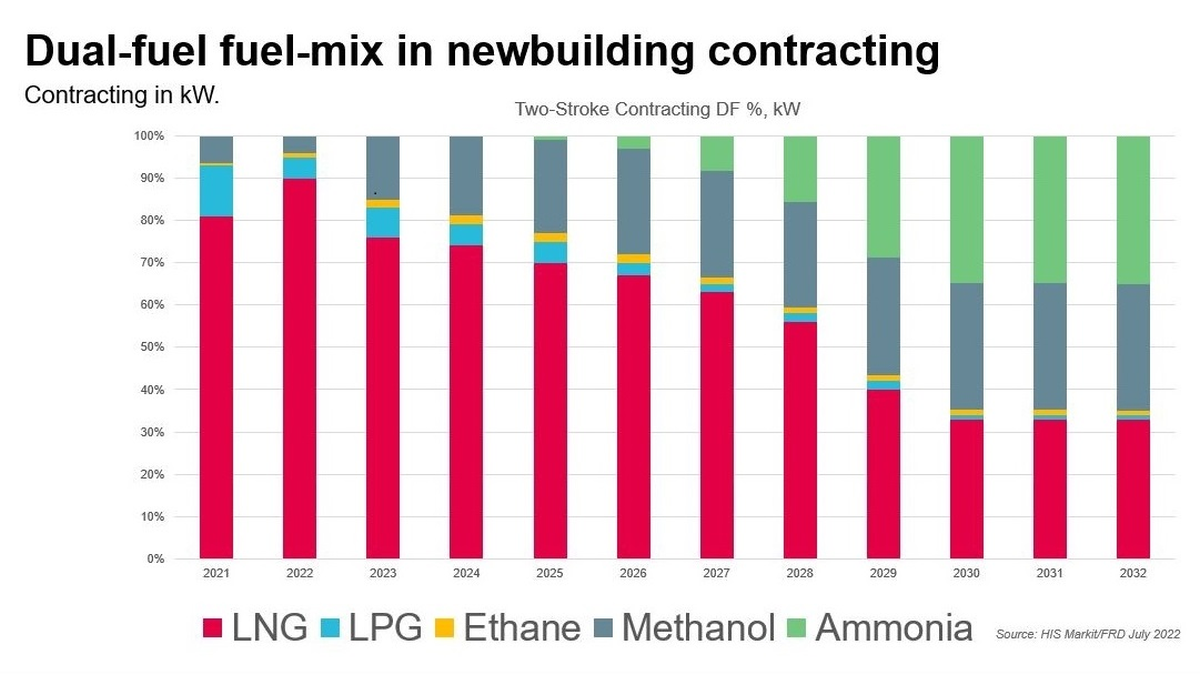
MAN Energy Solutions head of promotion and customer support Thomas Hansen provided details of the Danish engine designer’s orderbook. “We currently have a total orderbook for 78 ME-LGIM engines, of which 24 are firm orders for G95-variants. In addition, 19 of our 50-bore variants are already on the water and have accumulated more than 140,000 running hours on methanol alone. As a fuel, the future looks promising for methanol and we fully expect its uptake to encompass around 30% of all dual-fuel engine orders in just a few years from now,” said Mr Hansen.
The accompanying graph is the projected fuel adoption within two-stroke dual-fuel engines. Today, LNG-fuelled engines make up the vast majority of dual-fuel engine contracting as represented in red in the bar graph. Interest in methanol is increasing and a steady uptake to around 30% of all dual-fuel engines contracted is expected by MAN Energy Solutions just a few years from now, as indicated in dark-blue. Towards the end of the decade, ammonia (green) is expected to pick up as a marine fuel.
Developed for operation on conventional and methanol fuel, the two-stroke, electronically controlled ME-LGIM dual-fuel engine is based on MAN Energy Solutions’ proven Diesel-principle ME-series, of which there are approximately 5,000 engines in service.
The Maritime Hybrid, Electric & Hydrogen Fuel Cells Conference, Bergen, will be held 25 October 2022. Details and tickets can be found here
The Maritime Decarbonisation Conference, Asia, will be held 29 November 2022. Register your interest and access more information here
Related to this Story
Events

Maritime Regulations Webinar Week
 16 Dec 2025
 GMT - ONLINE
Floating energy: successfully unlocking stranded gas using FLNGs and FSRUs
24 Feb 2026GMT - ONLINE
© 2026 Riviera Maritime Media Ltd.


