


Business Sectors
Business Sectors
Events
Contents

Register to read more articles.
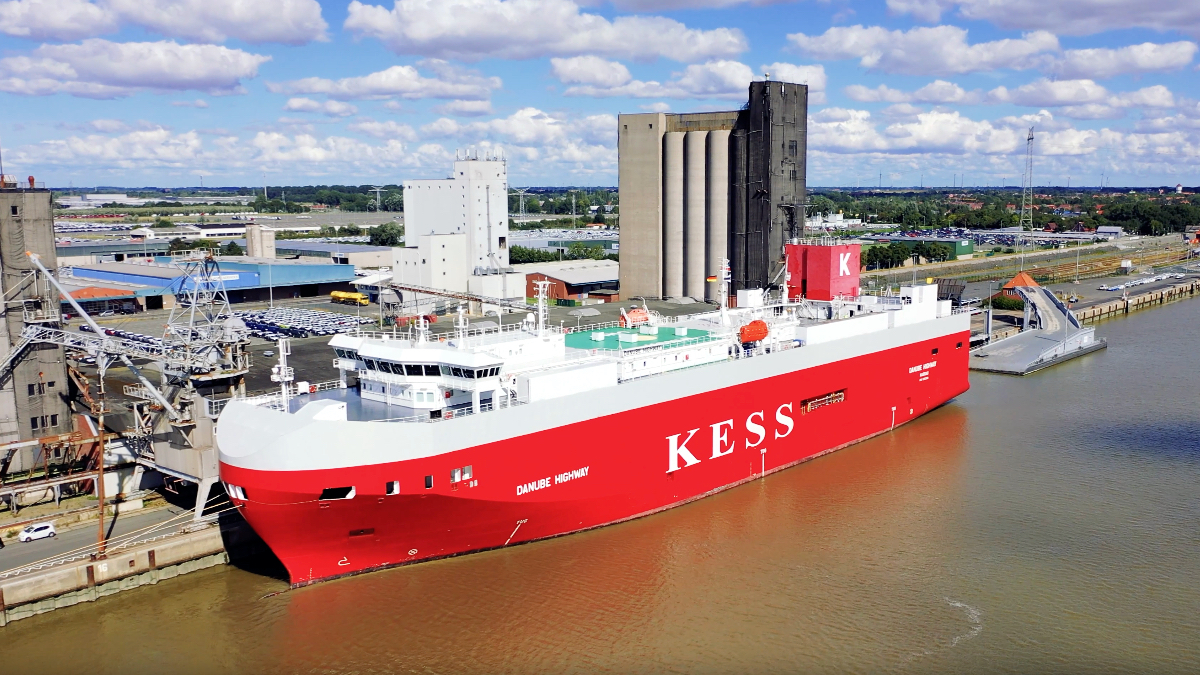
With an eye on emissions, K-Line books four LNG-fuelled car carriers for European shortsea service
The global orderbook for LNG-fuelled vehicle carriers exceeds 100 vessels, with these 1,380-car-capacity newbuilds earmarked for use by KESS in European service


Japan’s K Line has ordered four LNG-fuelled car carriers from China Merchant Jinling Shipyard (Nanjing) for operation by a wholly owned subsidiary in European shortsea shipping service.
Built for operation by K Line European Sea Highway Services (KESS), the 1,380-vehicle-capacity ships are designed specifically to transport small batches of imported vehicles, complying with size restrictions at European ports.
Designed to carry an Ice Class 1A notation, the 130-m roro vessels will be equipped with 60-tonne-capacity straight stern ramps, allowing vehicles to drive on and off the ship. This design element will enhance KESS’s capacity to handle heavy and oversized cargo and increase its flexibility to carry a wide variety of cargo types in addition to passenger cars.
This contract increases the number of car carriers booked this year to 19, pushing the global shipbuilding order book to 189 vessels. BRL Weekly Newbuilding Contracts reported K Line’s newbuildings will be delivered between January and September 2028.
LNG propulsion and shaft generators
Since United European Car Carriers (UECC) pioneered LNG dual-fuel propulsion a decade ago with the introduction of Auto Eco and Auto Energy, natural gas has emerged as a dominant choice for pure car truck carriers (PCTCs) to reduce CO2 and greenhouse gas (GHG) emissions. There are now some 140 vessels in service, and another 101 PCTCs on order, according to DNV Alternative Fuels Insights.
Each of these KESS car carrier newbuilds will be equipped with a two-stroke, slow-speed Everllence LNG dual-fuel electronically controlled ME-GI engine and a shaft generator, which uses mechanical energy generated by the propulsion shaft to produce electricity during voyages for the ship’s electrical grid. This reduces the use of the ship’s auxiliary engines, saving fuel and emissions.
This propulsion machinery setup will reduce methane slip (unburnt natural gas that escapes into the atmosphere). Boil-off gas (BOG) in the fuel tanks is typically burned by the ship’s generator engines. But these vessels are equipped with vacuum-insulated LNG fuel tanks to reduce BOG. This enables a machinery configuration with lower methane slip, according to K Line.
The Japanese owner anticipates that using LNG will reduce the ship’s CO2 emissions by 25-30% and virtually eliminate SOx emissions compared to heavy fuel oil. Generally, using modern two-stroke, Diesel-cycle dual-fuel technology, NOX emissions are reduced 85-90%.
Using LNG and later bioLNG should mitigate emissions penalties under the EU Emissions Trading System and support regulatory compliance with FuelEU Maritime and IMO GHG reduction targets.
“Biomethane and e-methane can achieve very low, or even negative, lifecycle emissions depending on how they are produced. LNG-fuelled vessels can progressively decarbonise by blending in or switching to these fuels,” explained Øyvind Sekkesæter, senior consultant at DNV and lead author of a white paper published by the class society on low-GHG methane’s role in decarbonisation and regulatory compliance.
Moving towards bioLNG
K Line, which plans to reach net-zero by 2050 under its Environmental Vision 2050 strategy, said it “will consider using biodiesel and bioLNG fuel, or liquefied biomethane, in addition to LNG fuel” to reduce GHG emissions from its fleet.
Early this year, the company inked a long-term supply agreement for carbon-neutral bioLNG fuel for its dual-fuel propulsion car carriers. The ship operator claims that using bioLNG from this procurement agreement will enable it to reduce its GHG emissions by around 60,800 tonnes per year. It first trialled ISCC-EU-certified bioLNG on Oceanus Highway in 2025.





Related to this Story

Events

Maritime Regulations Webinar Week
 16 Dec 2025
 GMT - ONLINE

Floating energy: successfully unlocking stranded gas using FLNGs and FSRUs
24 Feb 2026GMT - ONLINE
© 2026 Riviera Maritime Media Ltd.


