


Business Sectors
Business Sectors
Events
Contents
Register to read more articles.
Ammonia fuel: industry needs to focus on safety, seafarer training
Over the next few years, ships will start using ammonia fuel for low-emissions oceangoing cargo transport, but will seafarers will be ready and supported?


Engine technology and vessel design concepts are ready for the maritime industry’s transition to ammonia fuel, but now safety concerns and seafarer competencies need to be addressed.
The shipping industry is developing ways to begin using ammonia as a main fuel instead of heavy fuel oil and diesel, to decarbonise transporting cargo and products between continents by sea.
To date, there have been a few successful pilot projects demonstrating its technical viability; engine technology has been developed and tested; and several designs for ammonia-ready ships have been approved by classification societies.
Now the industry needs to ensure ammonia can be handled safely as a fuel and ensure crews can be provided with the competencies and support to use it.
An expert panel considered these challenges during Riviera Maritime Media’s Ammonia as a marine fuel: overcoming safety and cost considerations by 2030 webinar, which was held in association with Win GD on 7 April 2025 during Riveria’s
Lloyd’s Register Maritime Decarbonisation Hub senior lead for human competency Anastasia Kouvertari, Solis Marine chief executive Rosalind Blazejczyk, V Group director for sustainability and decarbonisation Matt Dunlop, Anglo Eastern Group head of training Aalok Sharma and Win GD senior advisor for research and development, Andreas Schmid.
According to Ms Kouvertari, there are several working groups and alliances supporting the maritime industry in its adoption of ammonia fuel, while IMO subcommittees and committees are working through regulations.
Classification societies have granted approvals in principle for several ship designs and shipyards are building ammonia-prepared ships.
However, she said several ships may need significant upgrade work if ammonia fuel is to be deployed in future. “Readiness for ammonia is not easy to define, she said. “Many will require major retrofits, making it uneconomic.”
She added ships that are ammonia-ready level 4 and 5 may be able to run on this fuel if it is available. These owners should consider the “new competency requirements, occupational health hazards, operational and process safety, and gaps in competence and training standards and requirements.”
Win DG’s Mr Schmid said its X-DFA range of dual-fuel, two-stroke engines have been tested and will be ready for installation on ships from 2026. The original engine manufacturer developed and tested components including fuel control and delivery, injection and chamber combustion using 3D modelling and then used a single cylinder engine to prove its performance.
“We tested millions of running hours using these models and tested these individual steps,” said Mr Schmid.
Testing on a full engine started in November 2024 and the results show up to 100% ammonia can be combusted. “NOx emissions are well below diesel and ammonia slip is negligible,” he added, so there is no need for an aftertreatment catalyst. Ammonia slip was less than 10 parts per million (ppm) and N2O was less than 3 ppm.
Win DG has several engines to manufacture in the next two years as ships are built ready for ammonia fuel. “We have an orderbook for 30 2-stroke ammonia engines,” said Mr Schmid. These are for the X52DF-A1.0, X62DF-A1.0 and X72DF-A1.0 engines.
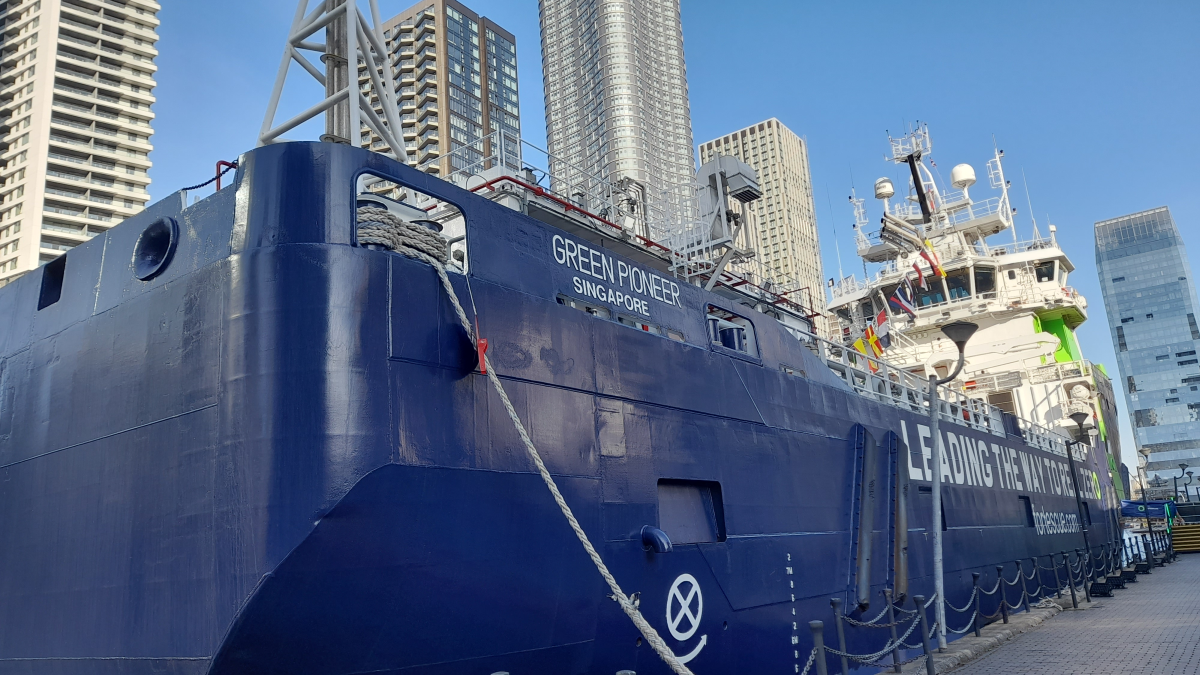
Solis Marine’s Ms Blazejczyk said some of the ship design challenges for ammonia fuel have been overcome, as demonstrated on Fortescue’s Green Pioneer, a platform supply vessel converted to run on ammonia on two dual-fuel engines.
"The knowledge and competency are not sufficient for ammonia as a fuel"
Key safety considerations and protection requirements include segregating ammonia fuel components, secondary enclosures, leak detection and isolation, ventilation and emergency responses and having full redundancy.
Segregation protects ammonia fuel components from damage or incidents, and from fuel preparation rooms, storage tanks, bunkering modules and the engineroom from manned areas using airlocks, said Ms Blazejczyk.
“Secondary enclosures are a double barrier to provide safe containment, protecting the ship.”
Ship operators need to be prepared to respond to a leak by shutting down areas, segregating the hazard, purging pipes and inert areas and venting leaked vapours.
V Group’s Mr Dunlop said safety is one of the many challenges the maritime industry needs to overcome, with others addressing operational and regulatory elements. “There are toxicity, combustion and flammability hurdles,” he said. There are occupational health hazards, and competency and training challenges.”
New equipment, engine and fuel systems need to be incorporated into newbuilds, safety requirements need to be agreed, approved and verified, and safety management systems updated.
Mr Dunlop said IMO’s International Convention on Standards of Training, Certification and Watchkeeping for Seafarers needs to be updated “to adapt new ways of working and training seafarers.”
Facilities for tactical demonstration and hands-on training are required to explore key scenarios to build the competencies of crews working with ammonia fuel systems.
Anglo Eastern’s Mr Sharma said simulators used for training seafarers on use of LNG and LPG engine and fuel systems could support building competencies for ammonia. He said Anglo Eastern’s academy in India has multiple engineroom simulators and real equipment to teach seafarers bunkering and ship operations, maintenance and familiarisation.
“We need to stay a step ahead to ensure safety and stability, with simulators and hands-on training,” Mr Sharma said. “Ammonia is not a cargo. The knowledge and competency are not sufficient for ammonia as a fuel.”
Webinar poll results
Attendees were asked to vote on a series of poll questions during the webinar. Here is a summary of the results.
Which alternative fuel is most likely to achieve widescale adoption for deepsea shipping?
Ammonia: 38%
Hydrogen: 2%
Methanol: 41%
Biofuels: 19%
Is our industry out of sync with having a proven safety approach for ammonia-fuelled vessels?
Yes: 65%
No: 35%
What is the biggest challenge in adopting ammonia as a marine fuel?
Safety concerns: 55%
Initial cost: 10%
Lack of infrastructure: 27%
Regulatory compliance: 8%
How will geopolitics impact alternative marine fuel adoption?
Accelerate adoption: 8%
Slow adoption: 45%
Shift priorities: 37%
No major impact: 10%
How soon will ammonia become a mainstream marine fuel?
Within 5 years: 4%
Within 10 years: 32%
More than 10 years: 45%
Never: 19%
What is your primary concern regarding ammonia as a fuel?
Toxicity and safety risks: 58%
Feasibility of green ammonia production: 22%
Lack of global supply chain readiness: 17%
Engine compatibility: 3%
(source: Riviera Maritime Media)
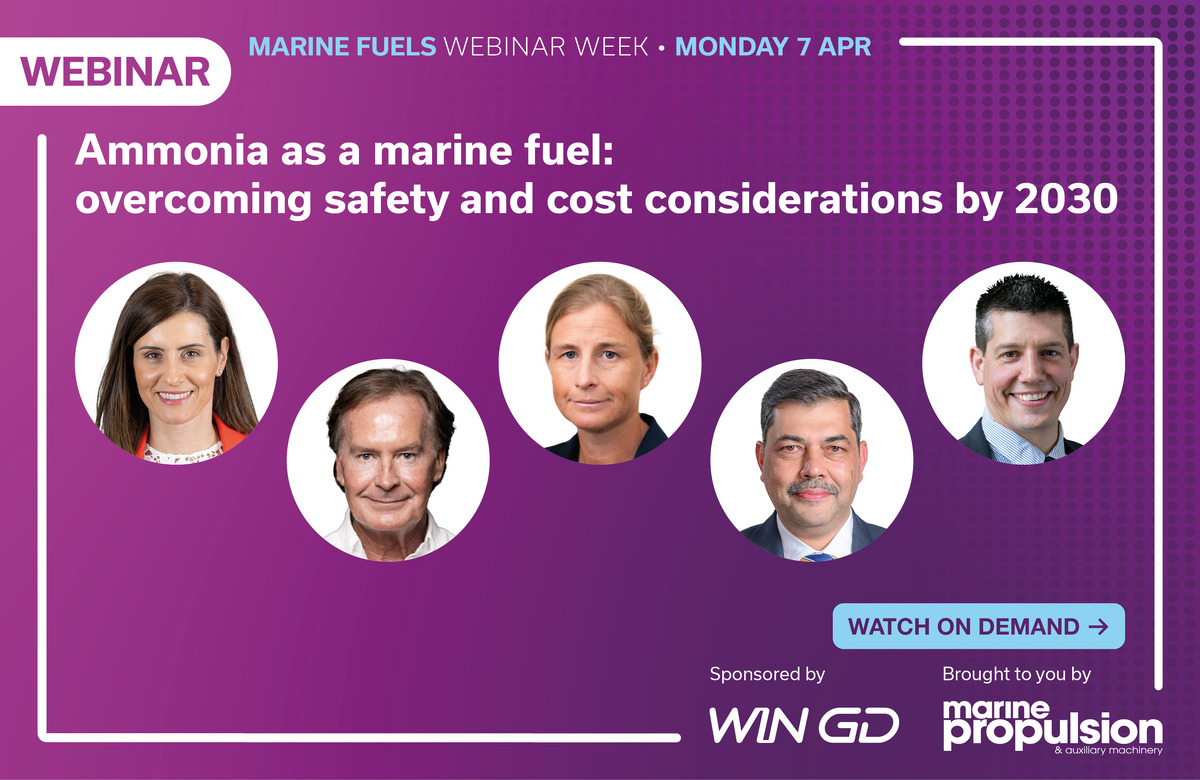
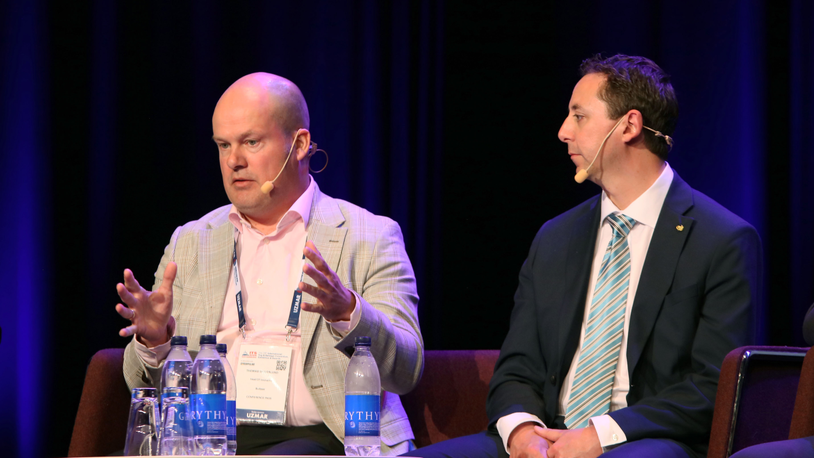
On the panel of Riviera’s Ammonia as a marine fuel: overcoming safety and cost considerations by 2030 webinar were (left to right): Lloyd’s Register Maritime Decarbonisation Hub senior lead for human competency Anastasia Kouvertari, Solis Marine chief executive Rosalind Blazejczyk, V Group director for sustainability and decarbonisation Matt Dunlop, Anglo Eastern Group head of training Aalok Sharma and Win GD senior advisor for research and development, Andreas Schmid.
Related to this Story
Events

Maritime Regulations Webinar Week
 16 Dec 2025
 GMT - ONLINE
Floating energy: successfully unlocking stranded gas using FLNGs and FSRUs
24 Feb 2026GMT - ONLINE
© 2026 Riviera Maritime Media Ltd.


