


Business Sectors
Business Sectors
Events
Contents
Register to read more articles.
Baltimore channel opened after wreck removal
Container ship Dali was salvaged, and Francis Scott Key bridge wreckage removed in the US as oil spills and damaged ships were tackled worldwide


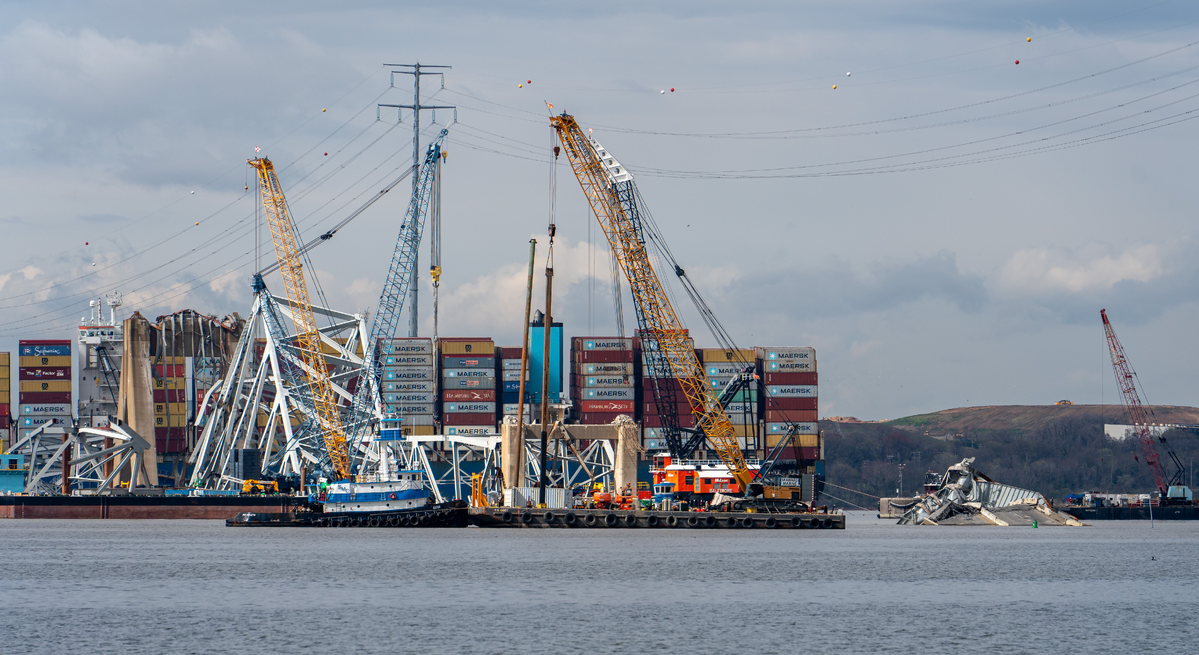
Salvage and wreck removal operations have opened a main shipping route to the Port of Baltimore, three months after a container ship struck the Francis Scott Key bridge causing it to collapse into the Patapsco River.
9,962-TEU, 289-m container ship Dali was removed from the bridge structure and refloated mid-May and by 10 June, US Army Corps of Engineers and US Navy Salvage and Diving restored the Fort McHenry Federal Channel to its original operational dimensions of 213.0 m wide and depth of 15.2 m for commercial maritime transit through the Port of Baltimore.
Following the removal of wreckage at the 15.2-m mudline, the response Unified Command performed a survey of the federal channel, certifying the riverbed as safe for transit. Surveying and removing steel below this mudline will continue to ensure future dredging operations are not impacted.
Fully restoring the federal channel to its original width and depth involved removing about 50,000 tonnes of bridge wreckage from the river and refloating Dali. At its busiest point, Unified Command, consisting of six agencies, led the response efforts involving 56 federal, state and local agencies, and 1,587 individual responders.
About 500 specialists from around the world operated a fleet of 18 barges, 22 tugboats, 13 floating cranes, 10 excavators and four survey boats.
The wreckage will continue to be transported to Sparrows Point for follow-on processing, while work in the channel from this point on involves routine maintenance ensuring future dredging operations will not be impacted.
Dali was refloated and removed from the channel into the Port of Baltimore on 20 May and with the assistance of five tugboats and other support vessels, was towed and pushed 4 km, arriving at a local Seagirt marine terminal. The vessel’s removal allowed the deep-draught commercial vessels that could not access the port prior to the bridge’s collapse to enter and exit the port again.
Dali, owned by Grace Ocean of Singapore and operated by Synergy Marine Group, had 22 crew on board when it crashed into the 47-year-old bridge at 01:30, 26 March 2024, causing loss of life and significant damage.
The Key Bridge response Unified Command included the US Coast Guard, US Army Corps of Engineers, Maryland Department of the Environment, Maryland Transportation Authority and Witt O’Brien’s, representing Synergy Marine and Maryland State Police.
Preparations for refloating Dali included evaluating sonar and lidar imagery and dive surveys, removing submerged and unstable wreckage and controlled demolition of the steel bridge structure on the ship’s bow. Responders also removed severely damaged containers and overhanging wreckage from the initial bridge collapse from the deck of Dali. Precision cuts were made with small charges to break the span across the deck into smaller pieces.
Pollution clean-up
In the Belgian port of Antwerp, the Deurganck dock oil spill was cleaned up from ships and the terminal quay walls, and all ships involved in the incident and contamination had left by 16 June.
Oil was discovered in Deurganck dock on 7 June after it leaked during a bunkering operation. Brabo Cleaning Services and the Maritime Access Department worked together to limit the spill within the dock area and clear the pollution using absorbent pads and oil screens.
About 20 ships, including seagoing vessels and barges, were contaminated by the oil and had to be cleaned before leaving the dock, but no pollution entered the Scheldt river. During clean-up operations, there was a selective traffic ban to the Deurganck dock and selective traffic allowed to the DP World and MSC terminals, but other terminals and the Kieldrecht lock remained operational.
Several vessels and diving teams were used for the oil clean up and drones were used to monitor the situation, while Civil Protection Services provided logistics support.
As quayside walls were cleaned of pollution, more ships were able to dock at the terminals for unloading, lightering cargo and bunkering. Available resources were deployed to protect incoming ships from remaining pollution and these vessels were cleaned before they could disembark. Barges were allowed to provide loading, unloading and bunkering while clearance work continued.
In Singapore, dredger Vox Maxima struck bunker vessel Marine Honour at Pasir Panjang Terminal causing a large oil spill requiring clean-up operations at sea and along coastlines. Singapore’s Maritime Port Authority (MPA) laid booms to control the leak, sent patrol craft to spray dispersants and use skimmers on the spill, and activated its response contractor. According to MPA, around 400 tonnes of oil leaked into the sea, and due to the tidal currents, parts of the spillage landed along the southern shorelines, including Sentosa, Labrador Nature Reserve, Southern Islands, Marina South Pier and East Coast Park. There were reports of birds and animals being covered by oil from the spill and beaches and marinas were closed.
Groundings and sinkings
In Fiji, salvage operations of a new naval patrol vessel, RFNS Puamau, were hampered by the weather and sea conditions off Lau. This newbuild from Australian shipbuilder Austal was delivered in March 2024 and gifted to the Fiji Navy as part of an ongoing programme of goodwill and mutual security between Australia and the neighbouring island nations.
On its maiden voyage, this US$10.6M vessel grounded on a reef and started flooding. Fiji Navy dispatched another Austal-built patrol boat, RFNS Savenaca, to the site for emergency support and salvage operations. Crew were evacuated and plans developed for effecting temporary fixes and removing all fuel and onboard stores before refloating the damaged vessel. As of 20 June, operators were awaiting the arrival of a dedicated salvage vessel and specialised recovery equipment from Australia.
In the Red Sea, two bulk carriers were struck and damaged by cruise missiles from Yemen’s Houthi rebels. Crews from both ships were evacuated as they continued to burn and remained navigational hazards. Verbena (2008-built, 11,400 dwt) had sunk by 18 June; the second, Greek bulk carrier Tutor, was in danger of sinking and salvage ships were mobilised to assist.
In Italy, passengers were evacuated from damaged vessel Audace off port of Monfalcone while sailing between Grado and Trieste. Italian coastguard vessels and a diving team were mobilised to support the emergency as the vessel was taking on water from the bow.
In Taiwan, crew members from 52-m coastal cargo ship Hui Feng were evacuated 12 June after it was damaged by fire, started in the engineroom. Three vessels supported evacuation and monitored the drifting abandoned ship.
In the Canary Islands, Ardentia Marine refloated tugboat Picacho, which sank 13 May at its berth in the port of Las Palmas de Gran Canaria, and towed it to the Canary Naval Recovery facilities for dismantling.
In April, Tsavliris Salvage Group refloated partly laden 44,146-gt bulk carrier Vela Star after it ran aground in a channel to the Port of Buenos Aires, Argentina. The company despatched the tugs Ona Don Lorenzo, with 63 tonnes of bollard pull, and Ona Triunfo (60 tonnes of bollard pull) and a Tsavliris salvage master from Buenos Aires to assist the casualty. Vela Star was refloated and escorted to an anchorage point 23 km offshore.
Sign up for Riviera’s series of technical and operational webinars and conferences:
- Register to attend by visiting our events page.
- Watch recordings from all of our webinars in the webinar library.
Related to this Story
Events

Maritime Regulations Webinar Week
 16 Dec 2025
 GMT - ONLINE
Floating energy: successfully unlocking stranded gas using FLNGs and FSRUs
24 Feb 2026GMT - ONLINE
© 2026 Riviera Maritime Media Ltd.


