


Business Sectors
Business Sectors
Events
Contents
Register to read more articles.
Biofuel: strong potential for converting existing box ships
Biofuel would be a good way of retrofitting existing box ships to meet future environmental legislation but obstacles stand in the way; ammonia and green methanol options for container ships explored


Bio diesel could be the answer for existing box ships to meet the new 2026/2030 regulations – but fierce competition from other sectors for this fuel is a major obstacle.
DNV executive vice president for business development Jan-Olaf Probst tells CST about the issues, “Bio diesel, in our opinion, can easily reduce CO2 emissions from 30-40% right up to 80% depending on where the biofuel is coming from. The main problem for biofuel is the maritime industry is in competition with the car and air industries for its use. But cars can easily be transferred to electric power. The electric infrastructure is much easier for cars than for ships.” Therefore, he argues that cars should focus on electric power, leaving the maritime industry to biofuel, especially for existing vessels.
Explaining why existing vessels, including container ships, are a good match for biofuel, he says, “Existing vessels could switch over to biofuel just with tank cleaning, you could use your main engine as it is and immediately there is a huge CO2 reduction.”
The other obstacle to widespread use of biofuel for retrofitting ships is lack of regulation. Mr Probst says, “People see so many good solutions, but regulation is needed and needed much faster. It is stopping innovation and going forward, biofuel is a really good solution for existing vessels. IMO should specify clearly what kind of green biofuel is suitable for the maritime industry.”
Biofuel competition
Explaining how to overcome issues of regulation and competition for biofuel, he urges, “It is a matter of lobbying. The air industry has a much stronger lobby in the EU than shipping. It is a matter of talking to shipowners and asking them to stand up, go to their flag states and ask to raise their voices about the maritime industry needing biofuel. We need to make sure the maritime industry is getting a fair portion of biofuel.”
He uses some figures to highlight just how suitable biofuel would be for retrofitting existing container ships: There are currently around 5,500 container ships in the global fleet (this figure includes 200 vessels on order). Mr Probst explains, “If we jump to 2030, the fleet would have 3,300 vessels that are 18 years and older. We are in 2021, it is only 8.5 years away, do you really believe we can make 3,300 vessels meet the new emissions regulation in this timeframe? Therefore, it would be a way for the industry to say newbuildings should go for available green fuel, such as LNG, bioLNG and green methanol for feeders, but existing ships could be converted to biofuel.”
Looking at strong alternative fuel contenders for container ship newbuildings, Mr Probst makes the distinction between LNG, which works well for larger container vessels – 15,000 TEU-20,000 TEU – and green methanol, which would be a good investment for direct cargo operation feeder ships.
Mr Probst says that pre-investment in the piping systems needed for green methanol could allow ships to be converted later. Furthermore, using green methanol could lead to a CO2 emissions reduction of up to 80%.
Another matter that will help container ship operators use green methanol is that interim guidelines for its use have been published. Mr Probst says, “The publication of interim guidelines for green methanol is a huge step forward as it is much easier to design the vessel as opposed to using alternative design. Interim guidelines are the first stage to the use of green methanol being clearly regulated. They give you a much more stable decision with regards to regulation.”
Since LNG as a fuel is regulated via the IGF code, a “shipowner can go to a shipyard and sign a shipbuilding contract immediately because the IGF code shows how the ship should be designed and operated.”
He points out the container segment is one of the strongest growing for use of LNG as fuel.
AIP for ammonia ULCS
Lloyd’s Register (LR) has granted approval in principle (AiP) for an ammonia-fuelled ultra-large container ship (ULCS).
LR granted AiP to Daewoo Shipbuilding & Marine Engineering (DSME) and MAN Energy Solutions for its ammonia-fuelled 23,000-TEU ULCS design in September 2020. DSME generated the basic design of the ammonia propulsion system and MAN Energy Solutions was responsible for the development and specifications of the ammonia dual-fuel propulsion engine.
As the only class society involved in the project, LR’s role was to review the suitability and risks of the design which involved a hazard identification workshop, a hazard and operability analysis workshop and a design review in accordance with the approval of risk-based design process, which led to the AiP.
LR decarbonisation programme manager Charles Haskell tells CST, “Ammonia has risen in consideration as a fuel of choice due to the combination of lower levelled cost of production and the impact on storage in comparison to other zero-carbon fuels, as we look towards 2050. Essentially, ammonia is being used for its hydrogen – NH3. Due to its energy density compared with hydrogen, and being stored with less technical issues than hydrogen, ammonia is looked at favourably for deepsea vessels, particularly those with high energy demand, a category which container ships fit into.”
Mr Haskell says, looking more widely, the main challenges lie outside of technology – and focus instead on encouraging investment and building community acceptance. He says, “We encourage IMO to embrace the emerging opportunity to pursue bold market-based measures and sustainability criteria for marine fuels. We must drive supply and demand for zero-carbon energy sources while making fossil fuels less attractive.”
He explains that a big part of moving to low or zero-carbon fuels is landside rather than on board the ship – creating the infrastructure to put sufficient fuel volumes in sufficient locations. Mr Haskell continues, “A worldwide ammonia distribution system is already in place, but fuel needs to be available in the right locations at the right volumes. The existing ammonia transport network connects production and storage locations that serve the industrial market; it does not reach ports in a way that would allow ships to bunker.”
He says, “Perception of ammonia by the wider community, outside fleet operators, will need to change for it to become accepted as a fuel. Port authorities and regulators are presently reluctant to permit bunkering of ammonia due to toxicity hazards, while the reaction of citizens to large-scale ammonia storage in ports is untested.”
Due to the extreme toxicity of the fuel, Mr Haskell says it is critical to address the safety issues of ammonia to mitigate risks to people, assets and the environment.
“While ammonia is not highly flammable, concentrations in the air as small as 0.25% can cause fatalities, making the fuel highly toxic to people. Today’s residual and distillate fuel oils (and even natural gas) all present lower risks than ammonia. Therefore, we are working with the Mærsk Mc-Kinney Møller Center for Zero Carbon Shipping and other industry partners to develop guidance around the safe use of ammonia as a fuel.”
He says handling ammonia on board ships will require a “complete new set of skills and safety procedures”. Fuel systems must be designed, manufactured, operated and maintained to ensure the safety of the ship crews, port staff and fuel suppliers.
Mr Haskell adds, “There is a need to understand the potential negative impacts on human lives, water and soil in case of leakage or accidents, and how to mitigate these types of risks. A new safety pathway is therefore needed to adopt ammonia. In addition, the combustion of ammonia in engines releases nitrous oxide, a greenhouse gas even more potent than CO2”. Thereby, additional equipment will be required on board to control NOx emissions.
Speaking in more depth about LR Maritime Decarbonisation Hub’s work with Mærsk Mc-Kinney Møller Center for Zero Carbon Shipping to develop guidance around the safe use of ammonia as a fuel, he says “The overarching purpose of the project is to understand and guide the safe use of ammonia as a fuel on board ships. Part of this will include developing a mature and detailed understanding of risk and safety concerns, which will be assessed through a quantitative risk assessment methodology in phase one of the project. This will ultimately lead to the development of best practices for safeguards in design and arrangements when using ammonia as a shipping fuel.”
The project will also determine the risk of fatality from unintended releases of ammonia, as well as determine the risk contribution of key equipment and spaces dedicated to ammonia storage. To illustrate the potential for risk mitigation measures, the project partners will assess alternate vessel designs, optimised to be fuelled by ammonia.
Mr Haskell sums up, “There is no question – decarbonisation is a monumental challenge, yet adapting to change is nothing new to shipping. We’ve navigated three industrial revolutions already, demonstrating resilience with each change, and now we’re navigating the fourth. Collaboration across all stakeholders is required to derisk the challenges and accelerate the transition. And with this, every type of organisation has a role to play now in the commercial pilots and trials that are laying the foundations for zero-carbon shipping."
COSCO decarbonisation efforts
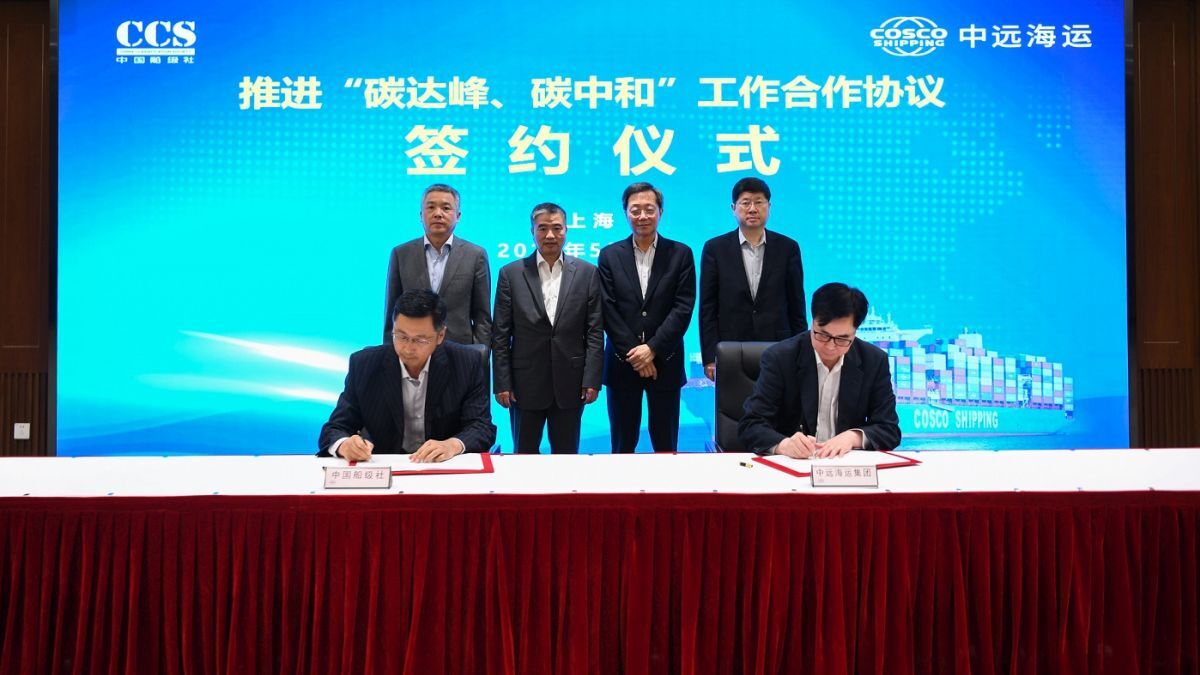
China Classification Society (CCS) and China COSCO Shipping Group have signed a new agreement that will see the organisations work together to tackle the issue of greenhouse gas emissions in the maritime sector.
CCS vice president Sun Feng and COSCO Shipping Group deputy general manager Huang Xiaowen signed the framework agreement during a ceremony in Shanghai last month.
Under the terms of the agreement, CCS and COSCO Shipping Group will pool resources to support China’s efforts in the fight against climate change. The organisations will leverage China’s national ‘carbon peak, carbon neutral’ development target, international efforts to reduce maritime transport emissions and the climate-neutral goals of the EU Green Deal to help guide research on energy consumption structure and the development of viable technological solutions.
Last September, Chinese President Xi Jinping announced plans to reduce the country’s emissions, committing China to strive for reaching carbon peak by 2030 and carbon neutrality by 2060.
CCS and COSCO Shipping Group have committed to working together to support the development of key core technologies, build an international co-operation platform, promote the establishment of industry standards and the formation of the International Maritime Organization’s proposal. Using their combined expertise and experience, they will aid carbon emissions reduction strategies within the shipping industry.
CCS president Mo Jianhui says, “The signing of this agreement will further deepen the strategic co-operative relationship between CCS and China COSCO Shipping Group, creating new and important opportunities to help support the implementation of major national strategies and China’s goal of achieving the ‘3060 double-carbon’ target.
“A partnership working approach will enhance research efforts into key core technologies to support decarbonisation and carbon neutrality in the shipping industry, as well as helping us to promote the development of relevant standards and regulations.”
CCS is well placed to support technological advances and the adoption of clean energy resources by maritime and offshore sector firms, having increased investment in research and development linked to shipping decarbonisation over recent years. Its work has led to the publication of numerous rules and guidelines covering areas such as using natural gas as fuel, LNG bunkering pontoons, surveying battery-powered ships, evaluating and inspecting marine rigid wing surface sails, and inspecting air lubrication drag reduction systems on ships.
Riviera Maritime Media’s Container Ship Tech & Ops Webinar Week is being held 2 September 2021 – use this link for more details and to register

Related to this Story

Events

Maritime Regulations Webinar Week
 16 Dec 2025
 GMT - ONLINE
Floating energy: successfully unlocking stranded gas using FLNGs and FSRUs
24 Feb 2026GMT - ONLINE
© 2026 Riviera Maritime Media Ltd.


