


Business Sectors
Events
Contents


Canadian Arctic and Norwegian Sea ECAs enter into force
New Emission Control Areas for the Canadian Arctic and Norwegian Sea will require ships to burn fuel with a sulphur content below 0.10% or use scrubbers


New Emission Control Areas (ECAs) for the Norwegian Sea and Canadian Arctic that set limits on SOX, NOx emissions and particulate matter from ship exhaust came into force as of 1 March 2026.
Adopted as amendments to Marpol Annex VI at IMO MEPC 82, the regulations will require ships transiting the ECAs to burn fuel with a sulphur content of less than 0.10%, unless they operate with exhaust gas cleaning systems that can achieve those equivalent SOx emissions levels. The regulations take effect as of 1 March 2027.
There is a subtle difference in the application of the regulation between the two ECAs. As explained by DNV, the Canadian Arctic ECA for NOx is based on the keel-laying date, agreed as 1 January 2025. This implies that ships with keels laid on or after this date must use Tier III-certified engines when operating in the Canadian Arctic ECA, effective from 1 March 2026.
A brief by the class society said the Norwegian Sea ECA for NOx follows the ‘three-date principle’ commonly used in Marpol Annex I. This approach considers the contract date, keel-laying date and delivery date of the ship. This approach eliminates the possibility of circumventing the IMO Tier III engine NOx certification requirements by advancing the keel-laying date before the application date.
As a result, ships with building contracts placed on or after 1 March 2026 or without a building contract, but with keels laid on or before 1 September 2026, or are delivered on or after 1 March 2030, must operate with IMO Tier III-certified engines within the Norwegian Sea ECA.
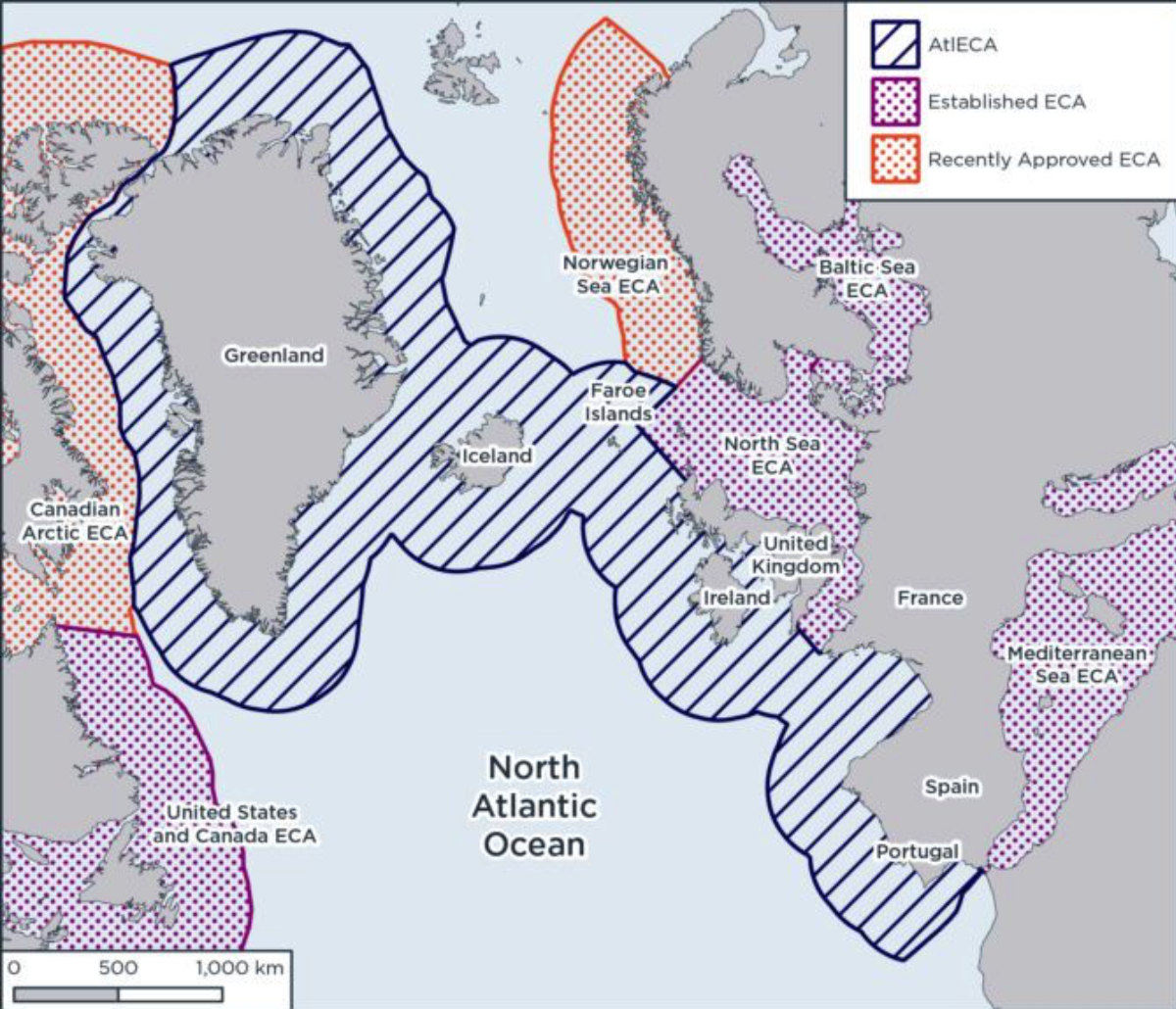
North-East Atlantic ECA
Next year, one of the largest ECAs in the world, the North-East Atlantic ECA, will enter into force, covering the Exclusive Economic Zones and territorial seas of Portugal, Spain, France, the UK, Ireland, Iceland, the Faroe Islands and Denmark (Greenland) that are not already part of any existing ECAs. Once it comes into force, the North-East Atlantic ECA will serve as a bridge, connecting it with the six existing ECAs (Canadian Arctic, United States and Canada, Norwegian Sea, Mediterranean Sea, Baltic Sea and North Sea).
While the 0.10% sulphur limit for fuel will take effect in 2028, one year after adoption, the requirement for NOx Tier III engine certification will apply to ships contracted on or after 1 January 2027, or in the absence of a building contract, keel laying on or after 1 July 2027, or delivered on or after 1 January 2031.
Independent research organisation International Council on Clean Transportation anticipates the new ECA will result in substantial health and air quality benefits. According to its research, ICCT estimates the North-East Atlantic ECA will reduce SOx emissions by up to 82%, particulate matter (PM2.5) by 64%, and black carbon by 36%. NOx emissions will decline by up to 71% over time with fleet renewal. As a result, the North-East Atlantic ECA is expected to prevent up to 4,300 premature deaths between 2030 and 2050 and save up to €29Bn (US$34Bn) in health-related costs.
Sign up for Riviera’s series of technical and operational webinars and conferences:
- Register to attend by visiting our events page.
- Watch recordings from all of our webinars in the webinar library.


Related to this Story


Events

Maritime Regulations Webinar Week
 16 Dec 2025
 GMT - ONLINE
Floating energy: successfully unlocking stranded gas using FLNGs and FSRUs
24 Feb 2026GMT - ONLINE
© 2024 Riviera Maritime Media Ltd.


