


Business Sectors
Business Sectors
Events
Contents
Nor-Shipping: raft of gas ship and LNG carrier tank designs green-lighted
Class society Korean Register is working with several major shipyards to develop designs for new vessels and vessel components


Foward deckhouse LNG carrier and 150,000-m3 ammonia carrier designs
Korean Register (KR) has signed two memoranda of understanding (MoU) with Hanwha Ocean during Nor-Shipping 2025 in Oslo. The agreements cover the joint development of an LNG carrier (LNGC) featuring a forward deckhouse arrangement and a 150,000-m3 ultra-large ammonia carrier.
KR and Hanwha Ocean’s MoU for the joint development of an LNG carrier features a deckhouse positioned at the bow, "a forward-thinking design that shifts the wheelhouse and accommodation spaces from the traditional stern placement".
"This innovative concept breaks away from conventional ship architecture and offers enhanced layout flexibility. The optimised hull form design is expected to reduce wind resistance and improve fuel efficiency, while providing more space for incorporating energy-saving devices such as wind-assisted propulsion systems, further enhancing operational performance," the companies said.
Hanwha Ocean will proceed with the basic design of the forward deckhouse LNGC, while KR will assess the safety and regulatory compliance of the design and issue an approval in principle (AiP) upon successful review.
The 150,000-m3 ammonia carrier project aims to develop an ultra-large vessel capable of transporting substantial volumes of ammonia, while also utilising ammonia as marine fuel. Special emphasis will be placed on design safety, given the toxicity and corrosiveness of ammonia.
Under the agreement, Hanwha Ocean will lead the vessel’s basic design, including gas dispersion analysis and toxic zone layout mapping based on various leakage scenarios, to ensure rapid emergency response capabilities. KR will assess the design’s safety and technical feasibility in accordance with international regulations and classification rules, with the aim of granting an AiP.
Three-tank LNG carrier design
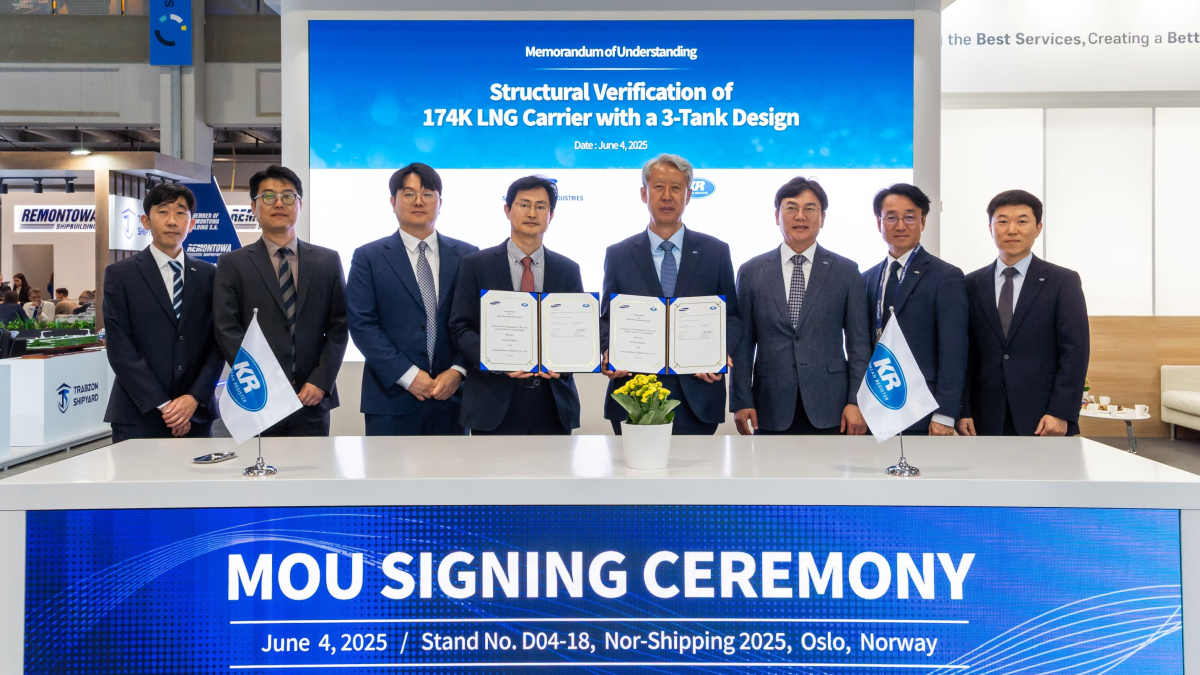
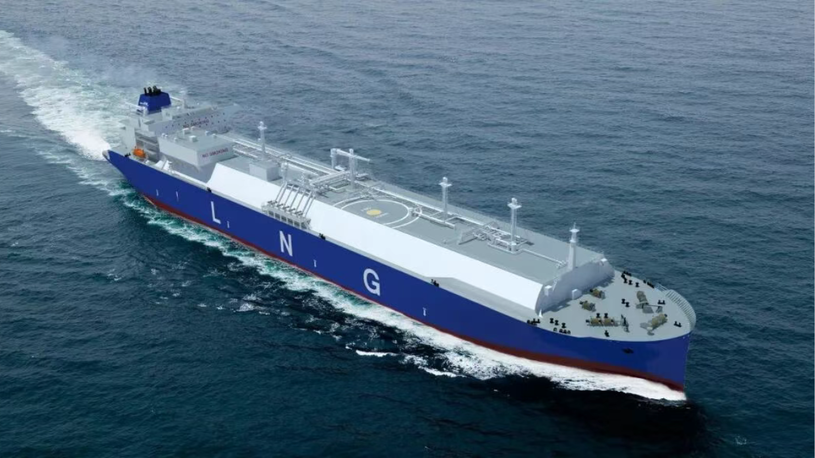
KR also signed an MoU with Samsung Heavy Industries (SHI) on 4 June at Nor-Shipping 2025 in Oslo to jointly develop a 174,000-m3 LNG carrier featuring three cargo tanks.
"Despite the ongoing trend toward larger vessels across all ship types, the 174,000-m3 LNG carrier remains the standard design in the global LNG shipbuilding market, with dozens of orders placed annually," KR said.
KR and SHI say they plan to introduce a revised cargo tank configuration – reducing the number of tanks from four to three – while ensuring both economic efficiency and structural safety.
"Reducing the number of tanks is expected to lighten the hull, thereby improving fuel efficiency and decreasing natural boil-off and vaporisation of LNG, ultimately reducing operating costs. Fewer tanks also mean fewer onboard pumping systems, which simplifies maintenance and reduces long-term operational expenses," the companies said.
However, larger individual tank sizes can lead to more pronounced liquid movement – known as sloshing – within the tank. This motion can exert repeated pressure loads on the tank walls and internal structures, potentially affecting the vessel’s structural integrity. KR said it will conduct a thorough review to ensure the vessel’s compliance with applicable classification rules and international regulations, and plans to grant an AIP once structural safety and conformity have been verified.
ECA techniques for IMO Type-C gas carrier cargo tank designs
In another LNG carrier tank-related agreement, KR signed an MoU with HD Hyundai Mipo and HD Korean Shipbuilding & Offshore Engineering (HD KSOE) that focuses on applying engineering critical assessment (ECA) techniques to the design of Type-C cargo tanks for liquefied gas carriers to ensure their structural safety.
"With the maritime industry accelerating its transition toward decarbonisation, demand is growing for ships powered by alternative fuels such as LNG, ammonia and hydrogen. These fuels are typically stored and transported in high-pressure, cryogenic liquefied form, requiring advanced safety measures for onboard containment systems. Therefore, ensuring the structural integrity of cargo tanks has become a critical element in next-generation, environmentally sustainable ship design," the companies said. "This MoU represents a proactive response to these evolving needs. The three parties aim to improve the structural safety and design reliability of IMO Type-C independent tanks – one of the most widely adopted containment systems for low-emissions vessels. Type-C tanks are commonly used on small to mid-sized gas carriers and bunkering vessels due to their structural independence and ability to store high-pressure cargo, and therefore require precise structural analysis to ensure safety."
To tackle these technical challenges, the partners say they will apply an ECA – a fracture mechanics-based structural analysis method – from the early stages of design. ECA techniques simulate potential crack propagation in metallic structures, and assess whether the structures can safely withstand real-world operating conditions. The methodology is particularly well-suited for high-pressure, low-temperature environments such as those found in liquefied gas storage.
Under the agreement, HD Hyundai Mipo will conduct structural strength and fatigue assessments of the tanks, and HD KSOE will lead tank design and perform ECA-based structural evaluations. KR will review safety and compliance of the design in accordance with its classification rules and the international convention (IGC Code), with the goal of issuing an AIP.
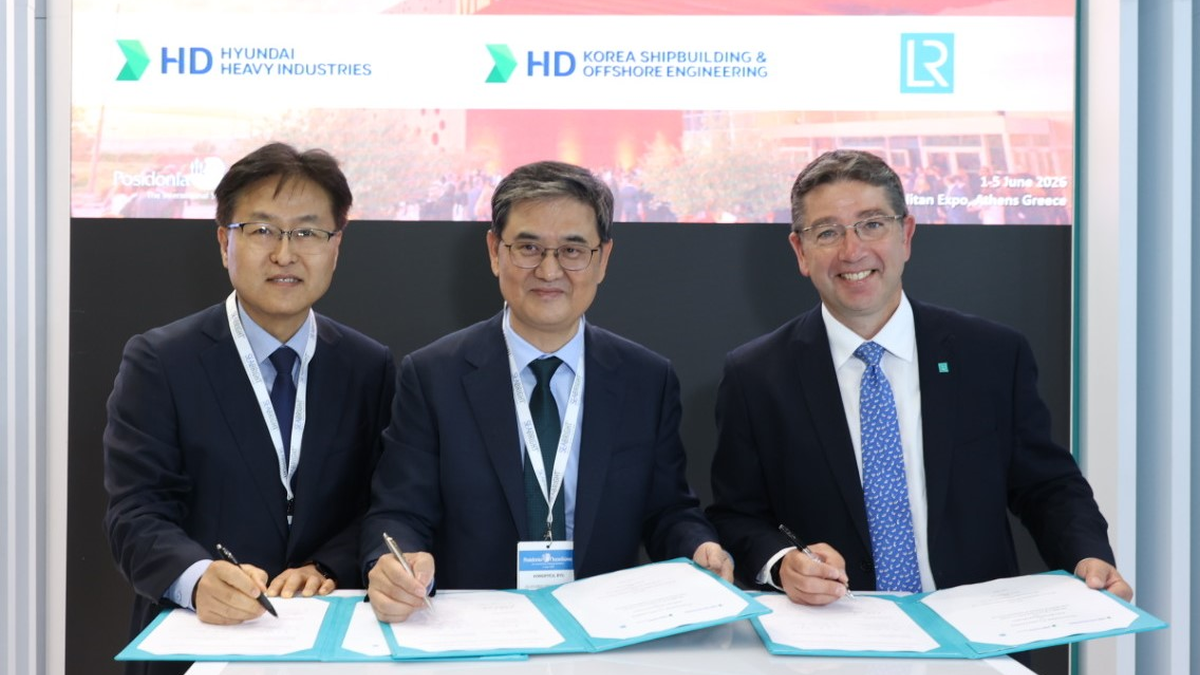
Korean Register has also signed a memorandum of understanding HD Hyundai Heavy Industries to jointly develop a next-generation very large ethane carrier.
Sign up for Riviera’s series of technical and operational webinars and conferences:
- Register to attend by visiting our events page.
- Watch recordings from all of our webinars in the webinar library.
Related to this Story
Events

Maritime Regulations Webinar Week
 16 Dec 2025
 GMT - ONLINE
Floating energy: successfully unlocking stranded gas using FLNGs and FSRUs
24 Feb 2026GMT - ONLINE
© 2026 Riviera Maritime Media Ltd.


