


Business Sectors
Business Sectors
Events
Contents
Register to read more articles.
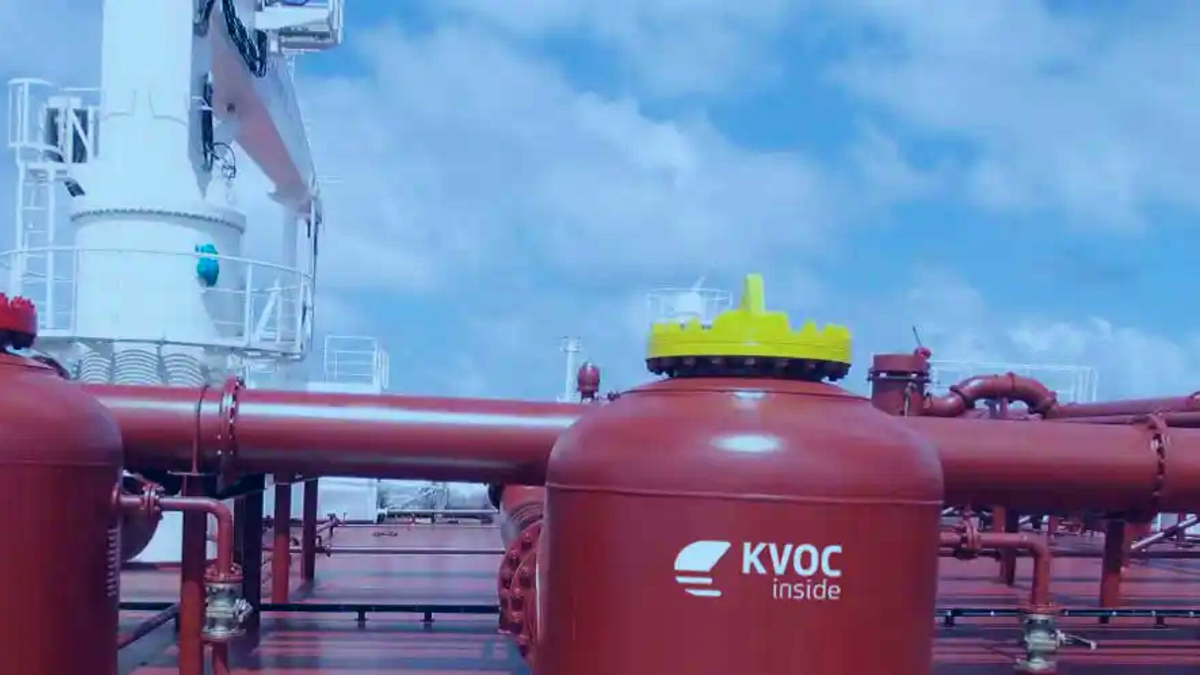
Norway proposes higher PV valve settings for tankers
Draft Marpol Annex VI amendments would require 0.20 bar PV valve opening pressure on new crude oil tankers


Norway has proposed amendments to Marpol Annex VI that would require new tankers carrying crude oil to be fitted with pressure-vacuum (PV) valves set to a minimum opening pressure of 0.20 bar gauge, as part of work at IMO to address volatile organic compound (VOC) emissions from shipping.
In a submission under ’Any other business’ to the Sub-Committee on Pollution Prevention and Response (PPR 13), which took place 9-13 February 2026, Norway wrote that VOC emissions from international shipping can contribute to climate impacts “both directly and indirectly through the formation of methane and ozone”.
The paper cites the Fourth IMO GHG Study 2020, stating that non-exhaust emissions of non-methane VOCs are generated mainly during loading, unloading and when transporting oil and fuels, with estimated non-exhaust emissions ranging from 2.3M tonnes per year to 2.5M tonnes per year from 2012 to 2017.
Norway links the proposal to the Initial IMO Strategy on the reduction of GHG emissions from ships, which lists “additional measures to address VOC emissions” as a candidate short-term measure.
It notes that Marpol Annex VI regulation 15 already regulates VOC emissions from tankers through requirements for vapour emissions-control systems and VOC management plans.
The submission traces the proposal’s development through earlier IMO work: Norway and Canada had previously provided a study on VOC control measures, which included increasing PV valve settings from current standard at 0.14 to 0.20 bar.
Following consideration of that study, Norway noted that MEPC 77 instructed PPR to investigate how VOC reductions could be further addressed, and that the Committee later approved the scope of work on VOC reduction set out in annex 18 to document PPR 10/18/Add.1.
Norway’s paper also describes safety screening already carried out within IMO.
At PPR 11, the Sub-Committee invited the Sub-Committee on Ship Systems and Equipment (SSE) to consider the proposed requirement and identify any negative implications.
Norway reports that, following consideration of the relevant submissions at SSE 11, SSE “concluded that a requirement of a 0.20 bar minimum opening pressure for PV valves would not have any negative safety implications” and referred the paper back to PPR 13.
The technical basis for the requirement is set out as a cargo-tank pressure management measure.
Norway stated, “Keeping a higher pressure in the cargo tank suppresses the evaporation of volatile components from the crude oil and helps to keep the lighter hydrocarbons dissolved within the liquid phase.”
It added that a higher maintained pressure would “reduce the formation and emissions of VOC”. Norway also cautions that an equipment requirement alone will not deliver the intended outcome.
The submission stated, “This technical measure should be supported by appropriate operational practices, ensuring that cargo tanks are not unnecessarily vented during laden voyages and that terminals do not require tankers to depressurise their tanks prior to arrival.”
In discussing how the requirement would be applied operationally, Norway references IMO guidance on VOC management plans (MEPC.1/Circ.680), noting that the ship should define a target operating pressure for cargo tanks that is as high as safely possible.
Norway added, “the opening pressure of the PV valve should serve as the ‘target operating pressure’”, and argued that VOC management plans should be “genuinely ship-specific and reflect the cargo properties, loading patterns and operational characteristics of each individual crude oil tanker.”
Norway’s submission noted the requirement for implementation across the VOC value chain and that achieving a substantial reduction in VOC emissions requires co-operation among stakeholders including terminals, shipping companies, oil producers and regulators.
Sign up for Riviera’s April 2026 International Chemical and Product Tanker Conference:
- Register to attend here: The International Chemical and Product Tanker Conference 2026, London.
- View the latest issue of Tanker Shipping & Trade here: Tanker Shipping & Trade.

Related to this Story


Events

Maritime Regulations Webinar Week
 16 Dec 2025
 GMT - ONLINE
Floating energy: successfully unlocking stranded gas using FLNGs and FSRUs
24 Feb 2026GMT - ONLINE
© 2026 Riviera Maritime Media Ltd.


