


Business Sectors
Business Sectors
Events
Contents

Register to read more articles.
OSV industry's 'moon shot': the complex route to decarbonisation amid market realities
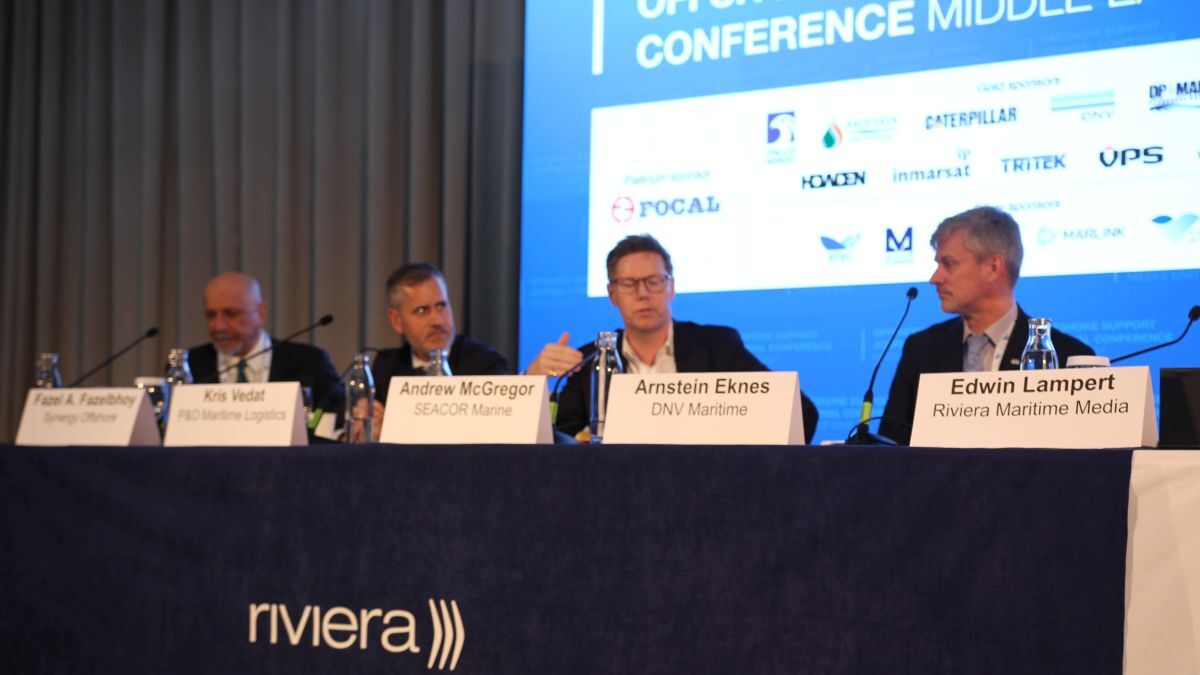
DNV Maritime director Arnstein Eknes explains the key to solving the decarbonisation challenge is data collection. Without it, the sector is like ‘15 different Apollo rockets, each with unique fuels and solutions’


At Riviera’s Offshore Support Journal Conference, Middle East, drawing parallels with the Apollo space programme, DNV Maritime segment director OSV and special ships, Arnstein Eknes, framed the industry’s decarbonisation challenge as a stepped journey rather than a single leap. Just as Apollo 11’s success built upon earlier missions, Mr Eknes argued the maritime sector’s transformation requires a phased approach beginning with operational efficiency, progressing through smart energy deployment and ultimately transitioning to future fuels.
SEACOR Marine’s vice president - international, Andrew McGregor emphasised sustainability investments must deliver tangible benefits for both vessel operators and charterers. Drawing from its experience with battery-hybrid systems, Mr McGregor highlighted how such investments can simultaneously reduce client fuel costs while delivering operational benefits through reduced engine wear and improved maintenance intervals.
The question of technological flexibility emerged as a crucial consideration, with Mr McGregor expressing concern about region-specific fuel solutions. "As shipowners, we’re nervous about solutions that limit our global operational flexibility," he noted, explaining battery hybridisation has proved successful precisely because it’s self-contained and globally deployable.
P&O Maritime Logistics head of technology and logistics, Kris Vedat identified data standardisation as a fundamental enabler for decarbonisation efforts. The current fragmentation of operational data across different platforms and formats significantly impedes progress toward meaningful emissions reduction. Mr Vedat emphasised that every aspect of performance improvement and emissions reduction relies on consistent, reliable data, making standardisation a crucial first step.
Synergy Offshore chief executive Fazel Fazelbhoy provided a sobering assessment of market dynamics, characterising the current situation as a "zero-sum game." He highlighted the persistent disconnect between environmental investment costs and charter rates, noting even proven technologies such as diesel-electric propulsion often fail to command premium rates despite their environmental benefits.
Mr Fazelbhoy pointed to basic inconsistencies in global power standards as emblematic of the standardisation challenges facing the industry. These fundamental disparities complicate the implementation of seemingly straightforward solutions like shore power, illustrating the complexity of achieving global consistency in environmental initiatives.
Commercial frameworks present another significant hurdle. Current charter party structures, with their early termination clauses and limited recognition of environmental investments, make it difficult for operators to commit to long-term sustainability initiatives. The industry needs new contractual frameworks that fairly distribute both the costs and benefits of environmental improvements.
Despite these challenges, immediate opportunities exist for meaningful progress. Operational efficiency improvements, data collection standardisation and proven technologies such as battery hybridisation offer tangible benefits without requiring industrywide consensus on future fuels. These steps can deliver immediate emissions reductions while maintaining the flexibility to adapt to future developments.
The medium-term horizon requires a focus on establishing standardised performance metrics and developing new charter party structures that better align environmental investments with commercial returns. Success in these areas would create the foundation for broader industry collaboration and more ambitious emissions-reduction initiatives.
When challenged to articulate how OSV operators can create viable decarbonisation strategies through to 2040, the industry leaders offered complementary perspectives.
P&O Maritime Logistics’ Mr Vedat stressed the industry must embrace data and artificial intelligence more fully, noting the sector has historically been hesitant to adopt such technologies. He advocated for embedding these changes into operational culture, arguing that without such fundamental transformation, technological investments alone would prove insufficient.
DNV Maritime’s Mr Eknes focused on immediate actionable steps, encouraging operators to begin with cost-free efficiency improvements. "Start first with your people and find out what you can do to increase efficiency without investment," he advised. He highlighted the success of initiatives such as efficiency competitions in driving behavioural change, noting significant improvements often require minimal capital investment. He also emphasised the importance of understanding and adapting to energy price fluctuations, citing examples of dramatic variations in renewable energy costs.
SEACOR Marine’s Mr McGregor approached the challenge from a practical investment perspective, emphasising the critical importance of establishing strong client relationships and securing long-term contracts to justify significant environmental investments. He stressed operators should not wait for perfect solutions, "We don’t need to rush into batteries right away. If you’re at the beginning of that journey, there are plenty of gains that can be made at practically zero cost through operational efficiency."
Synergy Offshore’s Mr Fazelbhoy provided a stark assessment of the investment challenge, arguing current business cases for environmental technology often don’t balance financially. "You have to take a leap of faith," he stated, suggesting investments might only break even initially but could generate returns of 15-17% IRR within five years as environmental premiums increase. However, he highlighted a more fundamental challenge: the industry’s inability to standardise even basic definitions.
When a vessel is launched in 2014 but delivered in 2019, the maritime community lacks consensus on its age. Classification societies typically reference the delivery date, calculating the vessel as five years old, while port state control authorities might count from launch, deeming it 10 years old. This discrepancy carries significant commercial implications, particularly in regions such as the Middle East where strict age limits govern vessel acceptance. For instance, the same vessel might be deemed too old to work in Qatar, where a 20-year age limit applies, while remaining acceptable in the UAE, which permits vessels up to 25 years old.
Riviera’s Annual Offshore Support Journal Conference, Awards & Exhibition will be held in London 4-5 February 2025. Click here to register for this industry-leading event.

Related to this Story



Events

Maritime Regulations Webinar Week
 16 Dec 2025
 GMT - ONLINE
Floating energy: successfully unlocking stranded gas using FLNGs and FSRUs
24 Feb 2026GMT - ONLINE
© 2026 Riviera Maritime Media Ltd.


